

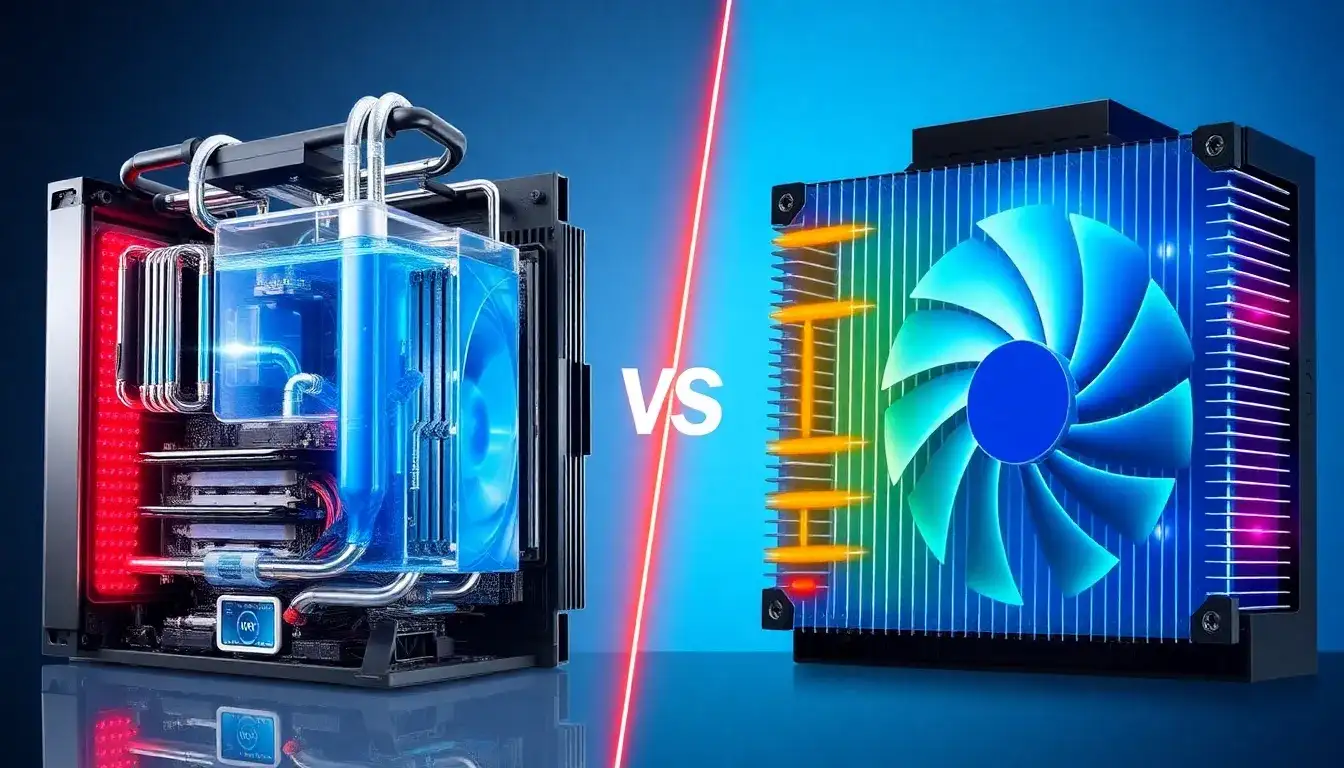
Thermal Management Systems: Liquid Cooling vs. Air Cooling
Thermal management systems in computing involve methods to dissipate heat generated by components like the CPU and GPU. The two primary approaches are liquid cooling and air cooling. Each has distinct advantages and disadvantages, which are crucial when deciding the best cooling method for your system.
Liquid Cooling
Advantages:
- Efficiency: Liquid cooling is generally more efficient than air cooling. It can handle higher thermal loads, making it ideal for overclocking and high-performance computing.
- Quietness: Liquid cooling systems are often quieter as they can maintain good temperatures while running fans at lower speeds.
- Flexibility: The radiator in a liquid cooling setup can be placed in various positions within the case for optimal heat dissipation.
Disadvantages:
- Cost: Custom liquid cooling systems are typically more expensive than air cooling setups.
- Complexity: They require more components (e.g., radiators, pumps, tubing), which can complicate installation and maintenance.
Air Cooling
Advantages:
- Cost-Effectiveness: Air cooling is generally less expensive and provides good performance for the price.
- Simplicity: It is straightforward to set up and doesn’t require additional components, making it easier to install and maintain.
- Accessibility: Suitable for those on a limited budget or not needing extreme cooling performance.
Disadvantages:
- Noise: Air cooling solutions can generate more noise as fans spin faster to dissipate heat.
- Limitations: Less effective at handling high thermal loads compared to liquid cooling.
Comparison Summary
| Feature | Liquid Cooling | Air Cooling |
|---|---|---|
| Efficiency | More efficient, especially for high loads | Less efficient, but cost-effective |
| Noise | Typically quieter | Can be noisy due to fan speed |
| Cost | Generally more expensive | More affordable |
| Complexity | Requires additional components, more complex | Simpler setup and maintenance |
| Performance | Better for overclocking and high performance | Suitable for standard to moderate performance |
Ultimately, the choice between liquid cooling and air cooling depends on your specific needs, budget, and performance requirements. If you prioritize efficiency and quiet operation for high-performance setups, liquid cooling might be the better option. For cost-conscious users with standard computing needs, air cooling can be a viable choice.
Original article by NenPower, If reposted, please credit the source: https://nenpower.com/blog/how-do-thermal-management-systems-compare-between-liquid-cooling-and-air-cooling/

