

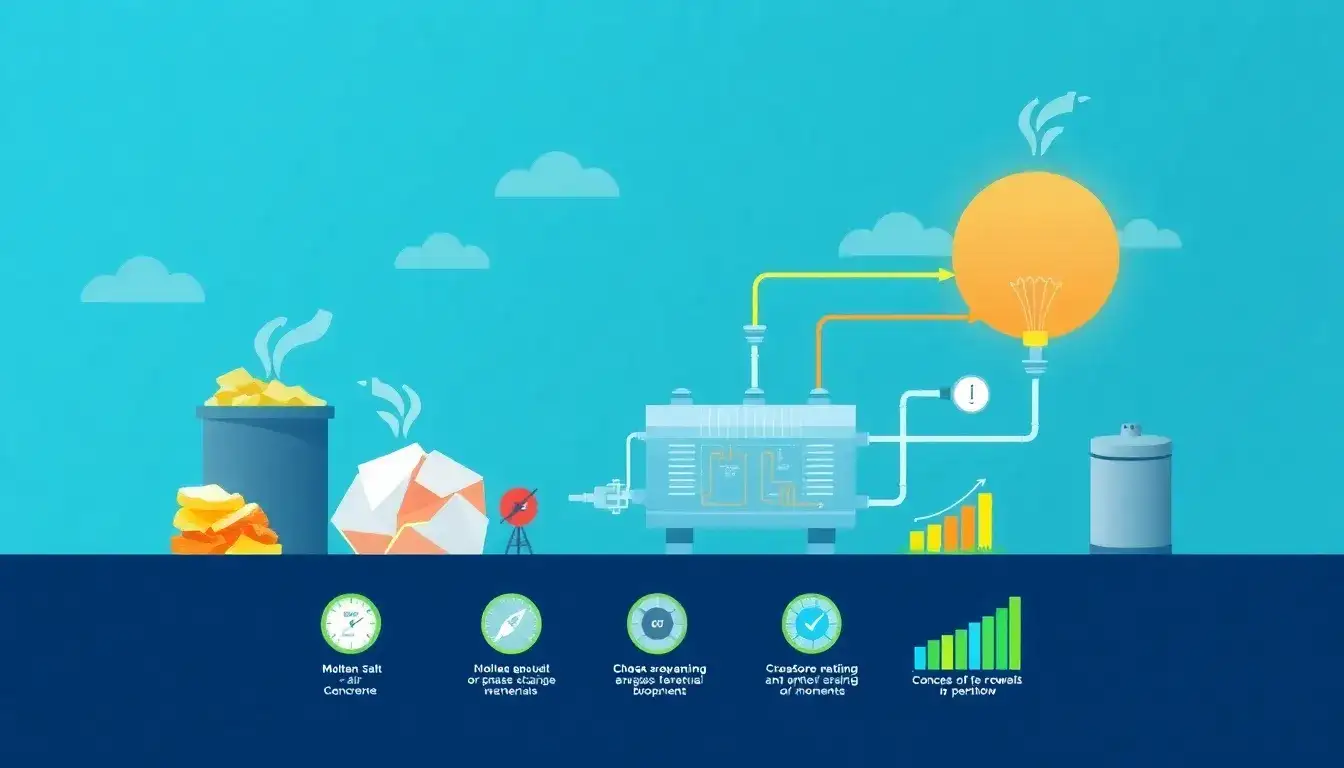
Role of Thermal Energy Storage in CAES Systems
- CAES systems compress air and store it underground or in pipelines, but the compression process generates heat which must be managed for efficient energy recovery during air expansion.
- TES is crucial for storing the heat generated during compression to use it later during expansion, improving overall system efficiency and reducing fuel consumption from external heating.
- The choice of TES medium (sensible heat in liquids or solids, phase change materials) affects the design of heat exchange systems, containment requirements, energy loss rates, and operating temperature ranges, all of which impact costs.
Impact on Capital and Operational Costs
- TES can constitute a notable portion of the CAPEX (capital expenditure) in CAES projects. For example, thermal energy storage costs have been estimated at approximately $350/kWh thermal capacity with a levelized cost around 13.5 cents per kWh thermal, which varies based on internal rate of return and scale.
- Advanced TES technologies, such as high-temperature particle storage media, promise to reduce TES costs substantially compared to traditional CAES and pumped storage hydropower (PSH) systems, potentially offering longer duration energy storage at lower costs.
- The cost of TES affects the total installed cost of CAES systems. CAES installed costs for 100 MW, 4-hour duration systems are roughly comparable to lithium-ion batteries (~$295/kWh), but TES innovations can improve cost competitiveness at longer durations (e.g., 10+ hours) due to lower storage medium and thermal management expenses.
Influence of TES Medium Characteristics on Overall CAES System Economics
| TES Medium Attribute | Influence on CAES Cost and Performance |
|---|---|
| Heat Storage Type | Sensible heat (liquid/solid) tends to be simpler but may have different cost and efficiency profiles versus phase change materials or advanced particles. |
| Operating Temperature Range | Medium selection guided by working fluid temperature affects power cycle efficiency and TES cost. |
| Containment and Energy Loss | More containment complexity and higher losses raise costs and reduce system efficiency. |
| Compatibility with Heat Exchange Fluid | Medium and fluid pairing impacts heat transfer efficiency and equipment costs. |
Summary
The type and design of thermal energy storage medium within CAES systems is a critical cost driver and a major determinant of system efficiency and economic viability. Advanced TES media can reduce both capital and operational costs by enabling better thermal integration, higher storage temperatures, and longer durations. Conversely, choosing less optimal TES media may increase losses, heat exchange complexity, and CAPEX, ultimately raising the levelized cost of storage in CAES systems.
This synthesis indicates that TES medium selection is a pivotal factor that heavily influences both the initial and ongoing costs of CAES systems and can be a lever for cost reduction and performance enhancement.
Original article by NenPower, If reposted, please credit the source: https://nenpower.com/blog/how-do-thermal-energy-storage-mediums-affect-the-overall-cost-of-caes-systems/

