

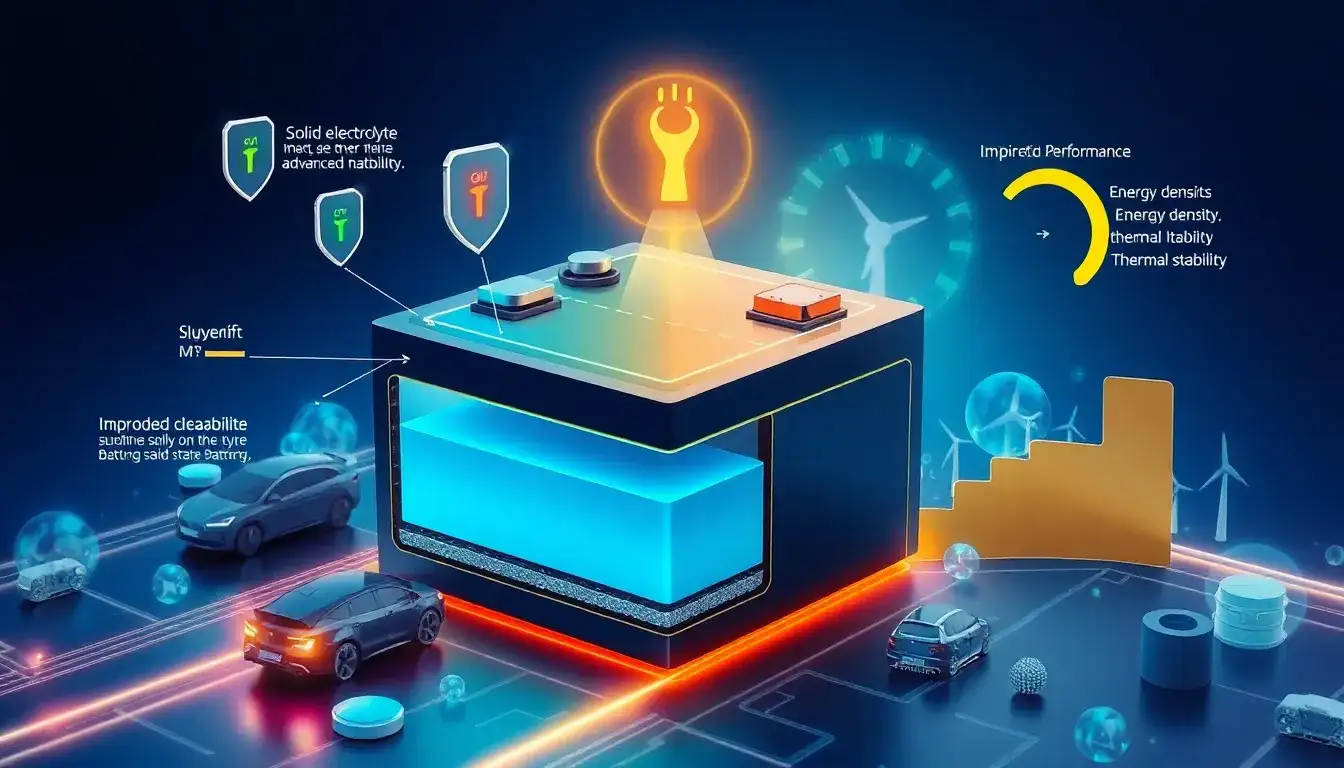
Solid-state batteries (SSBs) offer significant safety advantages over traditional lithium-ion batteries primarily due to their replacement of flammable liquid electrolytes with non-flammable solid electrolytes. This key safety feature reduces risks of fires and thermal runaway events, enhancing overall battery safety and stability.
Impact of Safety Features on Performance:
- Elimination of Flammable Electrolytes: By using solid-state electrolytes instead of liquid ones, SSBs significantly reduce the chance of electrolyte leakage and combustion. This inherently improves safety during battery operation and charging, enabling potentially safer, faster charging and operation at higher temperatures without the risk of thermal runaway.
- Thermal Stability: Solid electrolytes generally offer better chemical and thermal stability, which helps in preventing hazardous reactions often seen in conventional batteries under abuse conditions such as overheating or mechanical damage.
- Energy Density and Lithium Metal Anode Use: SSBs often use lithium metal anodes, which can boost energy density and battery performance. However, this introduces a new safety challenge: lithium metal tends to form dendrites—needle-like lithium deposits—that can penetrate the solid electrolyte, leading to internal short circuits and potential safety hazards. This creates a trade-off between the high energy density benefit and dendrite-induced risks.
- Dendrite Formation Risk: Despite improved overall safety, dendrite formation remains a critical issue impacting the reliability and lifespan of SSBs. Internal short circuits caused by dendrites can undermine both safety and performance, necessitating further materials innovation and interface engineering to mitigate these risks.
- Overcharging and External Short Circuit Behavior: Tests to date indicate that overcharging and external short circuits in SSBs do not typically lead to thermal runaway, suggesting enhanced tolerance to abuse conditions compared to liquid-electrolyte batteries.
Summary
The safety features of solid-state batteries—especially the use of non-flammable solid electrolytes—significantly improve their safety profile by reducing fire and thermal runaway risks, enabling safer operation and higher energy densities. Nonetheless, challenges such as lithium dendrite formation and associated internal short circuits remain critical concerns that can impact both safety and performance. Innovations in electrolyte materials and battery design targeting these issues are key to fully realizing the performance benefits of solid-state batteries while maintaining their superior safety advantages.


In essence, safety improvements in solid-state batteries enhance their overall performance by allowing safer, higher energy, and potentially faster-charging cells, but addressing dendrite-related risks is essential to ensuring long-term reliability and safety.
Original article by NenPower, If reposted, please credit the source: https://nenpower.com/blog/how-do-the-safety-features-of-solid-state-batteries-impact-their-overall-performance/

