

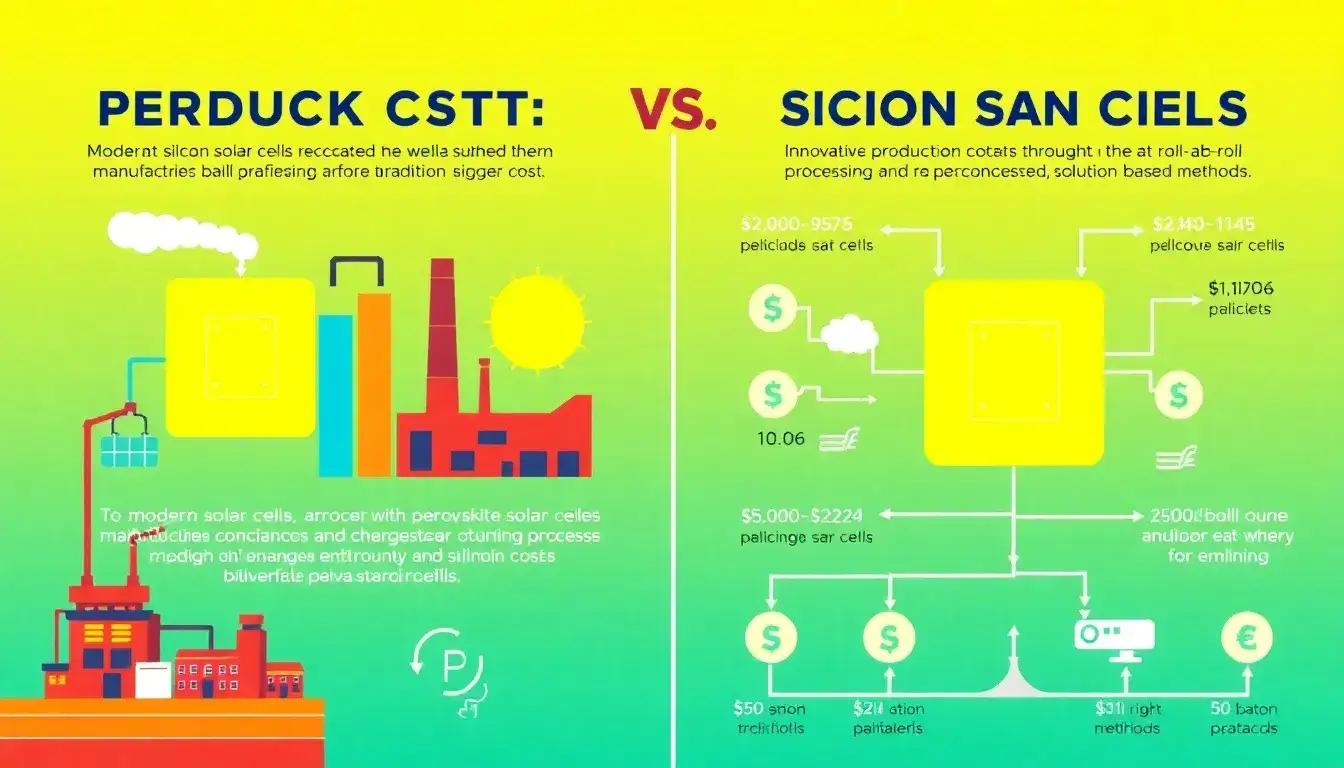
The production costs of perovskite solar cells (PSCs) are generally lower than those of traditional silicon solar cells, although some nuances arise depending on the type and scale of production and the specific technology considered.
Cost Comparison Overview
- Perovskite Solar Cells:
- Module production costs for PSCs have been estimated in the range of approximately $0.21 to $0.28 per watt (W) for single-junction modules, with some estimates around $0.25 per watt based on a 100 MW annual production capacity.
- The material costs for perovskite modules are notably lower due to the use of inexpensive, solution-processable precursors and simpler manufacturing processes such as roll-to-roll printing, which do not require the high-vacuum and high-temperature conditions typical of silicon cell fabrication.
- Production energy requirements are also lower, for example around 5.6 kWh per square meter of module produced, contributing to reduced overall manufacturing costs.
- Perovskite precursor ink costs around $250 per square meter, which currently is higher than polysilicon raw material priced approximately $100 per square meter, but economies of scale and faster production speeds could offset this difference as perovskite manufacturing scales up.
- Perovskite manufacturing benefits from rapid, low-energy fabrication under atmospheric conditions, enabling lower capital and operating costs.
- The levelized cost of electricity (LCOE) for PSCs has been estimated between 3.5 to 4.9 US cents/kWh, competitive with or lower than traditional energy sources when module efficiency exceeds 12% and lifetimes are around 15 years.
- Silicon Solar Cells:
- Current crystalline silicon PV modules typically cost more to produce, with per-watt manufacturing costs roughly three times higher than perovskite modules, due to complex high-purity material processing, high-temperature steps, and capital-intensive manufacturing facilities.
- For comparison, silicon solar panels have a minimum sustainable price (MSP) estimated around $0.25–0.27 per watt, slightly overlapping with or higher than perovskite panels, depending on the scale and region of production.
- Silicon module manufacturing involves more energy-intensive steps and more expensive materials like high-purity polysilicon and silicon wafers.
- Conventional silicon modules have longer lifetimes (20-30 years) and proven field stability, currently giving them an economic advantage over perovskites in some applications despite higher upfront costs.
Tandem Perovskite-Silicon Solar Modules
- Recent techno-economic analyses of U.S.-made perovskite-silicon tandem modules indicate production costs around $0.29 to $0.42 per watt depending on efficiency and module design, which is somewhat higher than single-junction perovskite cells but competitive with advanced silicon modules.
- Tandem modules offer higher efficiencies (25%-35%) and thus potentially lower cost per watt of electricity generated despite slightly higher manufacturing costs, due to better power output per area.
- These tandem costs currently exceed the lowest silicon module costs ($0.25–0.28 per watt) but are expected to decrease with further scaling and standardization of perovskite processing.
Summary Table
| Solar Cell Type | Estimated Production Cost ($/W) | Notes |
|---|---|---|
| Perovskite Solar Cells (single-junction) | ~$0.21 – $0.28 | Lower energy and material costs; scale-up can reduce costs further. |
| Crystalline Silicon Solar Cells | ~$0.25 – $0.27 (MSP) | Higher capital and energy costs; mature technology with longer lifetime. |
| Perovskite-Silicon Tandem Modules | ~$0.29 – $0.42 | Higher cost due to tandem complexity; higher efficiency offsets cost per watt. |
Key Takeaways
- Perovskite solar cells promise significantly lower production costs primarily due to simpler, lower energy manufacturing and cheaper materials compared to silicon solar cells.
- Current challenges with perovskites, particularly stability and lifetime, influence overall cost-effectiveness; achieving >12% efficiency and 15+ year lifetime is critical for economic competitiveness.
- Tandem perovskite-silicon modules have higher production costs than single-junction perovskite or silicon cells but can achieve higher efficiencies, enhancing cost-effectiveness in terms of electricity generated per area.
- Continued advancements in perovskite manufacturing processes, scale, and material standardization are expected to further reduce costs and improve competitiveness relative to silicon solar cells.
In conclusion, perovskite solar cells currently have lower production costs per watt than silicon solar cells, mainly due to cheaper materials and lower-energy, faster manufacturing processes. However, silicon’s maturity, longer lifetimes, and economies of scale still present cost advantages. Tandem modules represent a promising middle ground with potential for cost and efficiency gains as the technology matures.
Original article by NenPower, If reposted, please credit the source: https://nenpower.com/blog/how-do-the-production-costs-of-perovskite-solar-cells-compare-to-those-of-silicon-solar-cells/

