

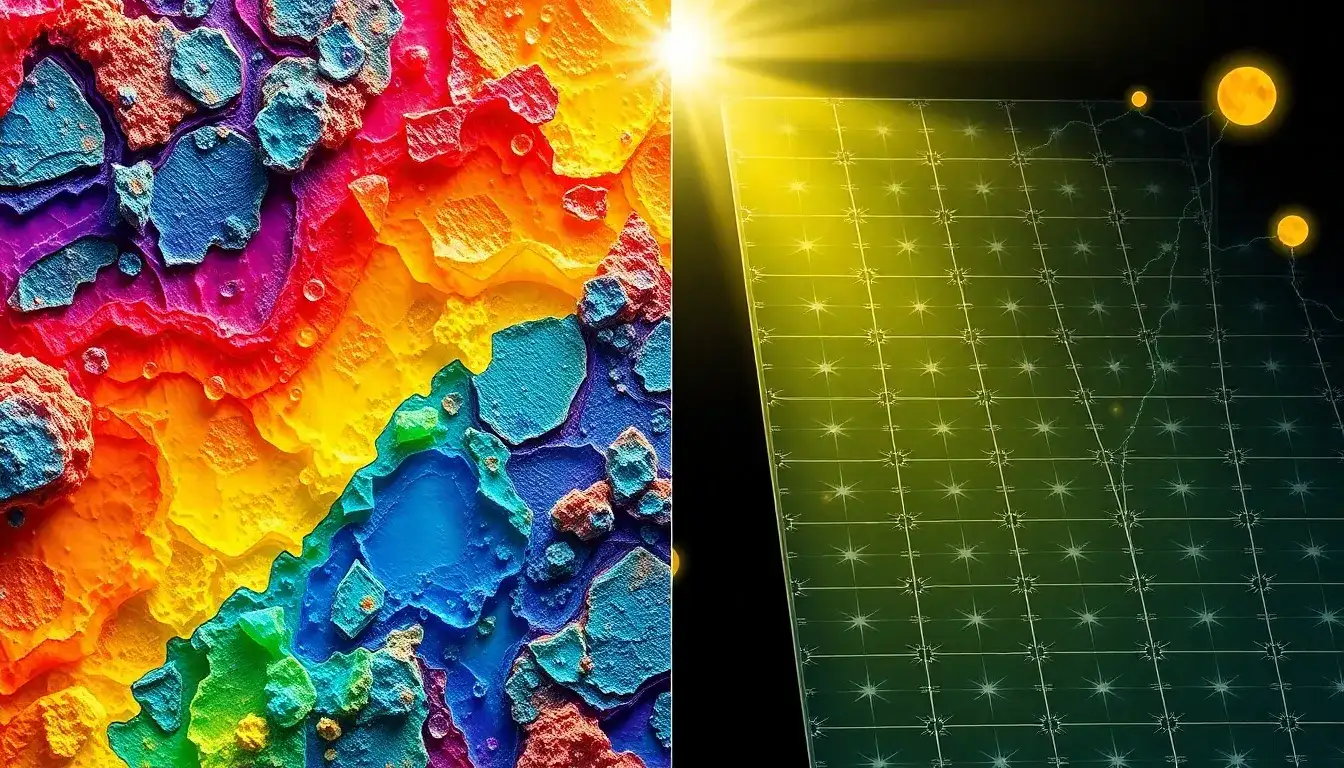
The materials used in perovskite solar panels differ significantly from those in traditional silicon solar panels in composition, structure, and manufacturing aspects.
Materials in Perovskite Solar Panels
- Perovskite solar cells primarily use metal-halide perovskites, which are compounds with a perovskite crystal structure typically of the form ABX3, where “A” and “B” are cations and “X” is an anion such as a halogen ion (iodide, bromide, or chloride).
- The common perovskite absorber materials include methylammonium lead trihalide (CH3NH3PbX3) and formamidinium lead trihalide (H2NCHNH2PbX3), which contain organic ions combined with lead and halogens.
- These materials combine organic and inorganic components (hybrid organic-inorganic metal halide compounds), and the presence of lead is a notable concern due to toxicity, although tin-based alternatives exist with lower efficiencies.
- Perovskites have tunable bandgaps (around 1.48 to 2.3 eV depending on composition), which can be closer to optimal for solar energy conversion than silicon’s fixed bandgap.
Materials in Silicon Solar Panels
- Silicon solar panels use crystalline silicon as the primary material, which is purely inorganic and abundant. Silicon semiconductors have a fixed bandgap of about 1.1 eV.
- Silicon is processed into wafers and forms the core semiconducting layer that absorbs sunlight and converts it into electricity.
- The material and manufacturing processes are mature and well-established but involve energy-intensive processes like high-temperature purification and crystal growth.
Comparison Summary
| Aspect | Perovskite Solar Panels | Silicon Solar Panels |
|---|---|---|
| Primary Material | Metal-halide perovskites (hybrid organic-inorganic lead/tin halide compounds) | Crystalline silicon (pure inorganic) |
| Composition | Organic ions + lead or tin + halogen ions (iodide, bromide, chloride) | Pure silicon |
| Crystal Structure | ABX3 perovskite structure | Diamond cubic structure of silicon |
| Bandgap | Tunable (1.48–2.3 eV) | Fixed (~1.1 eV) |
| Toxicity Concerns | Lead content in many formulations | Non-toxic |
| Manufacturing | Solution-processed, potentially lower energy and cost | High-temperature, energy-intensive |
| Material Abundance | Organic components + lead (less abundant, toxic) | Silicon is abundant and widely available |
In essence, perovskite solar panels use a newer class of hybrid materials that can be processed more cheaply and flexibly but have challenges like lead toxicity and stability. Silicon panels rely on a single-element, inorganic semiconductor with proven durability and non-toxicity but involve more costly manufacturing.
Original article by NenPower, If reposted, please credit the source: https://nenpower.com/blog/how-do-the-materials-used-in-perovskite-solar-panels-compare-to-those-in-silicon-panels/

