

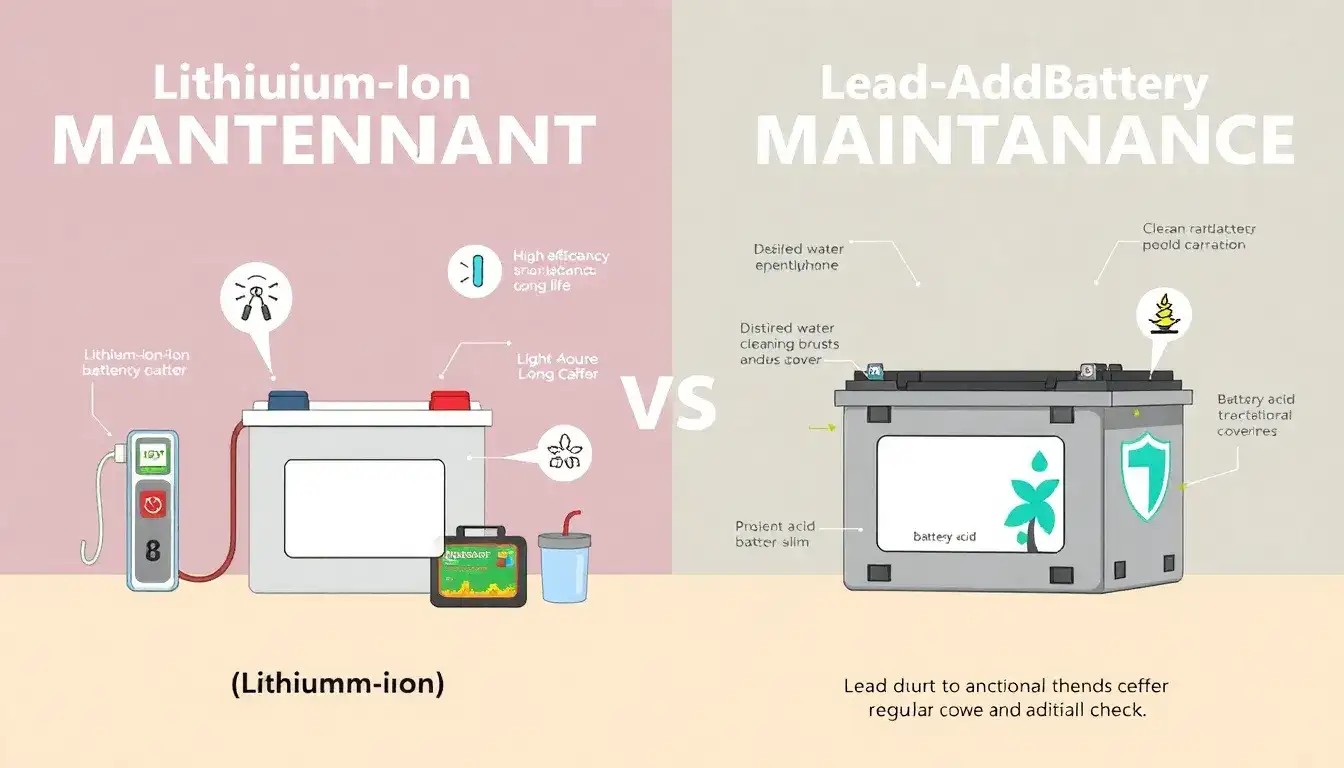
The maintenance requirements for lithium-ion batteries and lead-acid batteries differ significantly due to their distinct chemistries and properties. Here’s a comparison of their maintenance needs:
Lithium-Ion Batteries
1. Charging and Usage:
- Avoid Full Discharge: It’s recommended to keep lithium-ion batteries within a 20-80% charge range to avoid deep discharging, which can cause permanent capacity loss and stress the cells.
- Charging Conditions: Use chargers specifically designed for lithium-ion batteries to avoid overcharging and excessive heat generation.
2. Storage:
- Store at approximately 50% charge to prevent capacity loss.
- Maintain storage temperatures between 5°C and 20°C (41°F and 68°F) to minimize self-discharge and capacity loss.
3. Maintenance Checks:
- Regularly check charge status and run time to monitor aging.
- Replace batteries if run time decreases significantly or charge time increases.
Lead-Acid Batteries
1. Charging and Usage:
- Monitoring State of Charge: Lead-acid batteries benefit from being kept at full charge when stored to prevent sulfation.
- Charging Conditions: Use trickle or float charging to maintain charge levels during storage.
2. Storage:
- Store at full charge if possible to prevent sulfation.
- Avoid extreme temperatures and moisture, which can accelerate degradation.
3. Maintenance Checks:
- Regular checks for electrolyte levels (if applicable) and top-off with distilled water as needed.
- Battery terminals should be cleaned regularly to prevent corrosion.
Key Differences:
- Life Span: Lithium-ion batteries last longer (up to 10 years) and offer more charge cycles (3,000–5,000) compared to lead-acid (300-500 cycles).
- Sensitivity: Lithium-ion batteries are more sensitive to temperature, charging methods, and depth of discharge compared to lead-acid batteries.
- Storage Conditions: Lithium-ion batteries can be stored at partial charge without significant capacity loss, whereas lead-acid batteries should ideally be stored at full charge.
Original article by NenPower, If reposted, please credit the source: https://nenpower.com/blog/how-do-the-maintenance-requirements-of-lithium-ion-batteries-differ-from-those-of-lead-acid-batteries/

