

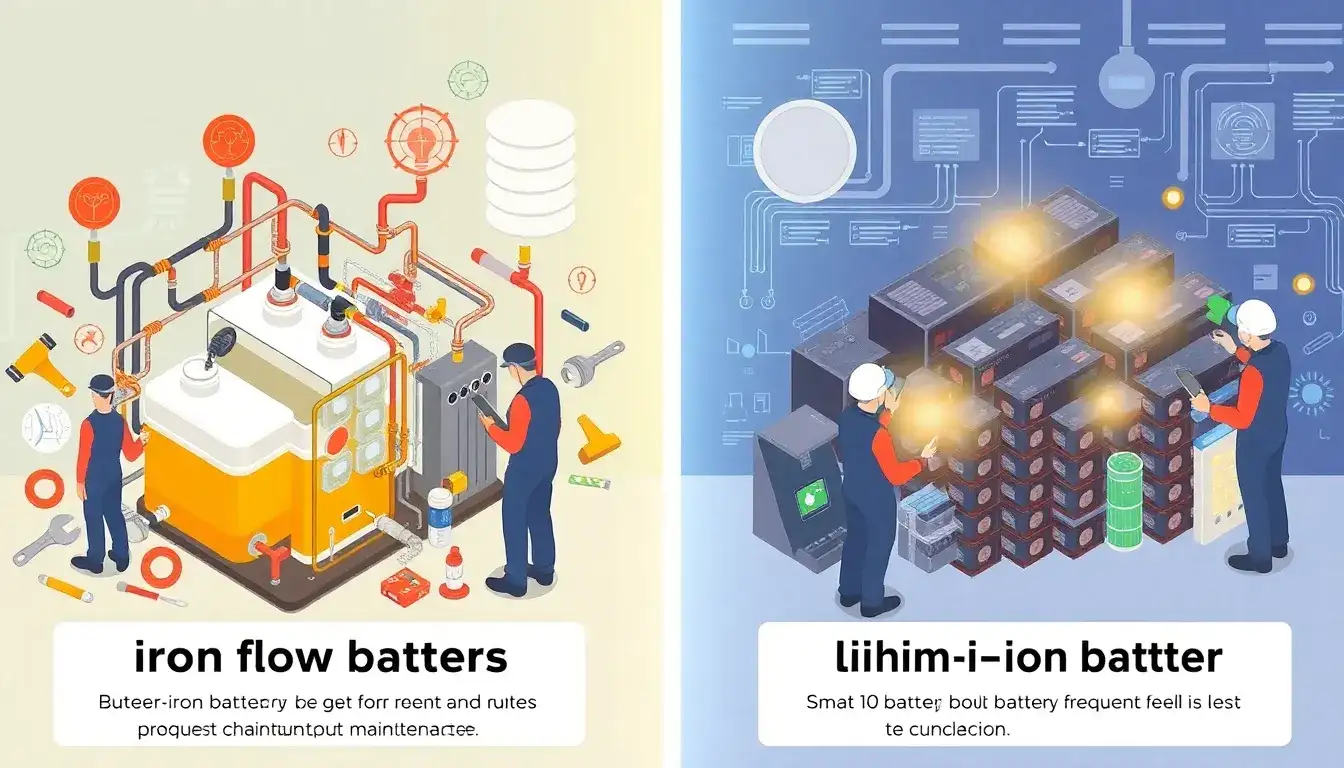
Maintenance Requirements Comparison: Iron Flow Batteries vs. Lithium-Ion Batteries
Iron Flow Batteries
- Complexity: Iron flow batteries involve more complex systems with auxiliary components like pumps and valves, necessitating regular maintenance to ensure proper function.
- Cooling: Unlike other flow batteries, iron flow batteries do not require cooling systems, simplifying their installation and maintenance.
- Safety: They are safer, with no risk of thermal runaway or chemical hazards, making them ideal for densely populated areas.
- Environmental Impact: Made from earth-abundant materials (iron, salt, and water), they have a lower environmental footprint and can be recycled at the end of life.
- Life Cycle: Designed for a 25-year life with unlimited charge/discharge cycles, reducing the need for frequent replacements.
Lithium-Ion Batteries
- Complexity: Relatively simple in structure with fewer auxiliary components, requiring less physical maintenance but needing monitoring of temperature and state of charge.
- Cooling: Lithium-ion batteries may require temperature control to optimize performance.
- Safety: Pose risks such as thermal runaway, necessitating careful handling and storage.
- Environmental Impact: Involve more toxic materials in production and recycling, contributing to higher environmental costs.
- Life Cycle: Have a typical life expectancy of around 5-15 years with a finite number of charge cycles before degradation.
In summary, iron flow batteries are designed for larger-scale applications with lower maintenance needs related to cooling but require more complex system maintenance due to auxiliary components. Lithium-ion batteries are widely used in various applications, including portable electronics and electric vehicles, but have environmental and safety drawbacks.
Original article by NenPower, If reposted, please credit the source: https://nenpower.com/blog/how-do-the-maintenance-requirements-of-iron-flow-batteries-differ-from-those-of-lithium-ion-batteries/

