

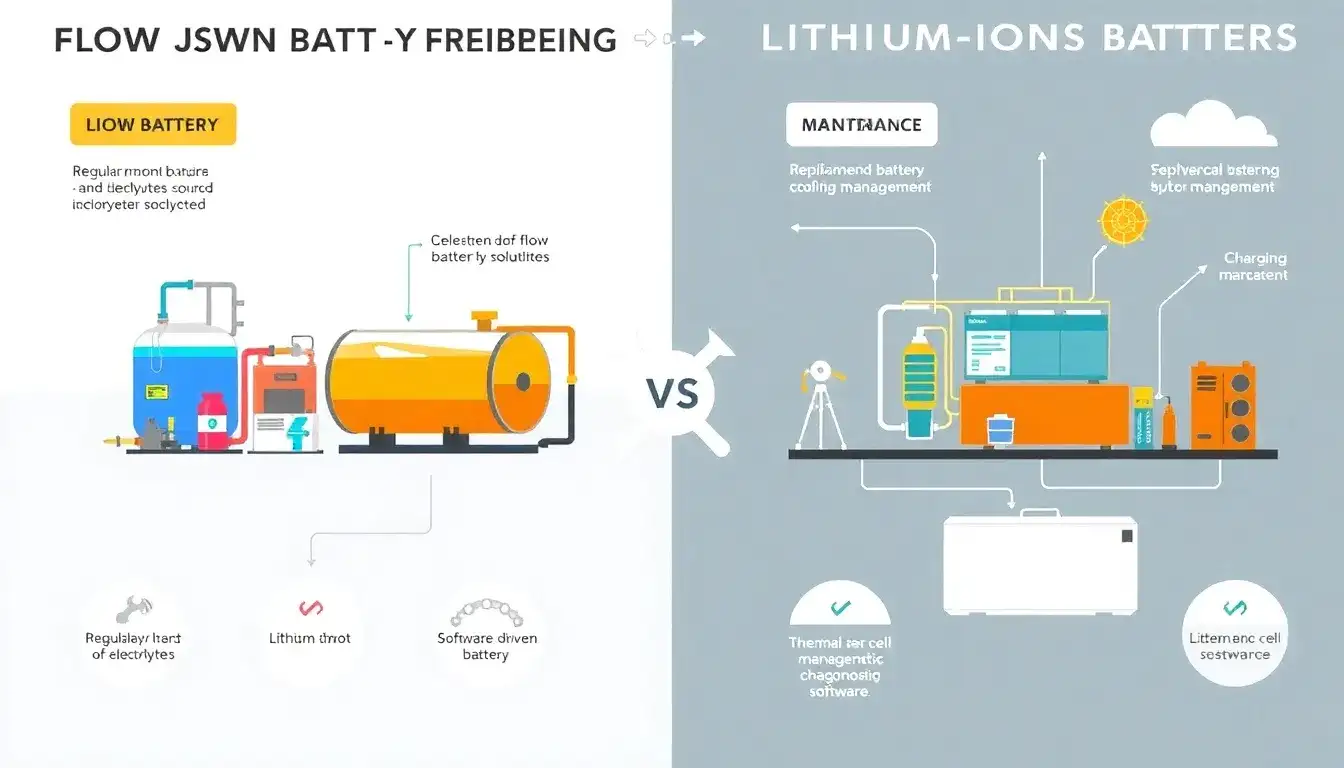
Maintenance Requirements: Flow Batteries vs. Lithium-ion Batteries
Flow Batteries and Lithium-ion Batteries have distinct design and operational characteristics that affect their maintenance requirements. Here’s a breakdown of how these two types of batteries differ in terms of upkeep.
Flow Batteries
- Design and Operation: Flow batteries store energy in liquid electrolytes in external tanks, allowing for flexible capacity and long-duration energy storage. They operate by circulating these electrolytes through electrodes, requiring pumps and a membrane to separate the electrolytes.
- Maintenance Requirements:
- Low Maintenance: Flow batteries are known for their low maintenance needs. Primus Power, a prominent manufacturer, recommends an annual maintenance visit for routine inspections, air filter replacements, and electrolyte adjustments.
- No Seasonal Prep: They do not require preparation for seasonal temperature changes and can be installed in cold conditions.
- Scalability and Access: Their design makes it easier to service components because the electrolytes are stored in tanks, which can be managed separately from the reaction area.
- Challenges: While flow batteries have low maintenance needs, they can experience issues like electrolyte degradation over time, particularly due to “crossover” where active species leak across the membrane.
Lithium-ion Batteries
- Design and Operation: Lithium-ion batteries store energy within solid-state materials on electrodes. They are common in devices like smartphones and electric vehicles due to their high energy density and efficiency.
- Maintenance Requirements:
- Limited User Maintenance: For most lithium-ion batteries, especially lithium iron phosphate (LFP) types, no regular maintenance is needed if installed correctly in suitable environmental conditions.
- Battery Management System (BMS): Lithium-ion batteries come with a BMS that automatically monitors temperature, state of charge, and other parameters to optimize performance.
- Seasonal Considerations: Although no seasonal preparation is necessary for LFP batteries, maintaining optimal temperatures is crucial for performance.
- Challenges: Lithium-ion batteries may suffer from degradation over time and require periodic replacement of battery packs, especially if used in demanding conditions.
Comparison Summary
| Feature | Flow Batteries | Lithium-ion Batteries |
|---|---|---|
| Design Complexity | External electrolyte tanks, pumps, membrane | Solid-state electrodes, BMS |
| Maintenance Needs | Low, annual visits for inspections and adjustments | Limited, mainly relies on BMS and environmental conditions |
| Environmental Flexibility | Can operate in cold conditions, no seasonal prep needed | Temperature-sensitive, performance impacted by extremes |
| Scalability | Flexible and scalable due to tank-based design | Generally not as scalable in terms of energy storage duration |
| Components Accessibility | Easier access for servicing due to separate tanks | Less accessible, as components are integrated within cells |
In summary, while both types of batteries have low maintenance needs, flow batteries require more manual upkeep (annual visits) but are designed for longer-duration energy storage and can be more easily serviced due to their modular design. Lithium-ion batteries, on the other hand, are more self-managing with their BMS but may require more frequent replacements over time, especially in demanding usage scenarios.
Original article by NenPower, If reposted, please credit the source: https://nenpower.com/blog/how-do-the-maintenance-requirements-of-flow-batteries-differ-from-those-of-lithium-ion-batteries/

