

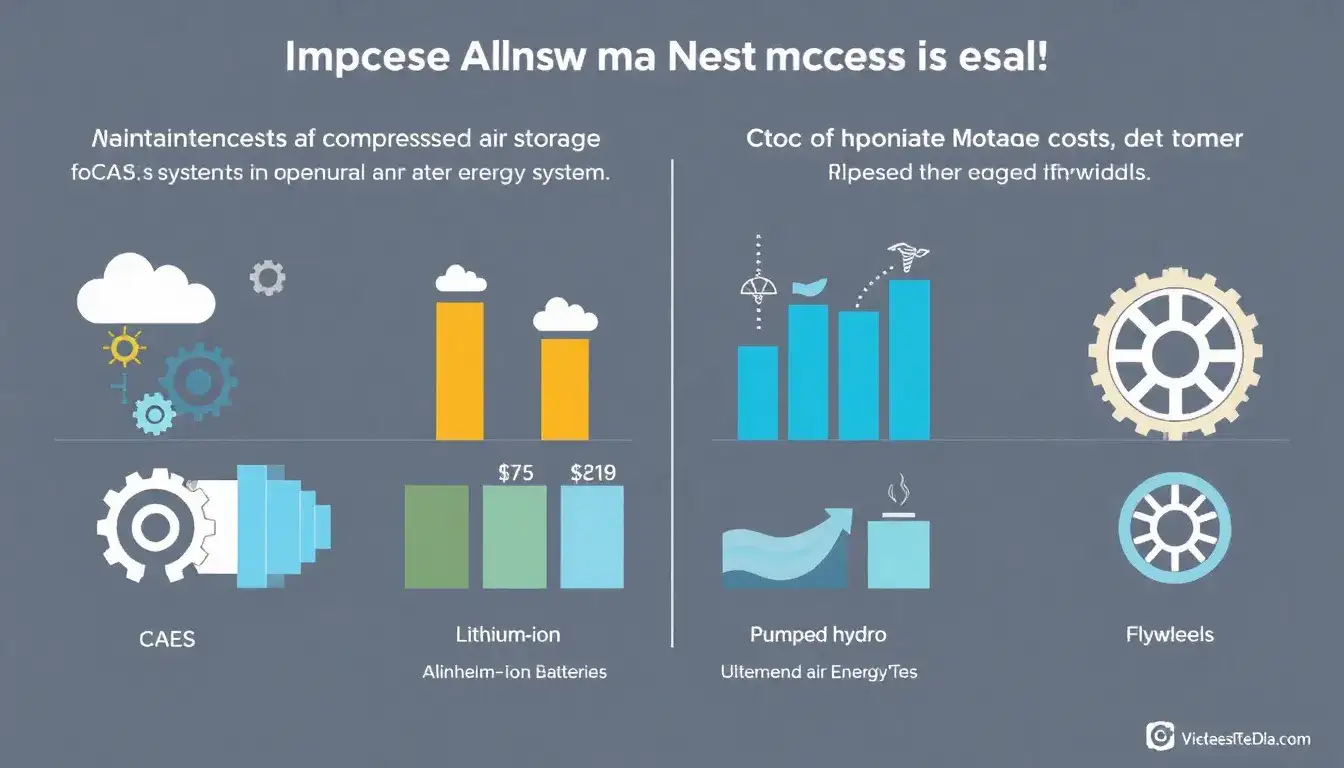
Comparing Maintenance Costs of CAES Systems with Other Energy Storage Methods:
- Compressed Air Energy Storage (CAES) vs. Lithium-Ion Batteries:
- CAES systems have lower initial capital costs compared to lithium-ion batteries but require more maintenance due to moving parts. The moving parts in CAES result in 5-10 times higher maintenance costs compared to lithium-ion batteries, which have no moving parts.
- However, CAES can offer long-duration energy storage at a lower cost per kWh than lithium-ion for durations exceeding 24 hours.
- CAES vs. Thermal Energy Storage (TES) and Flow Batteries:
- Thermal energy storage is generally cheaper than CAES in terms of initial investment, with global averages as low as $232/kWh compared to CAES at $293/kWh.
- Flow batteries are similar to CAES in terms of long-duration capabilities but have different cost structures; they are costlier than CAES globally but have seen significant investment in China.
- General Maintenance Costs:
- CAES maintenance costs are significantly affected by the efficiency and operational frequency of compressors and turbines. These costs can be estimated at around $10.30/kW-year for maintenance-related O&M.
- While CAES has lower maintenance needs compared to many traditional power generation technologies, it is costlier to maintain than stationary lithium-ion batteries due to its mechanical components.
Overall, while CAES offers advantages like scalability for long-duration storage, its maintenance costs are higher than those of lithium-ion batteries due to the presence of moving parts. However, compared to other long-duration storage technologies like thermal energy storage and flow batteries, CAES can be competitive in certain contexts.
Original article by NenPower, If reposted, please credit the source: https://nenpower.com/blog/how-do-the-maintenance-costs-of-caes-systems-compare-to-those-of-other-energy-storage-methods/

