

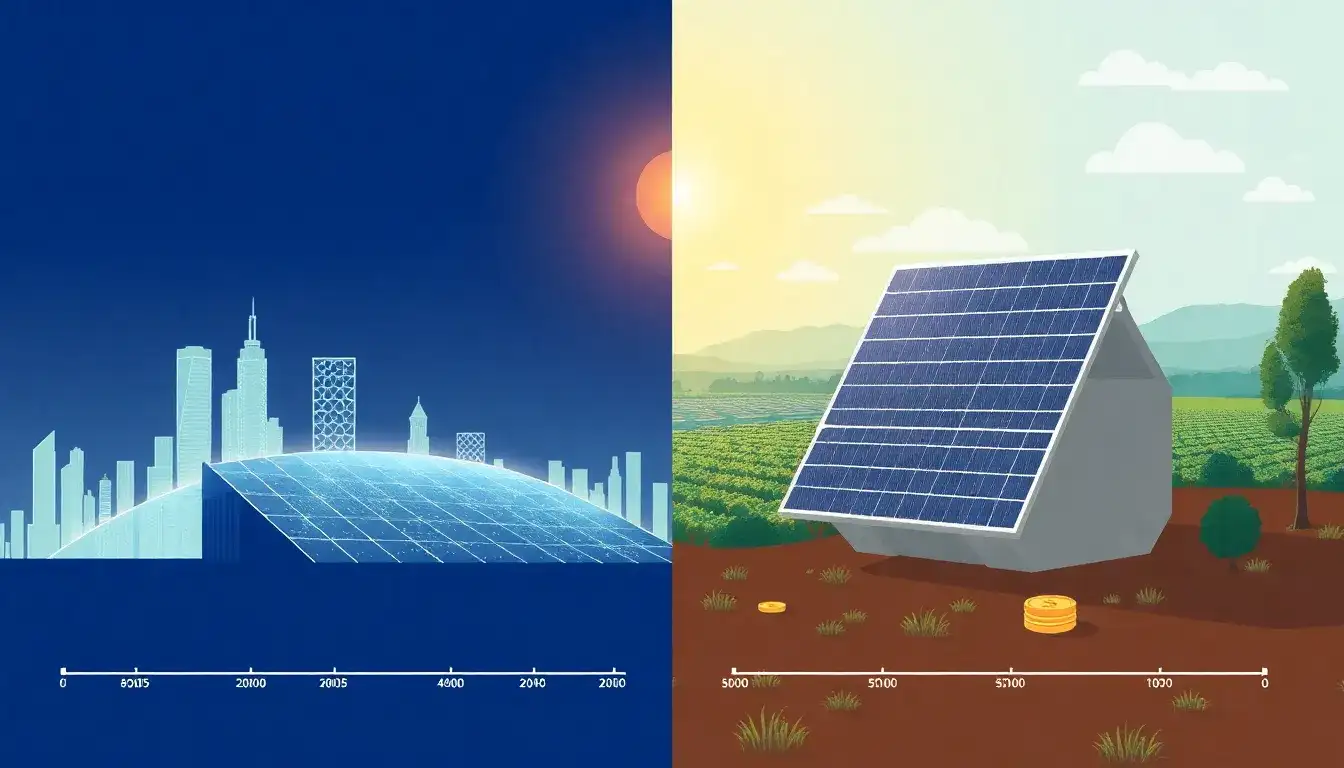
The lifetimes of perovskite and silicon solar panels significantly impact their overall cost-effectiveness, primarily through the total electricity generated over their operational period and thus their levelized cost of electricity (LCOE).
Silicon Solar Panels
- Silicon solar panels are a mature technology with a well-established lifespan of about 20 to 30 years, often guaranteed for 20 years.
- This long lifespan allows the initial investment cost to be amortized over many years of electricity generation, making the overall cost per unit of electricity relatively low and stable over time.
- Silicon panels typically balance moderate costs, good efficiency, and long durability, which supports their dominant commercial presence today.
Perovskite Solar Panels
- Perovskite solar cells historically suffer from very short lifetimes, sometimes lasting only minutes to hours in lab conditions, mainly due to degradation caused by factors like UV exposure and interface instability.
- Recent advances have extended their continuous operation to over 1,000 hours (around 40 days), but this is still far lower than silicon panels’ multi-decade lifespan.
- In practical terms, the best perovskite solar panels currently last around 30 months (about 2.5 years), which is significantly shorter than silicon panels.
- The short lifespan has a direct impact on cost-effectiveness: although perovskites can be cheaper upfront (estimated as low as $0.10/W) and have higher efficiency potential (up to ~29%), their rapid degradation means they need frequent replacement or result in higher LCOE, reducing economic competitiveness.
- Studies modeling LCOE show that perovskite solar modules with a 15-year lifetime could achieve competitive LCOEs (e.g., ~3.5 to 4.9 cents/kWh depending on efficiency), but shorter lifetimes drastically increase LCOE. Therefore, extending lifespan is critical for lowering costs.
Summary Comparison
| Feature | Silicon Solar Panels | Perovskite Solar Panels |
|---|---|---|
| Typical lifespan | 20-30 years | Currently ~2.5 years; research >1,000 h |
| Efficiency | ~20-25% (crystalline silicon) | Up to ~29% recorded |
| Cost per watt | Moderate, mature technology | Potentially very low (~$0.10/W) |
| Stability issues | Very stable, minimal degradation | UV degradation, interface instability |
| Impact of lifespan on cost | Long lifespan lowers LCOE significantly | Short lifespan increases LCOE drastically; improving stability is key |
Conclusion
The long lifetime of silicon solar panels enables a steady return on investment over decades, which keeps their overall cost of electricity low and predictable. In contrast, perovskite solar cells, despite their potential for low production cost and high efficiency, currently face challenges in durability. Their significantly shorter lifetimes mean that without improvements in stability, their overall cost performance suffers due to more frequent replacements and higher LCOE. Efforts to extend the operational lifetime of perovskite cells are crucial to making them a commercially viable and cost-competitive alternative to silicon technology.
Original article by NenPower, If reposted, please credit the source: https://nenpower.com/blog/how-do-the-lifetimes-of-perovskite-and-silicon-solar-panels-affect-their-overall-cost/

