

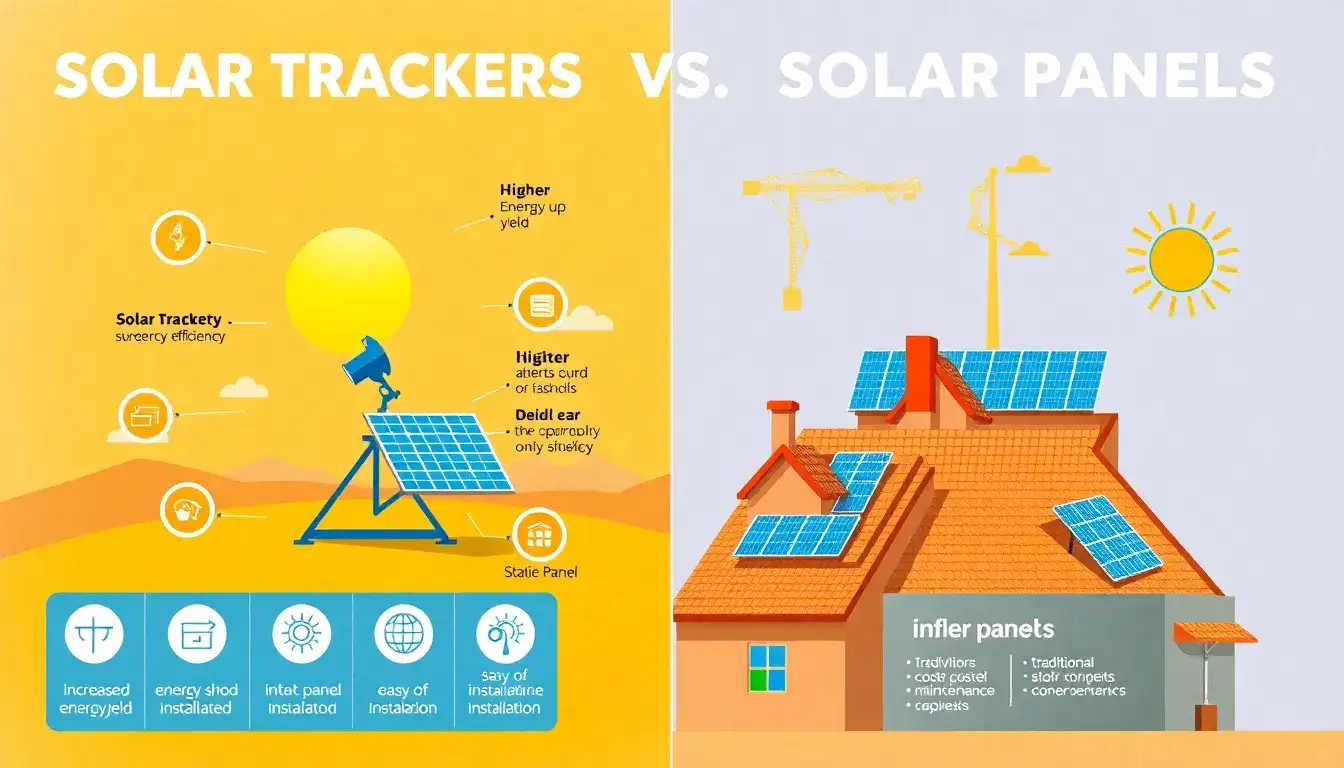
Incentives for solar trackers and solar panels differ somewhat in their structure and focus, although both are supported under federal and state programs to promote solar energy deployment and manufacturing.
Incentives for Solar Panels
- Solar panels primarily benefit from investment tax credits (ITCs), which allow system owners (residential, commercial, or industrial) to claim a percentage of the installation costs as a federal tax credit. For example, programs like NYSERDA’s NY-Sun provide financial incentives to install solar panels, structured by region and sector, with phased reductions as the market matures.
- The federal ITC can be increased by a 10% domestic content bonus if at least 40% of the components are U.S.-manufactured, and further boosted to potentially 40% total credit if prevailing wage and apprenticeship requirements are met.
Incentives for Solar Trackers
- Solar trackers, which adjust the position of solar panels to follow the sun and improve efficiency, also benefit from the ITC with the same domestic content bonus structure, incentivizing the use of U.S.-manufactured components.
- Uniquely, the Inflation Reduction Act (IRA) provides manufacturing production tax credits specifically targeting solar tracker components such as torque tubes and structural fasteners made in the U.S. These components qualify for production credits of $0.87/kg and $2.28/kg respectively, encouraging onshoring of tracker manufacturing.
- This component-specific manufacturing credit for trackers is not available for fixed-tilt racking or solar panels, which primarily rely on the ITC and domestic content bonus.
Comparison Summary
| Feature | Solar Panels | Solar Trackers |
|---|---|---|
| Federal Investment Tax Credit | Yes, base ITC + domestic content bonus | Yes, base ITC + domestic content bonus |
| Domestic Content Bonus | 10% increase if 40% U.S. content | Same as panels |
| Additional Manufacturing Credits | No | Yes, production credits on key components (torque tubes, structural fasteners) under IRA |
| State/Local Incentives | Regional programs like NYSERDA’s NY-Sun provide varying incentives by region and sector | Incentives generally linked to system cost reduction via ITC; less common standalone programs |
Conclusion
While both solar panels and solar trackers benefit from federal tax credits that reward domestic manufacturing and installation, solar trackers uniquely receive targeted manufacturing production tax credits under the Inflation Reduction Act. These credits for tracker components aim to boost domestic production and reduce costs, making trackers potentially more cost-competitive relative to fixed-tilt systems. Solar panels rely more on broad investment tax credits and state-level incentives tailored to installation volumes and locations.
This dual structure encourages not only adoption of solar technology but also incentivizes onshoring of manufacturing for trackers, complementing incentives applicable to solar panel deployment.
Original article by NenPower, If reposted, please credit the source: https://nenpower.com/blog/how-do-the-incentives-for-solar-trackers-compare-to-those-for-solar-panels/

