

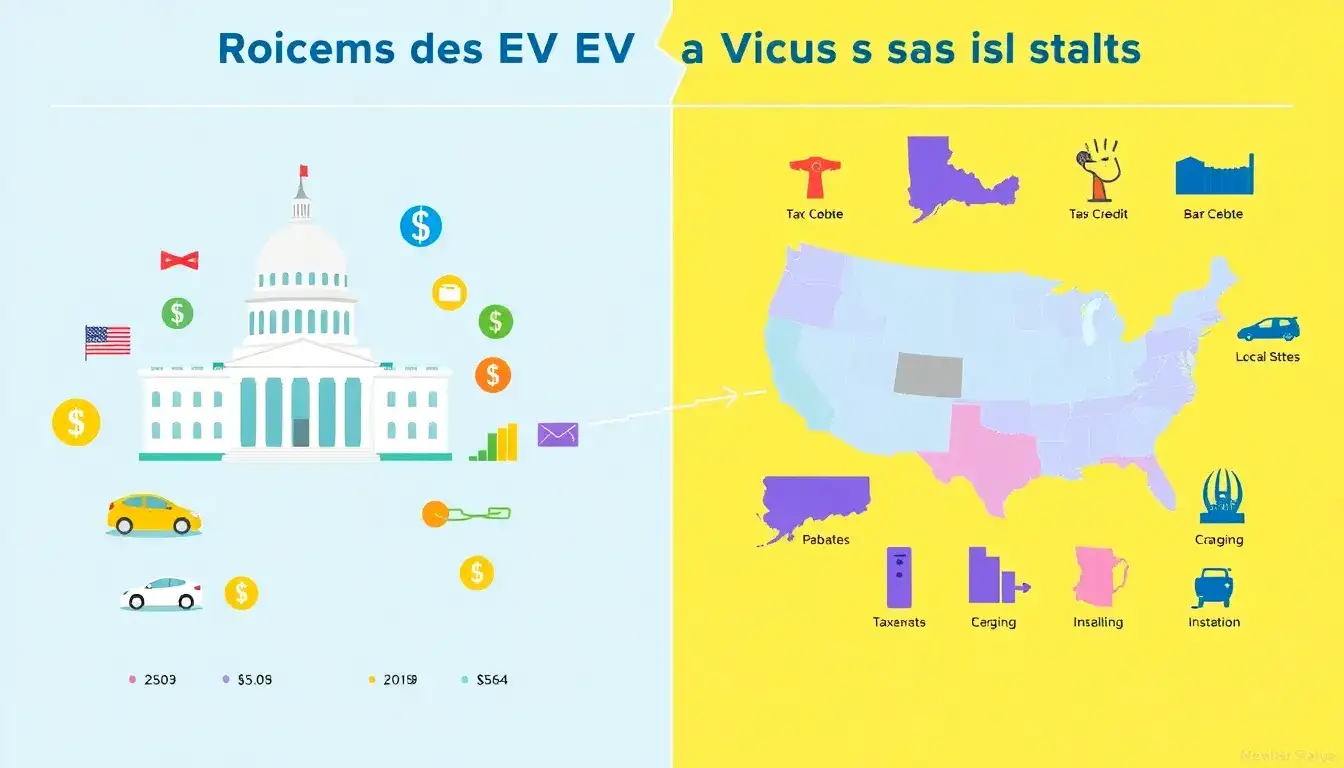
Federal EV tax credits primarily offer up to $7,500 for new qualified plug-in electric vehicles and fuel cell electric vehicles purchased in 2023 or later, and up to $4,000 for eligible used electric vehicles bought starting in 2023. The new vehicle credit depends on meeting specific battery assembly and critical mineral sourcing requirements within North America and certain trade partner countries, with percentages increasing year by year through 2032. The credit is structured in two halves: up to $3,750 for battery assembly in North America and up to $3,750 for critical mineral sourcing criteria, with partial credits possible if only one requirement is met. Used vehicle credits apply only to pre-owned EVs bought from dealers for $25,000 or less, with model years no newer than two years from the current year, and equal 30% of the sale price up to $4,000.
In contrast, state-specific incentives vary widely by state and can include rebates, tax credits, reduced vehicle registration fees, access to HOV lanes, and other perks. The amount and type of incentives differ significantly depending on local policies and budgets. State incentives often stack with federal credits, allowing greater total savings for EV buyers, but they are generally separate from and administered independently of the federal tax credits.
Key Differences Between Federal and State EV Incentives
| Feature | Federal EV Tax Credits | State-Specific Incentives |
|---|---|---|
| Amount | Up to $7,500 (new EVs), up to $4,000 (used EVs) | Varies widely by state; can range from a few hundred to several thousand dollars in rebates or credits |
| Eligibility Requirements | Battery assembly and critical minerals sourcing; vehicle price limits for used EVs | Vary by state; can include income limits, vehicle price caps, or residency requirements |
| Type | Tax credit applied at tax filing, non-refundable | Can be rebates, tax credits, fee reductions, HOV lane access, etc. |
| Administration | Federal IRS via tax return process | Administered by state energy departments or environmental agencies |
| Stacking | Can typically be combined with state incentives | Can often be combined with federal credits for cumulative benefit |
Federal tax credits are designed to incentivize domestic battery manufacturing and critical mineral sourcing, reflecting national industrial and environmental policy goals. State incentives tend to focus more directly on increasing EV adoption locally, addressing region-specific needs and budgets.
Overall, the federal EV tax credit offers a substantial, standardized benefit focused on new vehicle purchases with detailed eligibility criteria tied to manufacturing and sourcing, while state incentives provide additional, diverse, and often more immediately accessible benefits that vary by locality and policy objectives. Buyers should check both federal and their specific state’s offerings to maximize their total incentives when purchasing an EV.
Original article by NenPower, If reposted, please credit the source: https://nenpower.com/blog/how-do-the-federal-ev-tax-credits-compare-to-the-state-specific-incentives/

