

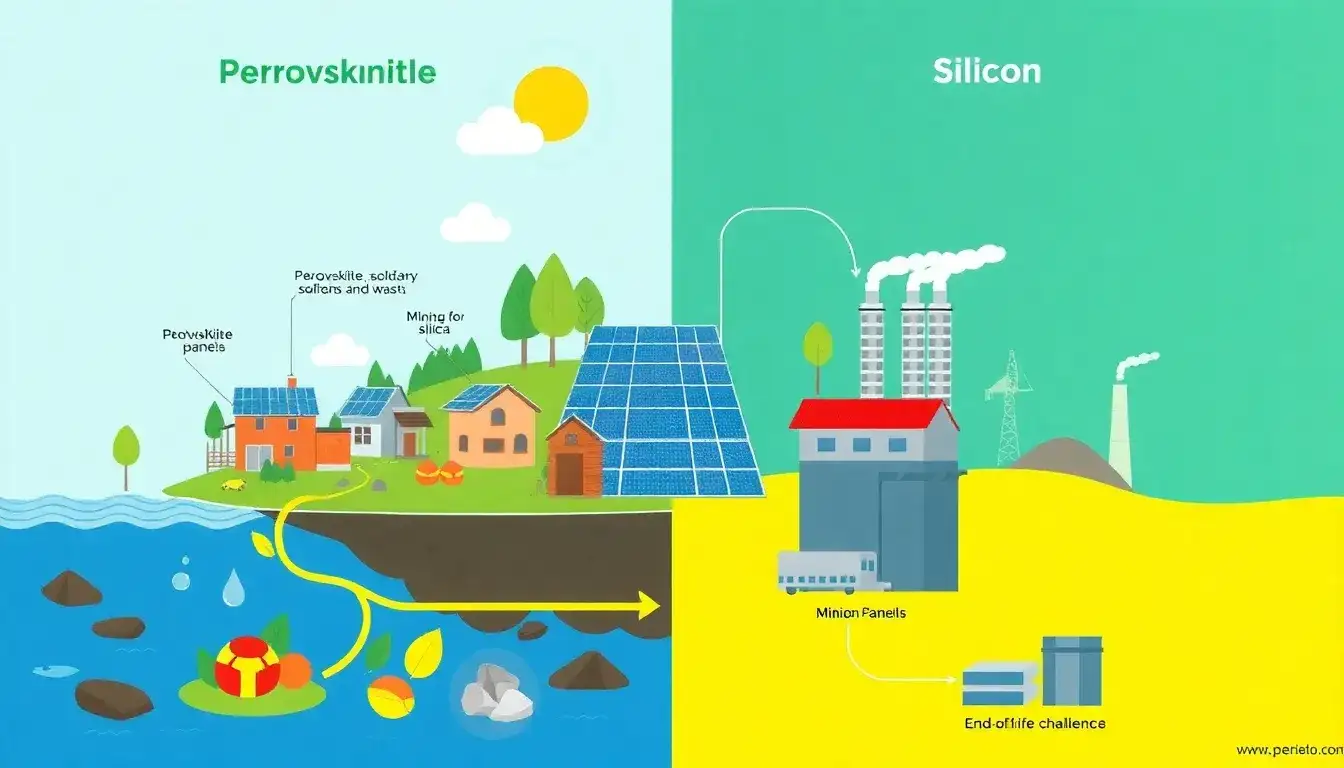
The environmental impacts of perovskite solar panels compared to silicon-based panels reveal a complex balance of benefits and drawbacks.
Lower Overall Environmental Impact in Tandem Modules
Studies assessing perovskite-on-silicon tandem solar modules have shown that they can have 6% to 18% less environmental impact than silicon-only solar modules when considering their full lifecycle and energy generation over the module’s lifetime (about 25 years). This reduction arises despite some increases in specific impact categories. For example, tandem modules may show up to 7% higher impacts in global warming potential, terrestrial ecotoxicity, freshwater consumption, fossil fuel depletion, and metal depletion during production stages. However, these increases are offset because tandem modules generate the same electricity faster—22 years versus 25 years for silicon alone—thus amortizing environmental costs more efficiently over time.
Main Environmental Burden from Silicon Wafer Production
The largest contributor to the environmental footprint in tandem module production is the silicon wafer manufacturing process, which drives global warming potential, freshwater use, and fossil fuel depletion. The addition of perovskite layers increases environmental impacts somewhat but less so than the silicon base. This highlights silicon production as the dominant impact factor in these hybrid modules.
Energy Payback and Lifecycle Assessment
Perovskite solar modules have demonstrated shorter energy payback times (EPBT) compared to other PV technologies, including silicon-based panels. They require less energy and fewer materials in manufacturing, contributing to reduced CO2 emissions per unit of electricity produced over their lifetime. However, improving device lifetime and reducing use of precious metals and energy-intensive steps in perovskite panel fabrication remain essential to lowering their carbon footprint further.
Toxicity Concerns Due to Lead Content
A significant environmental concern unique to perovskite solar cells is their use of lead in perovskite materials, which can pose risks if lead ions leak into the environment, particularly because many high-performance perovskites are water soluble and can release lead iodide. This potential toxic lead release during degradation or module disposal is a notable hazard absent in silicon panels, necessitating careful management and development of lead-free or lead-sequestering perovskite formulations.
Summary Comparison
| Environmental Aspect | Perovskite Solar Panels | Silicon-based Solar Panels |
|---|---|---|
| Overall lifecycle impact | 6%-18% lower for perovskite-on-silicon tandems | Higher due to energy-intensive silicon wafer production |
| Energy payback time (EPBT) | Shorter EPBT, less energy-intensive manufacturing | Longer EPBT due to wafer production energy needs |
| Global warming potential & resource use | Slightly higher in tandem modules but offset by faster energy generation | Dominated by silicon wafer production impacts |
| Toxicity / hazardous materials | Contains lead, risk of environmental lead leakage | Generally non-toxic materials |
| Water consumption & fossil fuel use | Tandem modules show slightly higher usage but offset over time | High due to silicon wafer processing |
Overall, perovskite solar panels, especially in tandem configurations with silicon, present promising environmental advantages in terms of lower lifecycle impact and energy payback compared to silicon-based panels. However, their environmental risks, particularly lead toxicity and stability issues, must be adequately addressed to ensure safe and sustainable deployment.
Original article by NenPower, If reposted, please credit the source: https://nenpower.com/blog/how-do-the-environmental-impacts-of-perovskite-solar-panels-compare-to-those-of-silicon-based-panels/

