

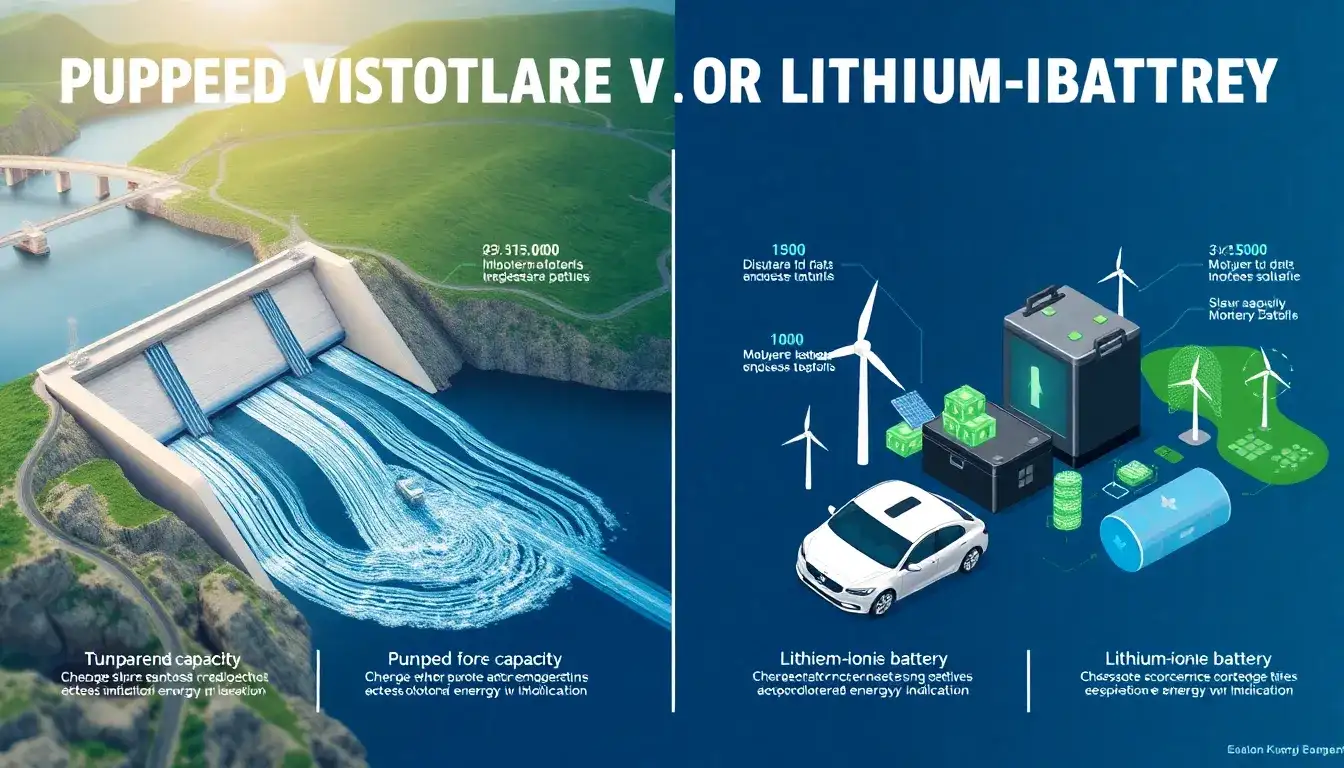
Comparison of Energy Storage Capacities: Pumped Hydroelectric Storage Systems vs. Lithium-ion Batteries
Overview
Pumped hydroelectric storage (PHS) systems and lithium-ion batteries are two major types of energy storage technologies used globally. Here’s how they compare in terms of their storage capacities and operational characteristics:
Pumped Hydroelectric Storage Systems
- Capacity: PHS systems are the largest-capacity form of grid energy storage available, accounting for about 95% of all active storage installations worldwide as of 2020. The global installed capacity is nearly 200 GW, with a total storage capacity of over 1.6 TWh.
- Operation: They store energy by pumping water from a lower reservoir to a higher one during off-peak hours using excess electricity. During peak demand, the water is released to generate electricity through turbines.
- Efficiency and Cost: The round-trip efficiency is between 70% to 80%. Although PHS systems are net energy consumers due to pumping losses, they increase revenue by selling electricity during peak demand periods.
Lithium-ion Batteries
- Capacity: Lithium-ion batteries are widely used in various applications, including electric vehicles and grid-scale energy storage. However, their total capacity for grid-scale storage is significantly less than that of PHS systems. The global installed capacity for lithium-ion batteries for grid-scale applications is increasing but is still much smaller compared to PHS.
- Operation: Lithium-ion batteries store electrical energy through chemical reactions. They can charge and discharge electricity quickly and are highly flexible in their deployment, from small-scale residential systems to large-scale grid storage facilities.
- Efficiency and Cost: Lithium-ion batteries generally have a higher round-trip efficiency compared to PHS, often around 90% or higher. They are versatile and can be scaled up or down depending on the application, though they are typically more expensive per unit of storage compared to PHS systems for large-scale applications.
Comparative Summary
| Feature | Pumped Hydroelectric Storage | Lithium-ion Batteries |
|---|---|---|
| Global Capacity | Nearly 200 GW (2020 data) | Much smaller compared to PHS |
| Storage Capacity | Over 1.6 TWh (2020 data) | Increasing but smaller in scale |
| Round-Trip Efficiency | 70% to 80% | Typically around 90% |
| Cost | Economical for large-scale storage | More expensive per unit |
| Operation Flexibility | Less flexible due to geographical constraints | Highly flexible in deployment |
In summary, while lithium-ion batteries offer high efficiency and flexibility in deployment, pumped hydroelectric storage systems are the dominant large-scale energy storage technology due to their immense capacity and cost-effectiveness for grid-scale applications.
Original article by NenPower, If reposted, please credit the source: https://nenpower.com/blog/how-do-the-energy-storage-capacities-of-pumped-hydroelectric-storage-systems-and-lithium-ion-batteries-compare/

