

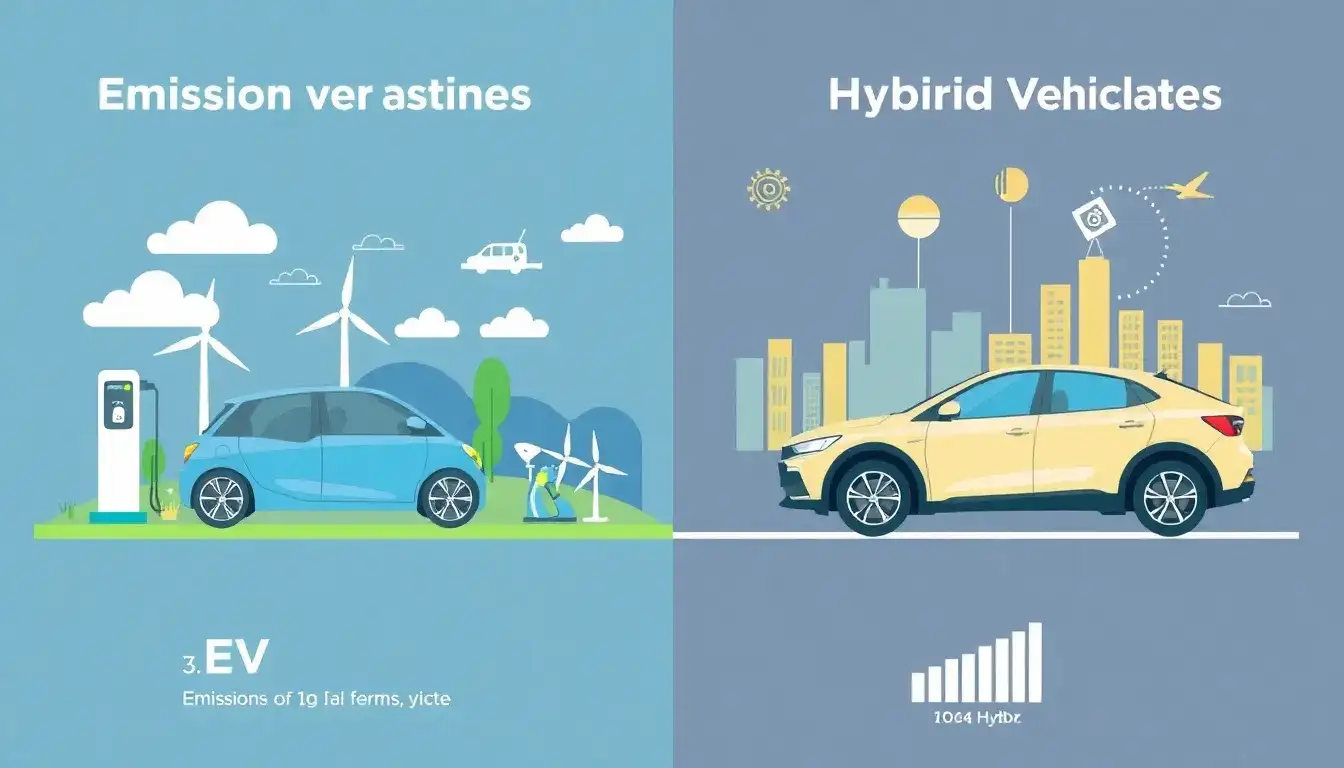
The emissions of electric vehicles (EVs) generally compare favorably to those of hybrid vehicles, but the specifics depend on various factors including electricity sources, driving habits, and vehicle manufacturing.
Tailpipe and Life Cycle Emissions
- Electric vehicles (EVs), including battery electric vehicles (BEVs), produce zero tailpipe emissions when operating solely on electricity. However, emissions do occur upstream during electricity generation depending on the power mix of the grid (coal, natural gas, renewables, etc.).
- Hybrid vehicles (HEVs and plug-in hybrids PHEVs) combine an internal combustion engine with an electric motor, leading to lower tailpipe emissions than conventional gasoline vehicles but not zero. HEVs recharge their batteries through regenerative braking and engine power, while PHEVs can run purely on electricity for limited ranges before switching to gasoline.
- Life cycle emissions (from production, fuel extraction, vehicle operation, and disposal) tend to be lower for EVs than for hybrids, especially in regions with cleaner electricity grids. However, EVs also have higher emissions during manufacturing mainly due to battery production.
Emission Comparisons
- Studies show fully electric vehicles typically emit fewer greenhouse gases over their lifetime than hybrids. For example, one comparison found lifetime CO2 emissions per mile were roughly 200 grams for battery EVs, about 260 grams for hybrids and plug-in hybrids, and over 350 grams for gasoline cars.
- According to emissions data, typical annual CO2 equivalent emissions are approximately 3,932 lbs. for EVs, 5,772 lbs. for plug-in hybrids, and 6,258 lbs. for regular hybrids. Gasoline vehicles produce over 11,000 lbs. annually, showing hybrids are significantly cleaner than gas vehicles but not as low as full EVs.
- A perspective from Emissions Analytics suggested that hybrids—particularly mild hybrids—can be very effective at reducing real-world tailpipe CO2 emissions, sometimes even outperforming EVs in certain practical usage scenarios due to smaller batteries and less energy-intensive production. However, this ignores upstream emissions in fuel and electricity production.
Contextual Factors
- The relative cleanliness depends heavily on how the vehicles are used and charged:
- In areas where electricity is generated largely from renewables or low-emission sources, EVs have a strong emissions advantage.
- If an EV is charged from a high-emission grid, the life cycle benefit over hybrids shrinks.
- Plug-in hybrids only show maximum emissions benefits when operated mostly on battery power, which is often difficult to enforce in practice.
- In very specific circumstances, such as particular driving patterns or electricity generation mixes, a hybrid can potentially have lower emissions than an EV, but these are exceptions rather than the norm.
Summary
| Vehicle Type | Tailpipe Emissions | Life Cycle Emissions (relative) | Notes |
|---|---|---|---|
| Battery Electric (EV) | Zero (when electric) | Lowest in general | Emissions vary with grid; higher manufacturing emissions |
| Plug-in Hybrid (PHEV) | Low to zero (on electric) | Moderate | Best when mostly on electric, else emissions increase |
| Hybrid (HEV) | Lower than gas cars | Higher than EVs, lower than gas | Effective CO2 reduction but still emits from engine |
| Gasoline Vehicles | Highest | Highest | Baseline for comparison |
Electric vehicles provide the lowest emissions over their lifetime in almost all typical scenarios, but well-driven hybrids can sometimes approach or slightly exceed their emissions performance depending on factors like grid electricity emissions and driving habits.
In conclusion, EVs are generally cleaner than hybrids in terms of emissions, especially when powered by low-carbon electricity, but hybrids still represent a meaningful emissions improvement over conventional gas vehicles and can occasionally outperform EVs under narrow conditions.
Original article by NenPower, If reposted, please credit the source: https://nenpower.com/blog/how-do-the-emissions-of-electric-vehicles-compare-to-those-of-hybrid-vehicles/

