

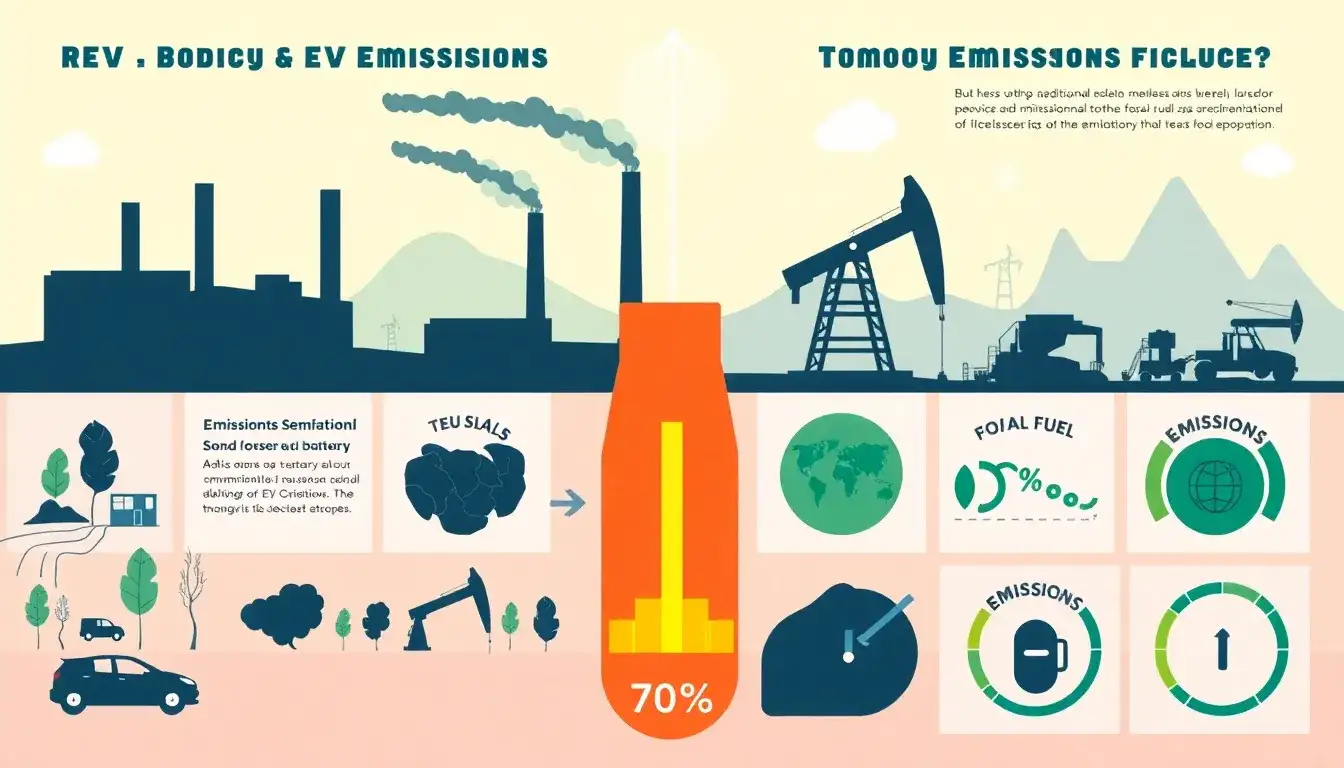
Electric vehicle (EV) battery production emissions are significant but must be contextualized against both EV lifecycle advantages and traditional fossil fuel industries’ impacts. Here’s a structured comparison:
EV Battery Production Emissions
- Battery-specific footprint:
- Producing a 75-kWh EV battery emits over 7 tons of CO₂e, contributing to double the production emissions of an internal combustion engine (ICE) vehicle overall.
- Studies report 56–494 kg CO₂ per kWh of battery capacity, translating to 1–2 g CO₂ per kilometer driven over the vehicle’s lifetime.
- Key drivers:
- Material extraction (lithium, cobalt, nickel) and energy-intensive refining processes dominate emissions.
- Energy sources (renewables vs. fossil fuels) critically influence outcomes—clean energy can halve battery manufacturing emissions.
Fossil Fuel Industry Emissions
- Upstream operations:
- Oil extraction (e.g., hydraulic fracturing, tar sands) and refining emit 4–50 kg CO₂e per barrel during production, with additional methane leakage amplifying climate impact.
- Coal mining releases methane (25–40x more potent than CO₂ over 100 years) and requires energy-intensive processing.
- Downstream combustion:
- ICE vehicles emit ~2.3 kg CO₂ per liter of gasoline burned, contributing 4.6–5.1 tons CO₂ annually per average vehicle.
- Power plants (coal/natural gas) emit ~400–1,000 g CO₂ per kWh, compared to near-zero for renewables.
Comparative Analysis
| Aspect | EV Batteries | Fossil Fuel Industries |
|---|---|---|
| Production Phase | 7+ tons CO₂e per battery | Oil/coal extraction: methane leaks, refining emissions |
| Operational Phase | Zero tailpipe emissions | High combustion emissions (e.g., 2.3 kg CO₂/liter) |
| Mitigation Levers | Renewable energy in manufacturing | Carbon capture, fuel switching |
While EV battery production has a measurable carbon footprint, it is offset over time by operational emissions savings. Fossil fuel industries generate continuous emissions during extraction, refining, and end-use combustion, making their aggregate impact substantially higher in most scenarios.
Original article by NenPower, If reposted, please credit the source: https://nenpower.com/blog/how-do-the-emissions-from-ev-battery-production-compare-to-those-from-traditional-fossil-fuel-based-industries/

