

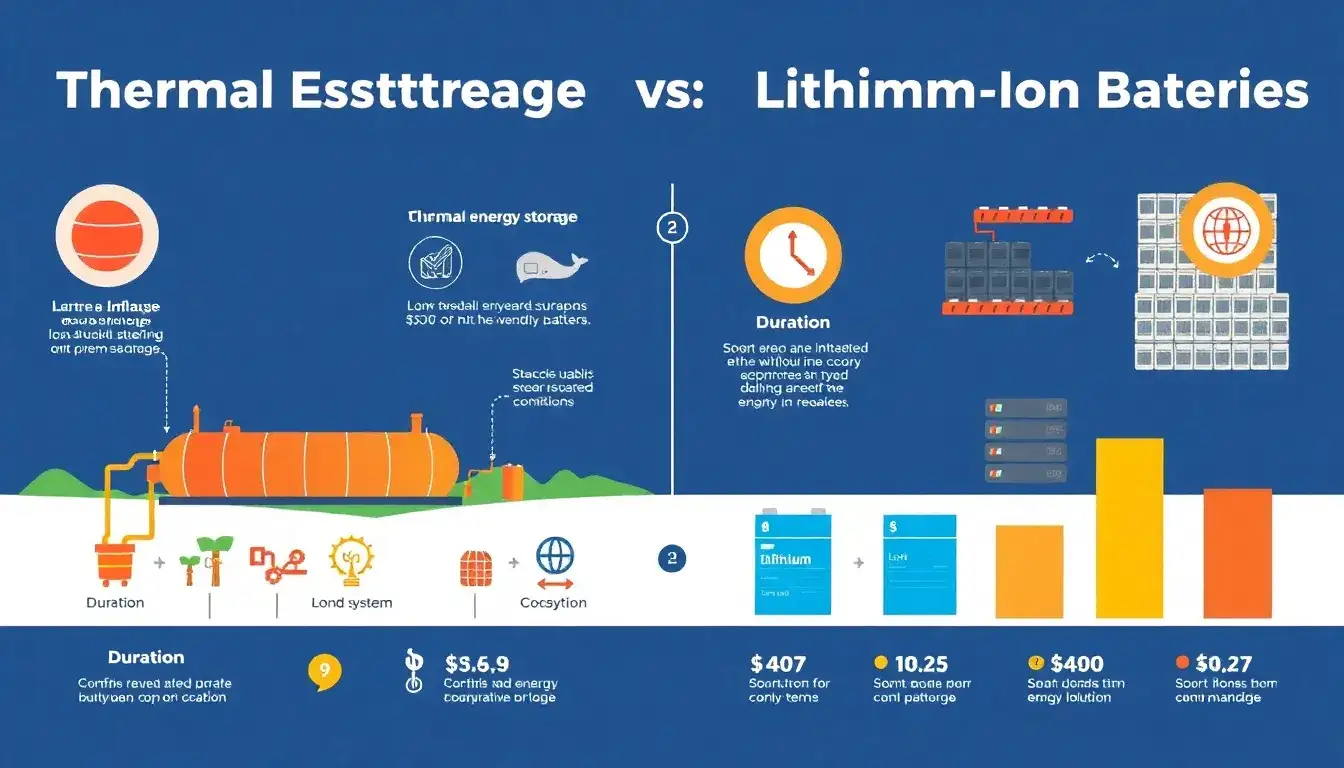
When comparing the costs of thermal energy storage and lithium-ion batteries for different durations, thermal energy storage emerges as a more cost-effective option for long-duration applications.
Cost Comparison
- Thermal Energy Storage: This technology has been reported as one of the least expensive options for long-duration energy storage (LDES), with a capital expenditure (capex) cost of approximately $232 per kilowatt-hour (kWh). It is particularly suitable for storing energy over extended periods, often up to several days.
- Lithium-Ion Batteries: These batteries are typically optimized for storage durations of four hours or less. As of 2023, the average capex for lithium-ion systems was around $304/kWh for four-hour duration systems. However, when used for longer durations, the cost increases linearly, making them less cost-effective compared to thermal energy storage for durations over eight hours.
Duration-Based Cost Advantages
- Short-Duration Storage (Less than 8 hours): Lithium-ion batteries are generally favored due to their high energy density, efficiency, and widespread adoption. However, their costs are higher than thermal energy storage when considering durations over eight hours.
- Long-Duration Storage (Over 8 hours): Thermal energy storage becomes more cost-effective. Its ability to store energy for extended periods without significant performance degradation makes it an attractive choice for applications requiring longer storage times.
Market and Geographical Considerations
- Global Market: In non-China markets, thermal energy storage and other LDES technologies have a better chance of competing with lithium-ion batteries due to the higher cost of lithium-ion outside China.
- China: Although China produces some of the cheapest lithium-ion batteries, thermal energy storage and other LDES technologies can still play a significant role due to favorable policies and large-scale project developments.
In summary, thermal energy storage is more economical for long-duration applications, while lithium-ion batteries remain preferable for shorter durations due to their inherent advantages in efficiency and energy density.
Original article by NenPower, If reposted, please credit the source: https://nenpower.com/blog/how-do-the-costs-of-thermal-energy-storage-compare-to-lithium-ion-batteries-for-different-durations/

