

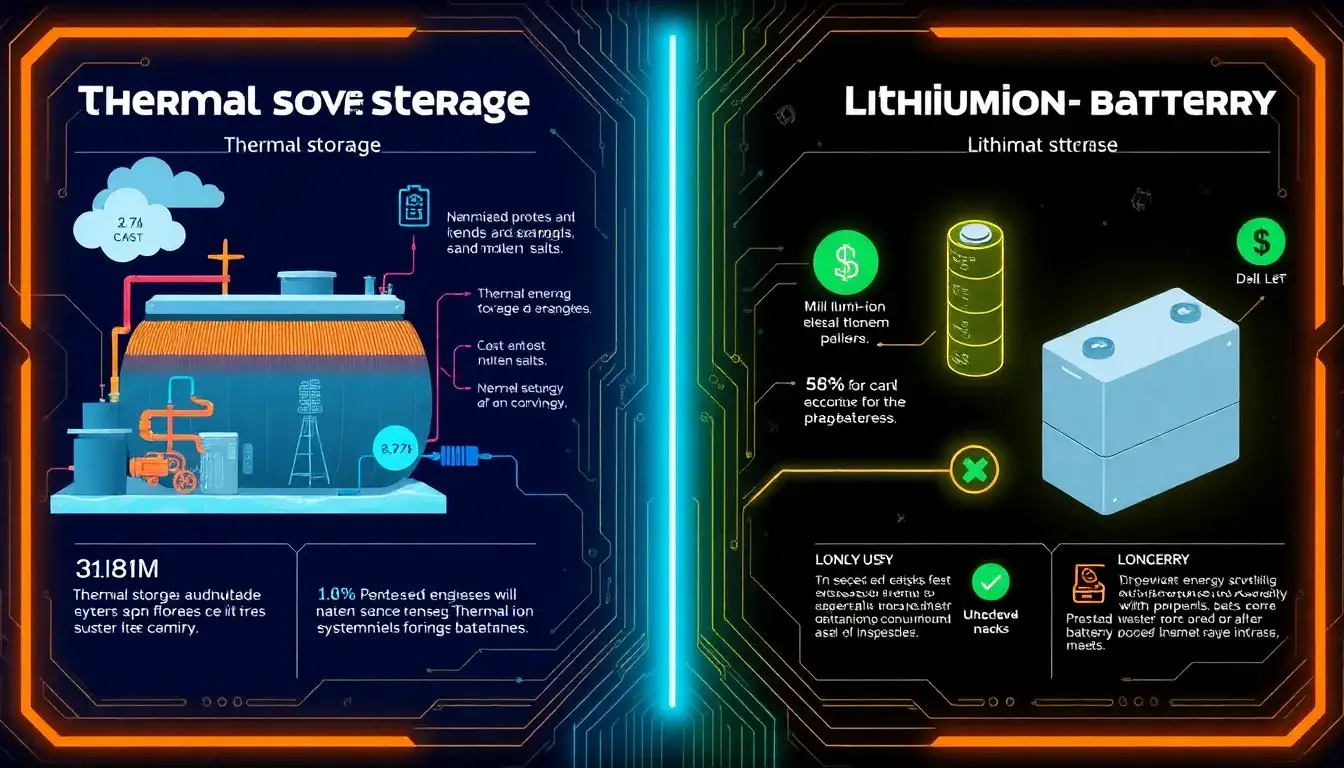
Thermal energy storage (TES) and lithium-ion batteries differ significantly in cost structures, storage mechanisms, and suitable applications, with TES generally offering a much lower cost per unit of energy stored, especially for long-duration storage.
Cost Comparison
- Thermal Energy Storage Costs:
TES costs vary depending on technology and scale, but typical capital expenditure (capex) figures for molten salt-based TES systems are around $232/kWh to $350/kWh (electrical equivalent basis varies depending on conversion efficiency), with levelized costs of thermal energy storage roughly estimated at 5 to 13.5 cents per kWh of thermal energy stored. Some advanced TES technologies, such as those using inexpensive materials like silica sand, can achieve extremely low storage costs as low as $2 to $4 per kWh of thermal energy stored (at high temperatures around 900°C) though this corresponds to thermal kWh rather than electrical, requiring conversion back to electricity which affects final cost equivalence. - Lithium-Ion Battery Costs:
Lithium-ion battery storage systems typically have installed capex costs around $304/kWh for four-hour duration systems globally, with system-specific costs varying by region and scale. Battery costs have seen rapid decline over the past decade due to economies of scale and technology improvements, with residential battery prices dropping 71% between 2014 and 2020 to about $776/kWh. However, lithium-ion batteries are generally more expensive for long-duration energy storage (>8 hours) compared to TES and other long-duration storage technologies.
Efficiency and Application Context
- Energy Density and Efficiency:
Lithium-ion batteries have a high energy density, making them ideal for applications where space and weight are constraints (e.g., electric vehicles and short-duration grid applications). Their round-trip efficiency typically ranges from 85% to 95%. TES, especially molten salt or particle-based systems, store energy as heat, which requires converting electricity into heat and vice versa, resulting in round-trip efficiencies typically lower than batteries but acceptable for long-duration bulk storage. - Appropriate Use Cases:
TES is particularly cost-effective for large-scale, long-duration energy storage (e.g., grid-scale storage for 8+ hours), industrial heat needs, and integrating variable renewable energy sources like solar and wind. Lithium-ion batteries excel in short-duration storage, fast response grid services, and mobile applications.
Summary Table
| Feature | Thermal Energy Storage | Lithium-Ion Batteries |
|---|---|---|
| Typical Capex Cost* | ~$232 to $350/kWh (thermal basis varies) | ~$304/kWh (for 4-hour systems) |
| Levelized Cost | ~5-13.5 c/kWh thermal energy | Higher for long-duration storage |
| Energy Density | Low (bulk, infrastructure scale) | High (compact, transport-friendly) |
| Round-trip Efficiency | Lower (often 40-50% to ~70%) | High (85-95%) |
| Best for | Long-duration, grid-scale, industrial heat | Short-duration, grid services, EVs |
| Material Costs | Inexpensive (sand, molten salt, graphite) | Expensive (lithium, cobalt, nickel) |
| Scale and Siting | Modular, scalable, can use existing infrastructure | Flexible, modular but costly at large scales |
*Costs are approximate and can vary by region, technology maturity, and scale.
In conclusion, thermal energy storage can be substantially cheaper than lithium-ion batteries for long-duration large-scale storage, particularly beyond 8 hours of discharge, due to the low cost of storage media and infrastructure materials. Lithium-ion batteries remain competitive and preferred for short-duration and transport applications due to their high energy density and efficiency.
Original article by NenPower, If reposted, please credit the source: https://nenpower.com/blog/how-do-the-costs-of-thermal-energy-storage-compare-to-lithium-ion-batteries-2/

