

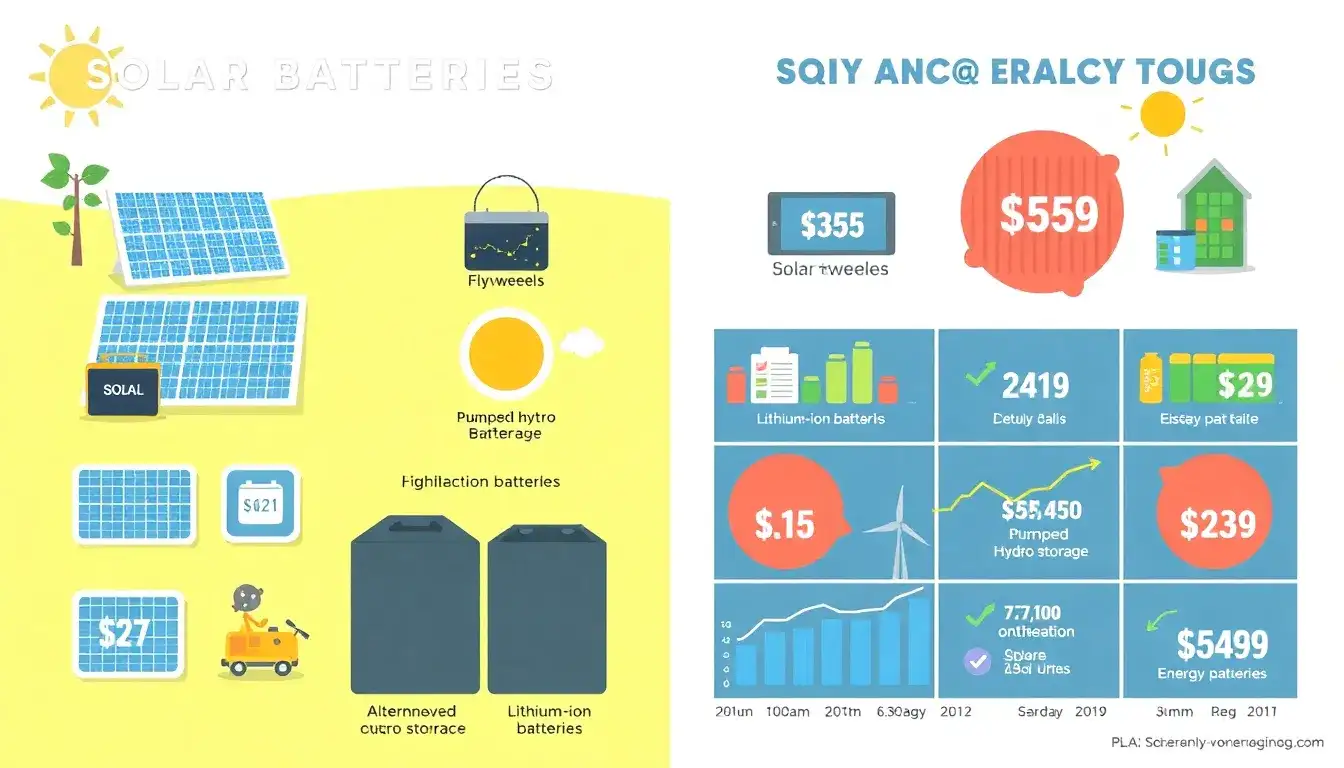
Comparing Costs of Solar Batteries to Other Energy Storage Options
Comparing the costs of solar batteries to other energy storage options involves understanding the pricing and characteristics of each technology. Here’s a breakdown of solar batteries and a comparison with other common energy storage methods:
Solar Batteries
- Cost Range: Solar battery systems typically cost between $6,000 and $18,000 for residential installations, with prices averaging around $1,300 per kilowatt-hour (kWh) before incentives and about $1,000 per kWh after tax credits.
- Capacity: Systems range from 5 kWh to 40 kWh, depending on energy needs.
- Installation Factors: Labor costs, system complexity, and the need for additional components like inverters can affect the total cost.
- Benefits: Solar batteries offer energy independence, backup power during outages, and the ability to store excess solar energy.
Other Energy Storage Options
- Traditional Lead-Acid Batteries
- Cost Range: Generally less expensive than solar batteries, with costs ranging from $5,000 to $15,000 for home systems.
- Drawbacks: Require more maintenance and have shorter lifespans compared to solar batteries.
- Lithium-Iron Phosphate (LFP) Batteries
- Cost Range: More expensive than solar batteries, typically between $9,000 and $30,000.
- Benefits: Long-lasting, efficient, and low maintenance.
- Hydrogen Fuel Cells
- Cost and Complexity: More complex and expensive than solar batteries, with costs not commonly listed for residential installations.
- Benefits: Zero emissions, long-term energy storage capability.
- Pumped Hydro Storage (PHS)
- Cost and Scale: Typically used for large-scale energy storage, PHS is less applicable for residential use. It is one of the oldest and most cost-effective forms of large-scale energy storage but requires specific geography.
- Benefits: High capacity for grid-scale applications.
- Flywheel Energy Storage
- Cost and Application: Generally used for short-term energy storage in commercial applications, flywheel costs vary based on technology and scale but are less common for residential use.
- Benefits: Quick charge/discharge cycles, suitable for high-power applications.
- Compressed Air Energy Storage (CAES)
- Cost and Scale: Another large-scale energy storage method, CAES is not suitable for residential use due to its geographical requirements and scale.
- Benefits: High energy storage capacity, though site-specific.
Comparison
- Solar Batteries offer a mid-range cost option with significant benefits for renewable energy users, especially for those with solar panels.
- Lead-Acid Batteries are more affordable upfront but have higher maintenance needs and shorter lifespans.
- LFP Batteries are more expensive than solar batteries but provide long-term efficiency.
- Large-Scale Methods (PHS, CAES) are too large for residential use and are typically employed in grid-scale energy storage.
Overall, solar batteries are well-suited for homes with solar panels, offering a balance of cost and benefits for energy storage and backup power.
Original article by NenPower, If reposted, please credit the source: https://nenpower.com/blog/how-do-the-costs-of-solar-batteries-compare-to-other-energy-storage-options/

