Comparing the costs of pumped hydro storage (PHS) to other energy storage solutions involves examining both capital costs and operating characteristics. Here’s a breakdown of how PHS compares:
Cost Comparison
Pumped Hydro Storage (PHS)
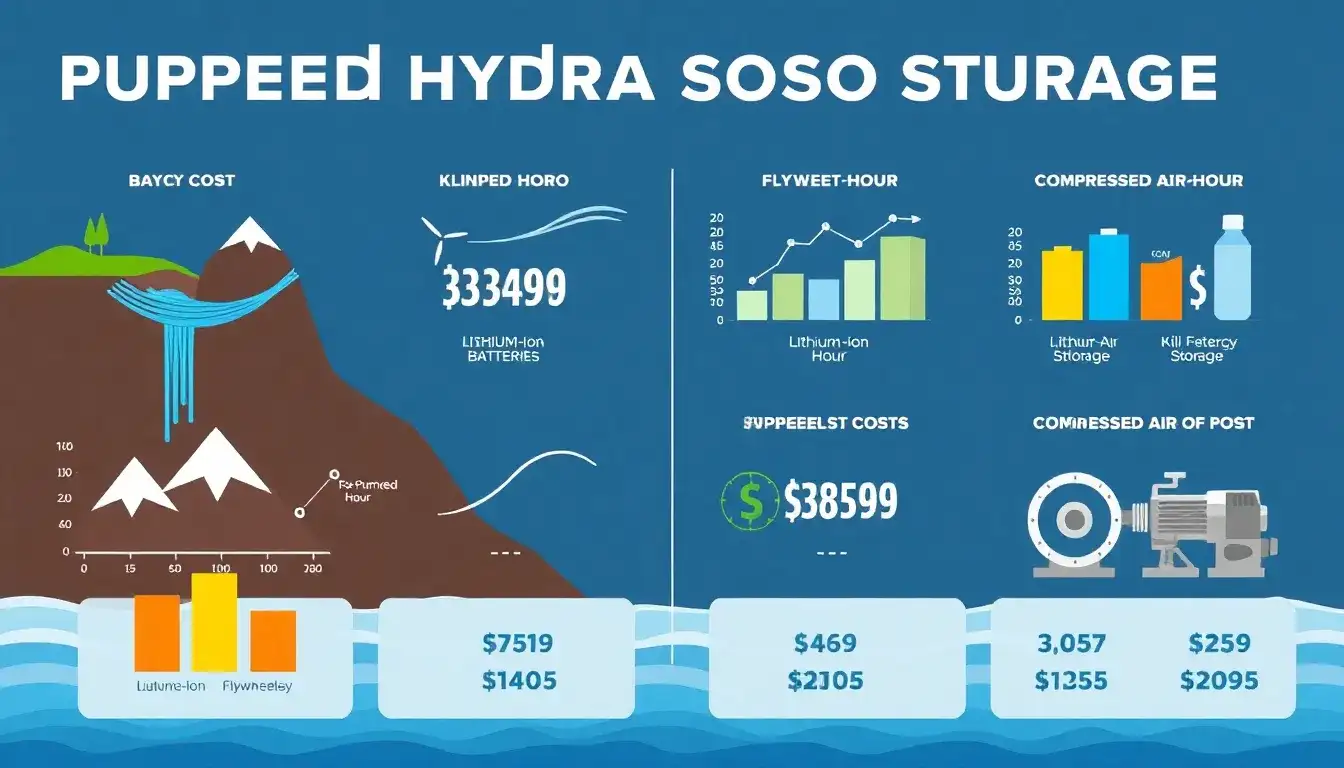
- Capital Costs: PHS projects typically range from approximately $1,438 to $4,243 per kW, depending on the site characteristics and scale of the facility.
- Cost per kWh: Estimated at about $165/kWh for large-scale facilities, making it competitive with other long-duration storage technologies when considering high energy-to-power ratios.
- Energy-to-Power (E/P) Ratio: PHS is efficient for high E/P ratios, often used for applications requiring long-duration storage (typically >8 hours).
Battery Energy Storage Systems (BESS)
- Capital Costs: Vary widely depending on the battery type, but lithium-ion batteries are often cited as having a capital cost around $200-$300 per kWh for shorter-term applications.
- Cost per kWh: Can be more expensive than PHS for long-duration storage but offer flexibility and ease of deployment for short-term applications.
Compressed Air Energy Storage (CAES)
- Cost per kWh: Around $105/kWh, making it another low-cost option for long-duration storage, though its application is limited by geography and infrastructure requirements.
Other Technologies
- Flywheels and Ultracapacitors: These technologies are generally more expensive per kWh but provide rapid response times for grid stability services.
- Redox Flow Batteries: Offer promise for medium-term storage with improving costs but currently have a lower round-trip efficiency compared to PHS.
Operational and Efficiency Considerations
- PHS Efficiency: PHS is highly efficient, with round-trip efficiencies typically around 80-87%, though recent advancements can push this higher.
- Scalability and Duration: PHS can store large amounts of energy for extended periods, making it ideal for grid resilience and long-term energy shifting.
- Location-Specific: Requires suitable geography with significant elevation differences, limiting deployment locations compared to more versatile technologies like batteries.
Conclusion
Pumped hydro storage offers one of the lowest costs per kWh among long-duration storage solutions when conditions are suitable, and it is particularly effective at storing large volumes of energy for extended durations. However, its deployment is geographically constrained, and it often requires substantial upfront investments. Other technologies, such as batteries, offer more flexibility in deployment for short-term or localized energy storage needs. Ultimately, the choice of storage technology depends on the specific energy storage requirements and the site-specific conditions for each project.
Original article by NenPower, If reposted, please credit the source: https://nenpower.com/blog/how-do-the-costs-of-pumped-hydro-storage-compare-to-other-energy-storage-solutions/