

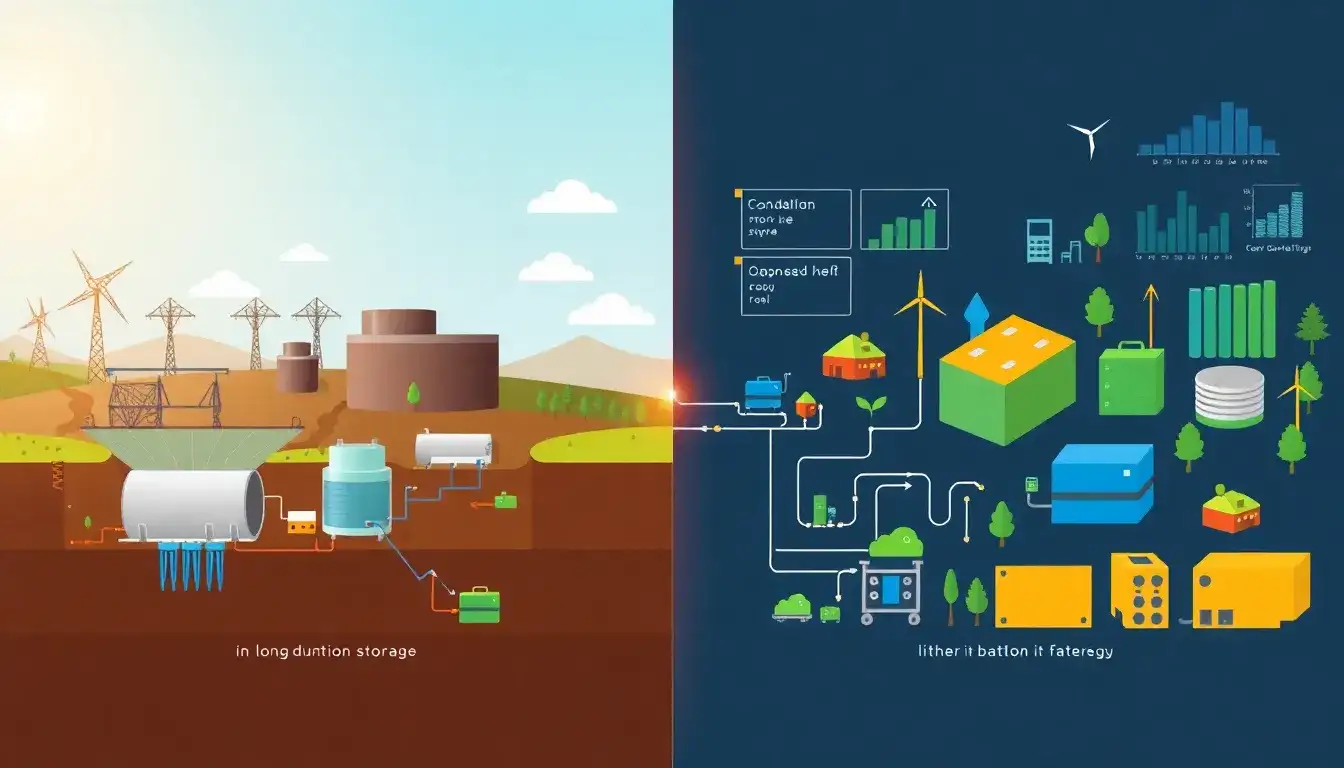
The costs of long-duration energy storage (LDES) technologies generally remain higher than those of lithium-ion batteries (LIBs) when measured on a levelized cost of storage (LCOS) basis, but they offer advantages for longer duration applications that lithium-ion systems are not optimized for.
Cost Comparison and Trends
- Lithium-ion batteries, especially for shorter durations around 4 hours, had an average capital expenditure (capex) of about $304/kWh in 2023. These systems currently dominate the market for daily cycling storage and have been continually decreasing in price over the last decade.
- Long-duration energy storage technologies, including pumped hydropower, compressed air energy storage, flow batteries, and others, typically target storage durations of 10 hours or more. Their levelized costs are expected to exceed the U.S. Department of Energy’s (DOE) $0.05/kWh target through 2030 without further innovation, implying they are presently more expensive than lithium-ion batteries for equivalent capacity.
- However, DOE reports and technology assessments highlight that with the implementation of key innovations, several LDES technologies—particularly pumped hydropower, flow batteries, and compressed air storage—could reduce costs below $0.05/kWh by 2030, which would make them more competitive or even cheaper for long-duration applications.
- Supercapacitors and other emerging LDES technologies currently have much higher LCOS estimates (e.g., around $0.33-$0.44/kWh projected for 2030 in some cases), reflecting their early-stage status and high capital costs compared to LIBs, but are under active development to improve.
Key Considerations
- Lithium-ion batteries have high energy density and relatively low upfront costs for short durations but become less cost-effective as storage duration extends beyond 4-6 hours due to the high cost per kWh of additional capacity.
- Long-duration storage technologies, with inherently lower self-discharge and sometimes lower material costs, become more economically attractive when used for storage durations exceeding 8-10 hours, especially for seasonal or multi-day storage needs.
- The market and research outlook suggest that as innovation continues, certain LDES technologies are poised to compete effectively with or complement lithium-ion batteries by offering lower costs and better suitability for long-duration grid services.
Summary
| Storage Type | Typical Duration | 2023 Capex or LCOS Estimate | Outlook by 2030 |
|---|---|---|---|
| Lithium-ion Batteries (LIB) | ~4 hours | ~$304/kWh capex | Further cost reductions expected |
| Pumped Hydropower, Flow Batteries, Compressed Air Storage (LDES) | 10+ hours | > $0.05/kWh LCOS currently | Potential to fall below $0.05/kWh with innovation |
| Supercapacitors (emerging) | 10 hours | Baseline ~$0.44/kWh LCOS in 2030 | Potential 24% improvement with innovation |
In conclusion, lithium-ion batteries remain the cost leader for short-duration energy storage, but long-duration storage technologies are improving and may soon offer lower cost options for longer storage durations, particularly if DOE innovation targets are met by 2030.
Original article by NenPower, If reposted, please credit the source: https://nenpower.com/blog/how-do-the-costs-of-long-duration-energy-storage-technologies-compare-to-lithium-ion-batteries/

