

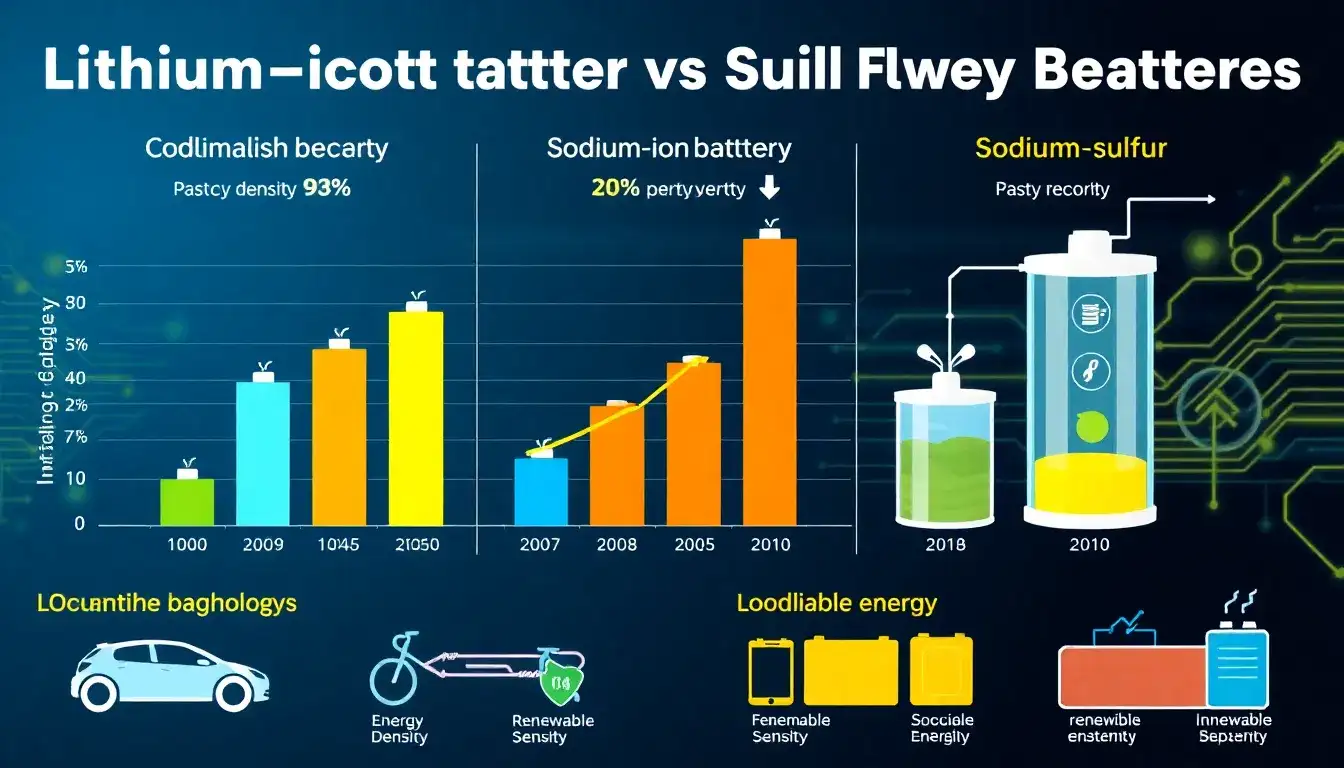
Comparing the costs of lithium-ion batteries to other battery technologies like sodium-sulfur and flow batteries involves considering several factors, including the specific application, material costs, and energy storage capacity. Here’s a comparison:
Overview of Battery Technologies
| Battery Type | Description | Cost |
|---|---|---|
| Lithium-ion | Widely used in consumer electronics and EVs due to high energy density. | Average cost around $115-$151 per kWh in 2024, depending on the application. |
| Sodium-sulfur | High-temperature batteries used for grid-scale energy storage. | Generally more expensive than Li-ion for most applications; exact cost varies by project. |
| Flow Batteries | Suitable for long-duration energy storage, commonly used in grid-scale systems. | Costs typically higher than Li-ion; often priced based on specific project requirements. |
Comparison Factors
1. Energy Density and Cycle Life
- Lithium-ion: Offers high energy density and long cycle life, making it suitable for portable devices and EVs.
- Sodium-sulfur: Has lower energy density but can store large amounts of energy at high temperatures.
- Flow Batteries: Lower energy density but designed for long-duration energy storage with potentially lower operational costs.
2. Scalability and Cost
- Lithium-ion: Economies of scale due to high demand drive costs down. Manufacturing is well-established globally.
- Sodium-sulfur: Less scalable for widespread use due to high-temperature requirements and material costs.
- Flow Batteries: Costs are high but decreasing as technology advances; less economies of scale compared to Li-ion.
3. Materials and Sustainability
- Lithium-ion: Uses lithium, cobalt, nickel, etc., with environmental concerns around mining and recycling.
- Sodium-sulfur: Utilizes sodium and sulfur, which can be sourced more sustainably compared to some Li-ion materials.
- Flow Batteries: Typically use vanadium, which is less subject to supply chain risks than lithium or cobalt.
Conclusion
Lithium-ion batteries are generally more cost-effective for consumer electronics and electric vehicles due to high energy density and economies of scale. Sodium-sulfur and flow batteries are often more suited to specific applications like grid-scale energy storage, where their unique characteristics (e.g., high-temperature storage or long-duration capacity) outweigh the cost disadvantages compared to Li-ion. However, their exact costs can vary widely based on project specifics and technological advancements.
For specific applications, the choice between these technologies often depends on the required energy storage capacity, operational conditions, and sustainability considerations.
Original article by NenPower, If reposted, please credit the source: https://nenpower.com/blog/how-do-the-costs-of-lithium-ion-batteries-compare-to-other-battery-technologies-like-sodium-sulphur-or-flow-batteries/

