

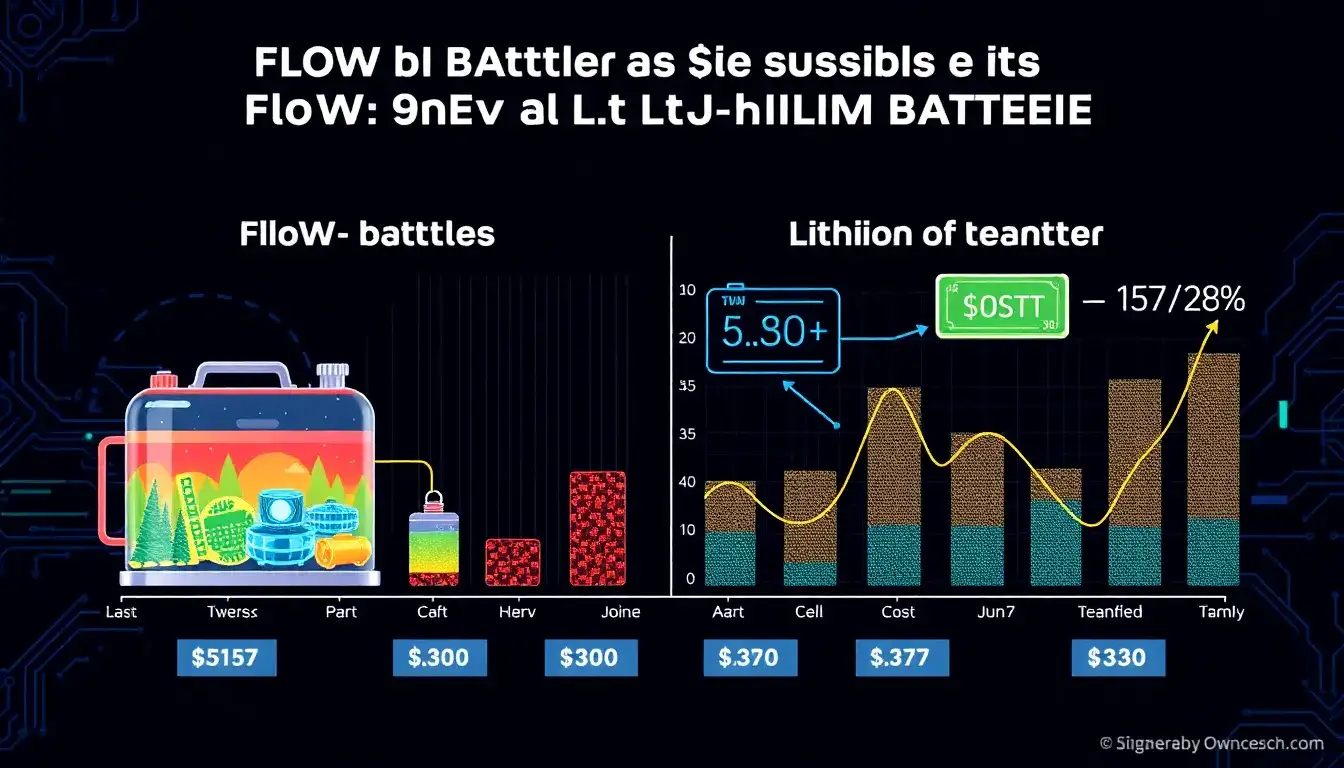
The cost comparison between flow batteries and lithium-ion batteries over time involves several factors, including initial costs, long-term efficiency, and performance durability.
Initial Costs and Performance
- Flow Batteries:
- High Initial Cost: The initial cost per kWh of flow batteries is generally higher than lithium-ion batteries, ranging from $200 to $500 per kWh. This is due to the complex system and large tanks required.
- Long Duration Storage: Flow batteries are ideal for long-duration energy storage (beyond 6 hours), offering consistent power output without significant degradation over time.
- Lithium-Ion Batteries:
- Lower Initial Cost: Lithium-ion batteries have a lower initial cost per kWh, typically between $100 and $300. They are well-suited for higher power density applications but have shorter discharge durations (typically under 2 hours).
- Shorter Lifespan: Lithium-ion batteries have a shorter lifespan, lasting about 5 to 10 years with a cycle life of 1,000 to 5,000 cycles.
Cost Over Time
- Flow Batteries: Although initially more expensive, flow batteries offer a longer lifespan (often beyond 20 years with minimal degradation) and higher cycle life (exceeding 10,000 cycles). This can lead to a lower total cost of ownership over the long term due to reduced replacement costs and lower maintenance needs.
- Lithium-Ion Batteries: The cost-effectiveness of lithium-ion batteries improves through mass production and technological advancements. However, their shorter lifespan means higher long-term costs due to more frequent replacements and potential recycling costs.
Cost Comparison Over Time
| Cost Factor | Flow Batteries | Lithium-Ion Batteries |
|---|---|---|
| Initial Cost | Higher ($200-$500/kWh) | Lower ($100-$300/kWh) |
| Long-Duration Storage | Suitable for >6-hour storage | Best for <2-hour storage |
| Lifespan | >20 years with minimal degradation | 5-10 years |
| Cycle Life | >10,000 cycles | 1,000-5,000 cycles |
| Long-Term Cost | Lower total cost of ownership due to longevity | Higher replacement costs over time |
Overall, while flow batteries are more expensive initially, their advantage in long-duration storage and longevity can make them more cost-effective in the long run, especially for large-scale applications. Lithium-ion batteries remain competitive for shorter-duration storage and high power density needs.
Original article by NenPower, If reposted, please credit the source: https://nenpower.com/blog/how-do-the-costs-of-flow-batteries-compare-to-lithium-ion-batteries-over-time/

