

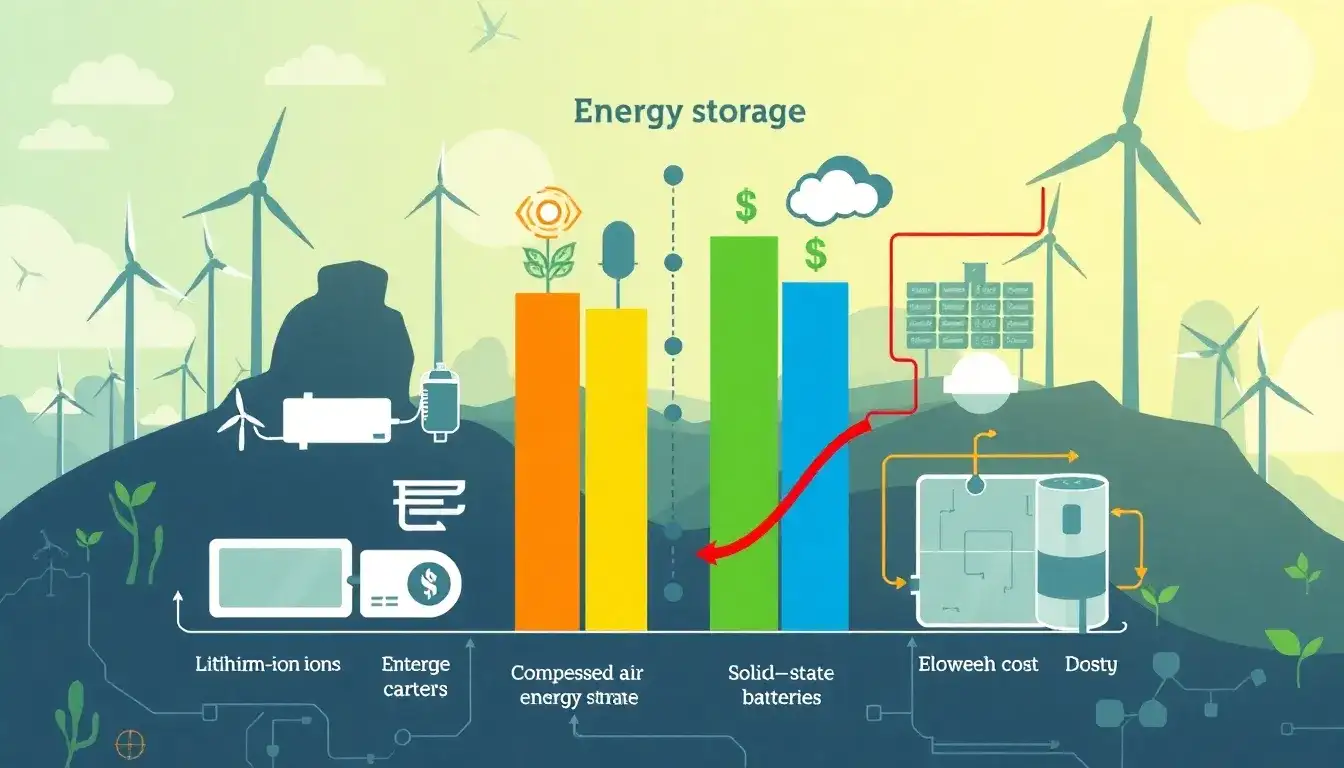
The costs of different energy storage technologies
The costs of different energy storage technologies vary significantly depending on scale, duration, and technology type. Here is a summary comparison based on recent data from authoritative sources:
Cost Per kWh (Installed Cost)
| Technology | Typical Installed Cost (USD/kWh) | Notes |
|---|---|---|
| Lithium-ion batteries (BESS) | Around $385 to $776/kWh (depending on scale) | Costs fell 71% between 2014-2020; residential systems around $776/kWh; utility-scale lower costs (~$385/kWh) |
| Pumped Hydro Storage (PSH) | Approximately $83 to $263/kWh | One of the lowest cost technologies for long durations; $263/kWh for 10-hour, large scale |
| Compressed Air Energy Storage (CAES) | Lowest cost at large scale (~$18 to $122/kWh) | Costs from $18/kWh at small scale up to $122/kWh for large 100 MW system; very competitive for durations ≥4 hours |
| Lead-acid batteries | Around $447/kWh | Higher costs compared to lithium-ion at utility scale |
| Thermal energy storage | Around $73/kWh to $83/kWh | Competitive with PSH, especially at longer durations |
| Hydrogen storage | Higher cost, e.g., $0.35/kWh levelized cost | Higher levelized cost of storage (LCOS) compared to CAES and PSH |
Levelized Cost of Storage (LCOS)
- CAES offers the lowest LCOS (~$0.10/kWh at 1,000 MW and 10-hour duration), closely followed by PSH ($0.11/kWh), and gravitational/storage ($0.13/kWh).
- Lead-acid and hydrogen systems tend to have the highest LCOS, $0.33/kWh and $0.35/kWh respectively.
- Hydrogen systems and thermal storage become more competitive at very long durations.
- Lithium-ion batteries have rapidly declining costs but still remain higher than large-scale mechanical storage for long-duration storage.
Key Trends
- Lithium-ion battery costs have plummeted over the last decade, making them dominant for short to medium duration applications and smaller scale or distributed storage.
- Mechanical storage technologies like pumped hydro and compressed air remain more economical for large scale and long duration storage.
- Thermal and hydrogen storage are promising for very long duration or seasonal storage but currently have higher costs.
- Cost effectiveness depends heavily on the application: duration, scale, and required power capacity influence the choice of technology.
In summary, lithium-ion batteries lead cost reductions and widespread deployment for most applications but are more expensive per kWh compared to pumped hydro, compressed air, and thermal storage for large-scale and longer duration storage. Compressed air and pumped hydro have the lowest cost per kWh for large utility-scale and long-duration storage, with thermal and hydrogen storage becoming more competitive for very long durations. Lead-acid batteries tend to be more costly and less competitive at the utility scale.
Original article by NenPower, If reposted, please credit the source: https://nenpower.com/blog/how-do-the-costs-of-different-energy-storage-technologies-compare-to-each-other/

