

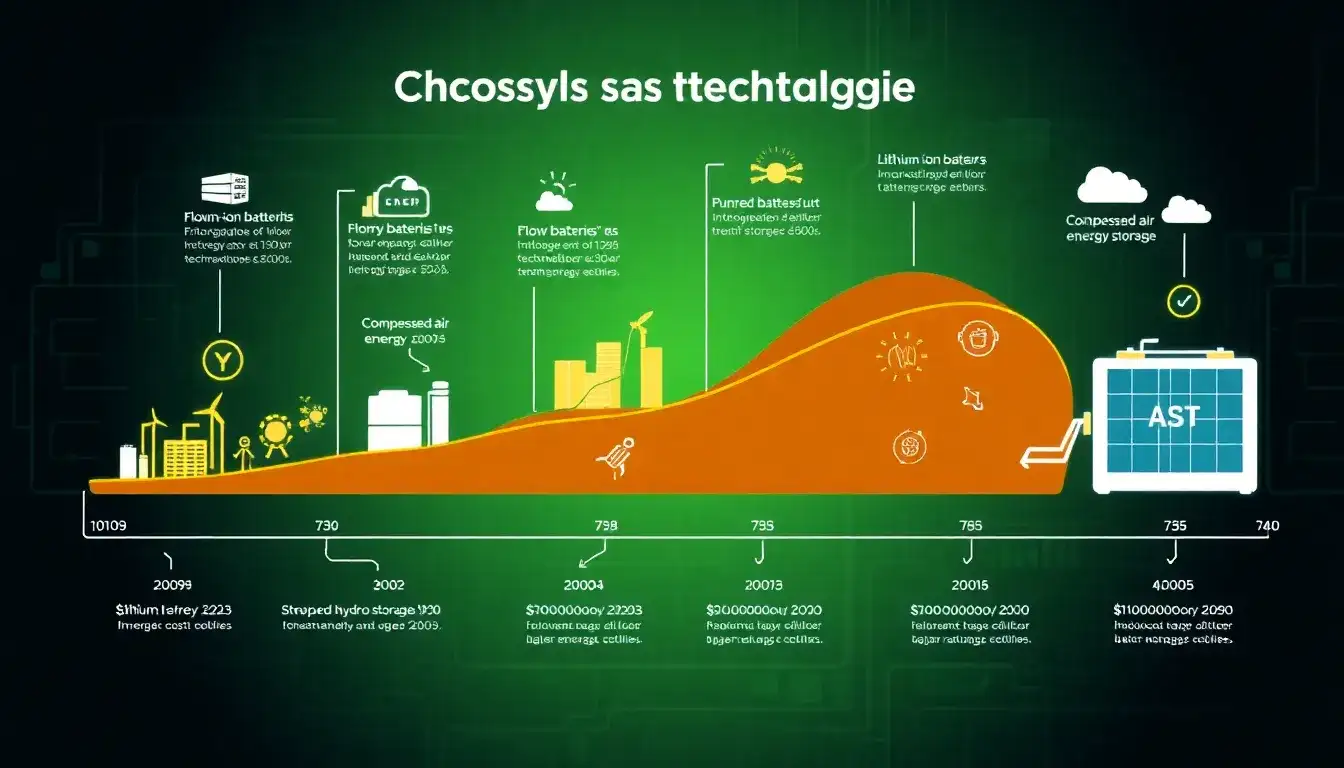
The costs of various energy storage technologies have evolved over time, with some technologies becoming more competitive in certain durations while others continue to face challenges in reducing costs.
Energy Storage Technologies and Costs
Lithium-Ion Batteries
- Cost Trend: Lithium-ion batteries, particularly Li-ion LFP and NMC types, have seen significant cost reductions over the years. However, their costs remain higher than some long-duration energy storage (LDES) technologies for durations exceeding eight hours.
- 2021 Costs: For a 100 MW, 10-hour system, costs were $356/kWh for LFP and $405/kWh for NMC.
- Current Status: Lithium-ion batteries are highly competitive in short to mid-duration applications but face challenges in long-duration storage due to the need for additional power conversion equipment and battery stacks to increase energy capacity.
Compressed Air Energy Storage (CAES)
- Cost Trend: CAES offers competitive costs, especially for longer durations, as expanding energy capacity requires only larger storage caverns.
- Costs: Estimated costs for CAES are lower for longer durations, with an installed cost of $122/kWh at 100 MW, 10-hour systems.
- Current Status: CAES is one of the least expensive LDES technologies, especially in China where it benefits from favorable policies.
Pumped Hydro Storage (PHS)
- Cost Trend: PHS costs are generally low, especially considering its long lifespan and scalability.
- Costs: PHS has total upfront installed costs starting from about $170/kWh.
- Current Status: PHS remains highly competitive for long-duration storage due to its long operational life and fixed upfront costs that scale well with project size.
Thermal Energy Storage
- Cost Trend: Thermal energy storage has shown competitive costs, particularly for long-duration applications.
- Costs: Installed costs are approximately $232/kWh, making it one of the cheapest LDES options.
- Current Status: Thermal storage benefits from low energy-related costs and is cost-competitive with lithium-ion for longer durations.
Other Technologies
- Flow Batteries: These have higher installed costs, typically over $400/kWh, but are well-suited for mid-duration applications.
- Gravitational Storage: This technology has higher costs, often above $600/kWh, limiting its competitiveness in current markets.
Future Outlook
Despite advancements in LDES technologies, lithium-ion batteries continue to benefit from economies of scale driven by adjacent industries like electric vehicles. However, non-lithium technologies, particularly CAES and thermal storage, are increasingly competitive for longer durations and offer opportunities for innovation and investment in regions like Europe and the U.S.
Original article by NenPower, If reposted, please credit the source: https://nenpower.com/blog/how-do-the-costs-of-different-energy-storage-technologies-compare-over-time/

