

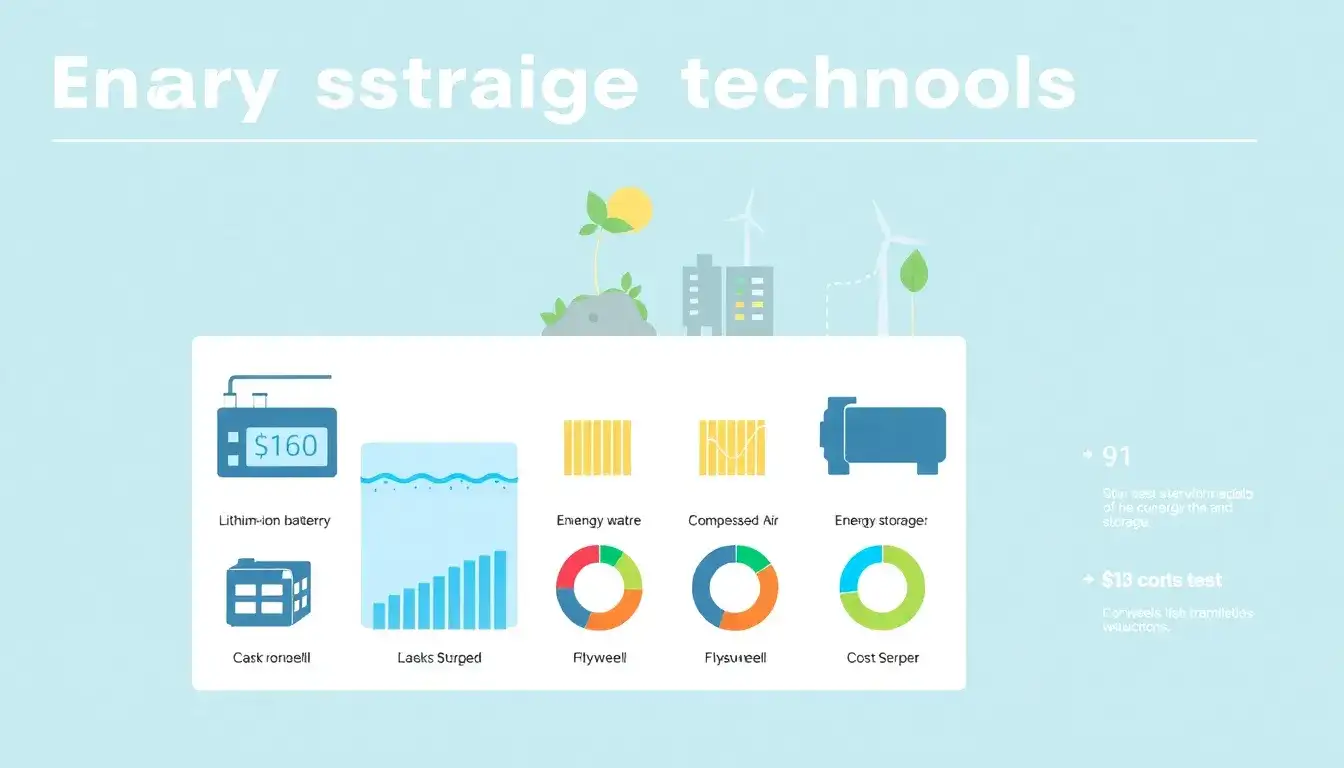
Comparing the costs of different energy storage technologies reveals a diverse landscape, with various technologies suited to different applications and durations. Here’s a summary of the costs associated with several major technologies:
Cost Comparison
| Technology | Cost Range (2022 data or latest) | Description |
|---|---|---|
| Thermal Energy Storage | Approximately $232/kWh | A low-cost option, often used for long-duration storage. It stores heat or cold and is relatively inexpensive compared to other technologies. |
| Compressed Air Energy Storage (CAES) | Approximately $122 to $295/kWh for durations ≥ 4 hours | CAES is very cost-effective, particularly at higher durations, making it one of the lowest-cost options for long-term energy storage. |
| Lithium-ion Batteries (LFP and NMC) | Approximately $356 to $482/kWh | Li-ion batteries have seen significant cost reductions over recent years. LFP and NMC are two types with slightly different chemistries and costs. |
| Pumped Hydro Storage (PSH) | Costs vary but comparable to CAES for long durations | While PSH has high upfront costs, its low operating costs and long lifespan make it competitive over time. It’s one of the largest energy storage technologies globally. |
| Hydrogen Energy Storage | Costs vary, often higher than conventional batteries for short-term use | Hydrogen storage can be cost-effective for very long durations, especially in applications where the hydrogen can be used directly. However, it is currently more expensive for short-term applications. |
| Gravity Storage | Approximately $643/kWh | This technology, though expensive, offers a unique and innovative approach to energy storage by using gravitational forces to generate power. |
| Lead-Acid and Zinc Batteries | Lead-acid: Approximately $409/kWh; Zinc: $449/kWh for smaller systems | These battery types are generally less expensive than Li-ion but have limitations in performance and application. |
| Vanadium Redox Flow Batteries | Approximately $385/kWh for larger systems | Flow batteries offer long-duration energy storage capabilities and are competitive with Li-ion batteries at certain scales. |
Trends and Projections
- Cost Reductions: Many technologies, especially lithium-ion batteries, are expected to see significant cost reductions by 2030 and beyond, with projected drops of 50% to 60%.
- Long-Duration Storage: Technologies like CAES and hydrogen become more cost-effective at longer durations, supporting grid stability over extended periods.
In summary, thermal and compressed air energy storage are currently among the cheapest options, while lithium-ion batteries dominate in terms of widespread deployment due to their versatility and declining costs. Pumped hydro storage remains a stalwart for long-term energy storage due to its scalability and reliability.
Original article by NenPower, If reposted, please credit the source: https://nenpower.com/blog/how-do-the-costs-of-different-energy-storage-technologies-compare/

