

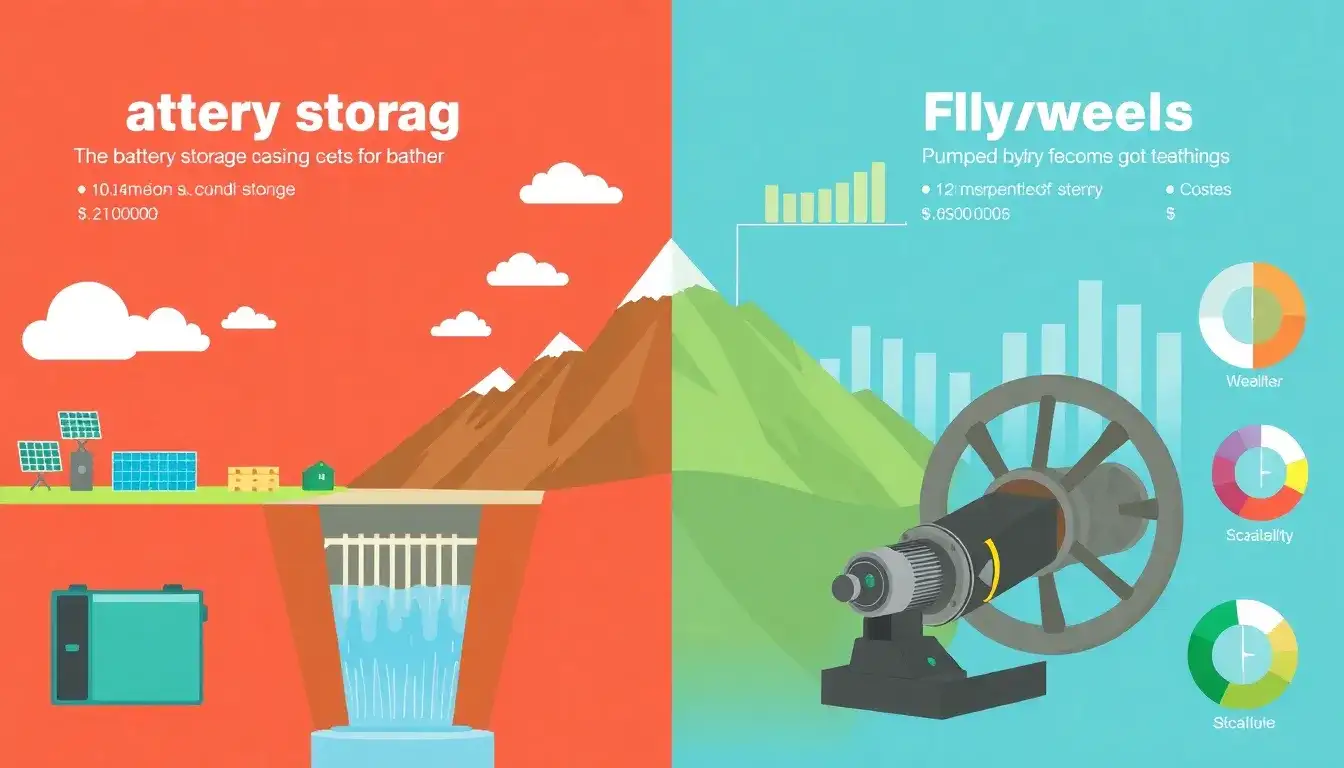
When comparing the costs of battery storage systems to traditional energy storage technologies like pumped hydro or flywheels, several factors come into play:
Battery Storage Systems
Lithium-ion Batteries
- Cost: As of recent projections, the cost of utility-scale lithium-ion batteries for 4-hour storage systems ranges from approximately $245/kWh to $403/kWh by 2030 and $159/kWh to $348/kWh by 2050. For home batteries, the cost is typically between $1,000 to $1,500 per kWh when professionally installed.
- Advantages: Lithium-ion batteries offer flexibility in application (e.g., both utility-scale and home storage), rapid deployment, and improving economies of scale.
- Disadvantages: Lithium-ion technology has scalability limitations for very long-duration storage compared to traditional methods.
Other Battery Technologies
- Flow Batteries: While their cost is higher than lithium-ion, they are gaining traction for long-duration storage, though still less cost-competitive outside of China.
- Sodium-Sulfur (NAS) Batteries: High-temperature technology that also faces challenges in cost reduction.
Traditional Energy Storage Technologies
Pumped Hydro Storage (PHS)
- Cost: PHS remains one of the most cost-effective long-duration energy storage solutions, especially suitable for large-scale storage needs.
- Advantages: Offers high energy storage capacity, reliability, and environmental benefits.
- Disadvantages: Limited by geography (requires suitable terrain) and high upfront costs for infrastructure development.
Flywheels
- Cost: Generally more expensive than batteries and PHS, with high capital costs due to technology and energy efficiency limitations.
- Advantages: Fast response times and suitable for grid stabilization services.
- Disadvantages: Limited capacity for long-duration storage.
Compressed Air Energy Storage (CAES)
- Cost: Currently, CAES costs are higher than lithium-ion for short durations but competitive for long-duration storage, with averages around $293/kWh.
- Advantages: Can be viable for long-duration storage and suitable for integration with existing infrastructure.
- Disadvantages: Requires specific geological conditions and faces efficiency losses during the energy conversion process.
Thermal Energy Storage
- Cost: Among the cheapest long-duration energy storage technologies, with costs around $232/kWh.
- Advantages: Highly flexible in application (cooling or heating) and can be cost-effective for specific industrial or building-scale uses.
- Disadvantages: Often requires specific conditions or infrastructure like cooling systems for optimal operation.
Comparison Summary
| Technology | Cost Range | Advantages | Disadvantages |
|---|---|---|---|
| Lithium-ion Batteries | $245-$403/kWh (utility), $1,000-$1,500/kWh (home) | Flexible, improving economies of scale | Scaling limitations, cost variability |
| Pumped Hydro Storage | Highly dependent on infrastructure | Large-scale, reliable, environmental benefits | Limited geography, high upfront costs |
| Flywheels | Generally expensive, high capital costs | Fast response, grid stabilization | Limited capacity, high cost |
| Compressed Air Storage | $293/kWh (average) | Suitable for long-duration, infrastructure integration | Efficiency losses, specific geology required |
| Thermal Energy Storage | $232/kWh (average) | Flexible, cost-effective for specific uses | Requires specific conditions or infrastructure |
In summary, while lithium-ion batteries offer flexibility and improving costs, traditional technologies like pumped hydro storage and thermal energy storage often provide more cost-effective solutions for long-duration energy storage when specific conditions are met. Other technologies, like flywheels and compressed air storage, have niche applications based on their characteristics.
Original article by NenPower, If reposted, please credit the source: https://nenpower.com/blog/how-do-the-costs-of-battery-storage-systems-compare-to-traditional-energy-storage-technologies-like-pumped-hydro-or-flywheels/

