

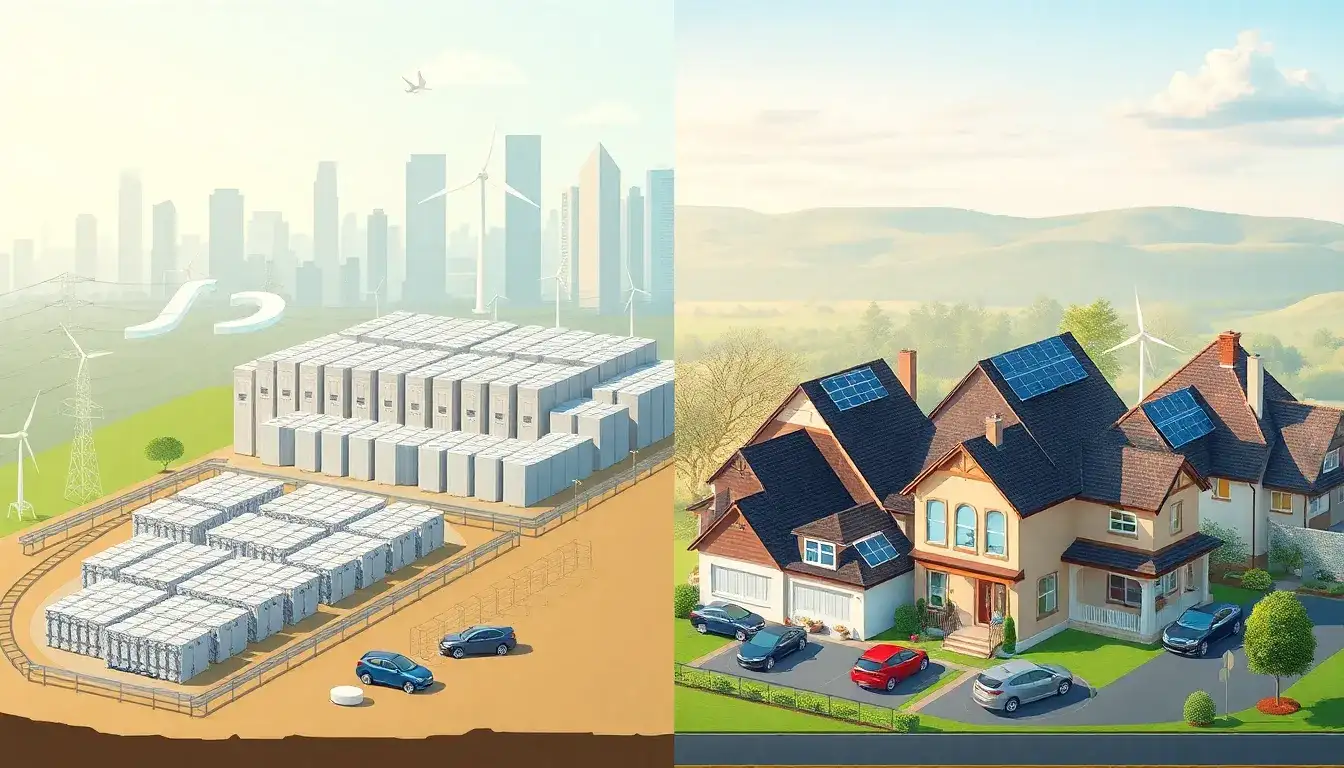
Cost projections for battery storage systems vary significantly between utility-scale and residential applications due to differences in scale, technology, and market dynamics.
Utility-Scale Battery Storage
Key Points:
- Costs: Utility-scale battery energy storage systems (BESS) are generally cheaper per kilowatt-hour (kWh) due to economies of scale. For 4-hour duration systems, costs in 2022 were around $482/kWh, projected to decrease to $159/kWh, $226/kWh, and $348/kWh by 2050 under different scenarios.
- Technological Improvements: Cost decreases are driven primarily by advancements in battery cell technology, with a focus on lithium-ion batteries. The cost reductions are also influenced by optimization in manufacturing and economies of scale across sectors like electric vehicles and consumer electronics.
- Durations and Costs: Longer-duration systems (e.g., 10 hours) tend to be cheaper per kWh because the cost of energy storage increases less than the cost of power components. However, shorter-duration systems are more cost-effective per kW.
- Market Incentives: Utility-scale projects benefit from large-scale incentives, such as tax credits, which can further reduce costs.
Residential Battery Storage
Key Points:
- Costs: Residential battery systems are generally more expensive, with costs that have historically been higher than utility-scale systems. For instance, in Germany, residential lithium-ion battery prices decreased to about $776/kWh between 2014 and 2020.
- Technological Variety: While lithium-ion batteries dominate both sectors, residential systems may be influenced by smaller-scale innovations and consumer demand patterns.
- Market Dynamics: Residential systems are more localized and subject to individual consumer purchasing decisions rather than the large-scale deployment strategies of utilities.
- Incentives: Residential users may benefit from localized incentives or subsidies, but these are typically less substantial on a per-unit basis compared to utility-scale projects.
In summary, utility-scale battery storage benefits from economies of scale, broader technological advancements, and larger incentives, leading to lower costs per kWh. Residential battery storage, while also decreasing in cost, remains more expensive per unit and is influenced by consumer markets and localized incentives.
Original article by NenPower, If reposted, please credit the source: https://nenpower.com/blog/how-do-the-cost-projections-for-battery-storage-systems-differ-between-utility-scale-and-residential-applications/

