

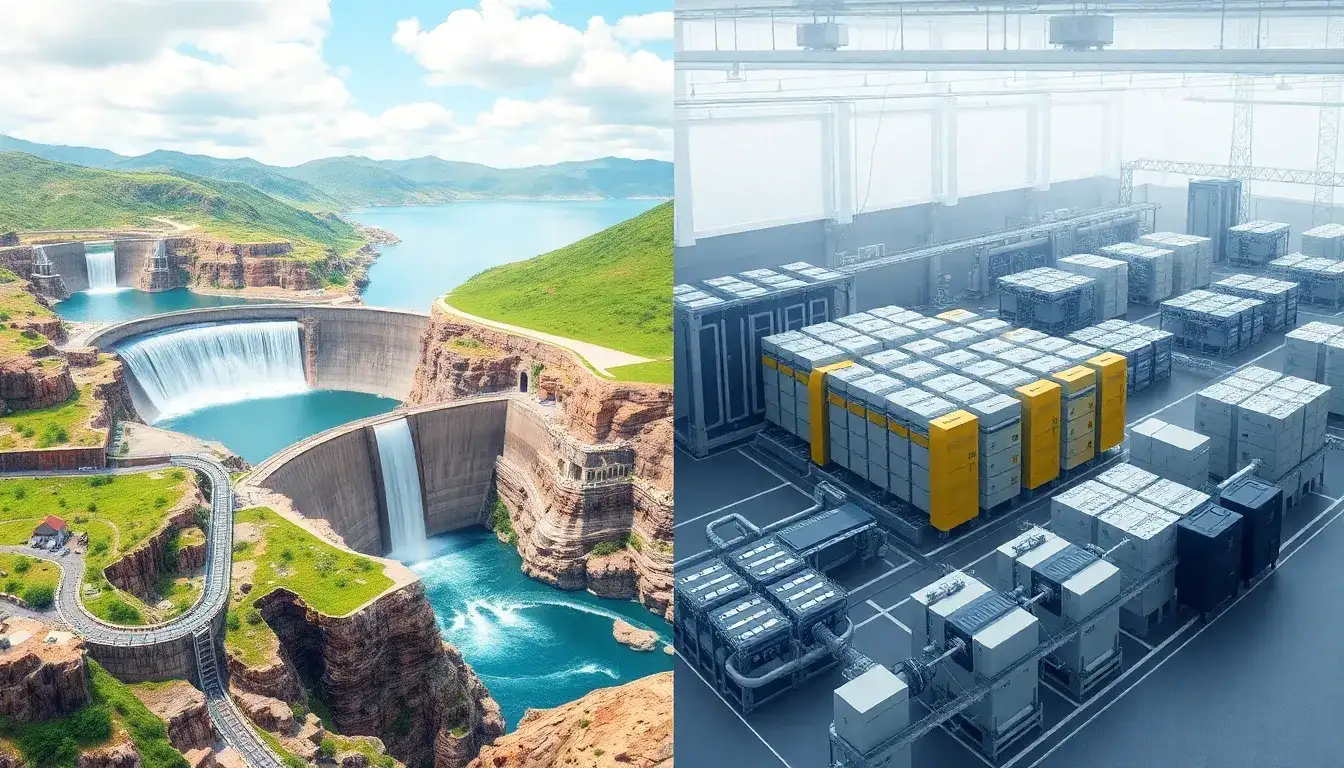
The construction requirements for pumped hydroelectric storage (PHS) systems and lithium-ion batteries differ significantly in several key areas:
1. Site Selection and Land Use
- Pumped Hydroelectric Storage (PHS): PHS requires extensive land for the construction of two reservoirs, which are typically man-made for closed-loop systems to minimize environmental impacts. The site must have suitable topography, geology, and proximity to power transmission lines.
- Lithium-ion Batteries: These can be constructed in almost any location, from small urban areas to large industrial sites, as they have a much smaller footprint compared to PHS systems.
2. Technical Infrastructure
- PHS: Involves complex engineering and construction of dams, reservoirs, penstocks, turbines, and generators. The hydraulic system must be robustly designed to handle various hydrological conditions, including floods and droughts.
- Lithium-ion Batteries: Primarily consists of manufacturing cells, assembling modules, and integrating them into systems. The technical infrastructure is less complex and involves more standardized components.
3. Environmental Considerations
- PHS: Has significant environmental implications due to the alteration of ecosystems by creating large reservoirs, which can affect biodiversity and water quality. However, it offers a renewable energy source.
- Lithium-ion Batteries: Also raises environmental concerns due to the use of lithium and other materials. However, they are modular and can be recycled, reducing their overall environmental footprint compared to large infrastructure projects like PHS.
4. Cost and Efficiency
- PHS: Offers high round-trip efficiency (around 80%) but requires substantial upfront investment due to the construction of reservoirs and infrastructure. The cost per kilowatt-hour of storage is generally lower over the lifecycle.
- Lithium-ion Batteries: Are more expensive per kilowatt-hour of storage but have the advantage of being scalable and deployable in a variety of settings. Their efficiency is also high but varies based on the application.
5. Scalability and Flexibility
- PHS: Provides massive energy storage but is limited by geography and environmental impacts, making scalability challenging.
- Lithium-ion Batteries: Are highly scalable and can be deployed in small to large capacities, providing flexibility in energy storage solutions.
In summary, while both technologies serve as energy storage solutions, PHS involves large-scale infrastructure projects with significant environmental and geographical considerations, whereas lithium-ion batteries offer modular, scalable storage solutions with different environmental and technical challenges.
Original article by NenPower, If reposted, please credit the source: https://nenpower.com/blog/how-do-the-construction-requirements-of-pumped-hydroelectric-storage-systems-differ-from-those-of-lithium-ion-batteries/

