

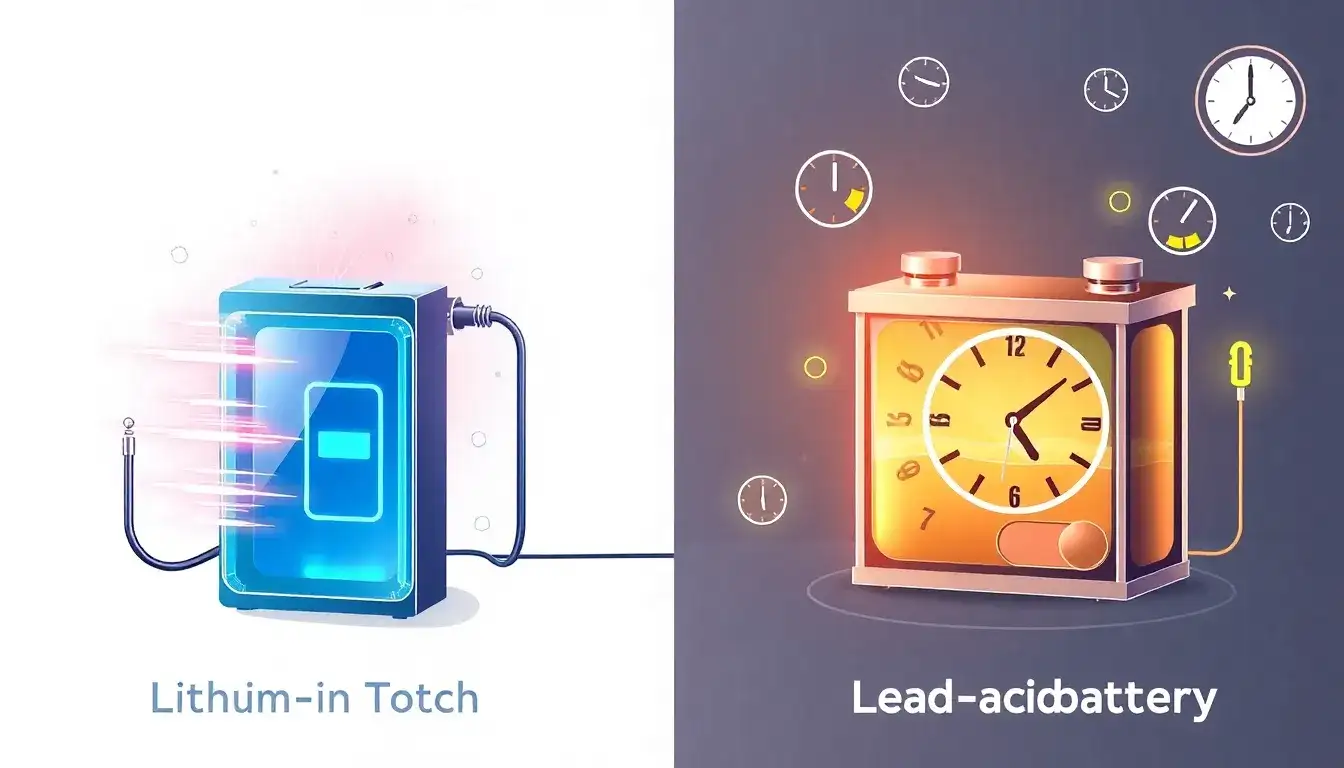
Comparison of Charging Times: Lithium-Ion vs Lead-Acid Batteries
Overview:
- Lithium-Ion Batteries are known for their faster charging capabilities compared to lead-acid batteries. They support rapid charging and can often be charged to 80-90% capacity quickly, which suits applications where battery usage time is crucial.
- Lead-Acid Batteries have traditionally been used for longer charge cycles and require more time to reach full capacity. Their slower charging rate is due to a less efficient design and a need to prevent overheating during charging.
Key Differences in Charging
1. Charging Speed:
- Lithium-Ion: Can achieve a full charge in significantly less time than lead-acid batteries. For example, some lithium-ion batteries can charge from 0% to 100% in about one hour at a 1C rate (like NMC types), while others (like LFP) might take about 1.5 to 2 hours at .5 to .8C rates.
- Lead-Acid: Generally takes longer to charge fully. They often require several hours to achieve a full charge and may need to be charged slowly to maintain health and longevity.
2. Charging Efficiency and Power Delivery:
- Lithium-Ion: Offers better power density and efficiency, delivering more energy relative to their size compared to lead-acid batteries.
- Lead-Acid: Has lower power density and efficiency, needing more bulk to deliver the same energy as lithium-ion batteries.
3. Charging Practices:
- Lithium-Ion: Often use opportunity charging, where batteries are charged briefly during downtime, reducing the need for complete charge cycles. This method keeps batteries healthy and extends their lifespan.
- Lead-Acid: Typically require full charge cycles to maintain capacity and reduce internal resistance over time.
4. Longevity:
- Lithium-Ion: Tend to last longer in terms of charge-discharge cycles, often exceeding 1,000 cycles while maintaining a significant portion of their initial capacity.
- Lead-Acid: Generally have shorter lifespans and may need replacement after 200-400 cycles depending on usage and maintenance.
In summary, lithium-ion batteries charge faster and offer more efficient use of energy compared to lead-acid batteries, making them a preferred choice for applications requiring rapid charging and high energy density. However, the choice between these technologies also depends on factors like cost, intended use, and maintenance requirements.
Original article by NenPower, If reposted, please credit the source: https://nenpower.com/blog/how-do-the-charging-times-of-lithium-ion-batteries-compare-to-lead-acid-batteries/

