

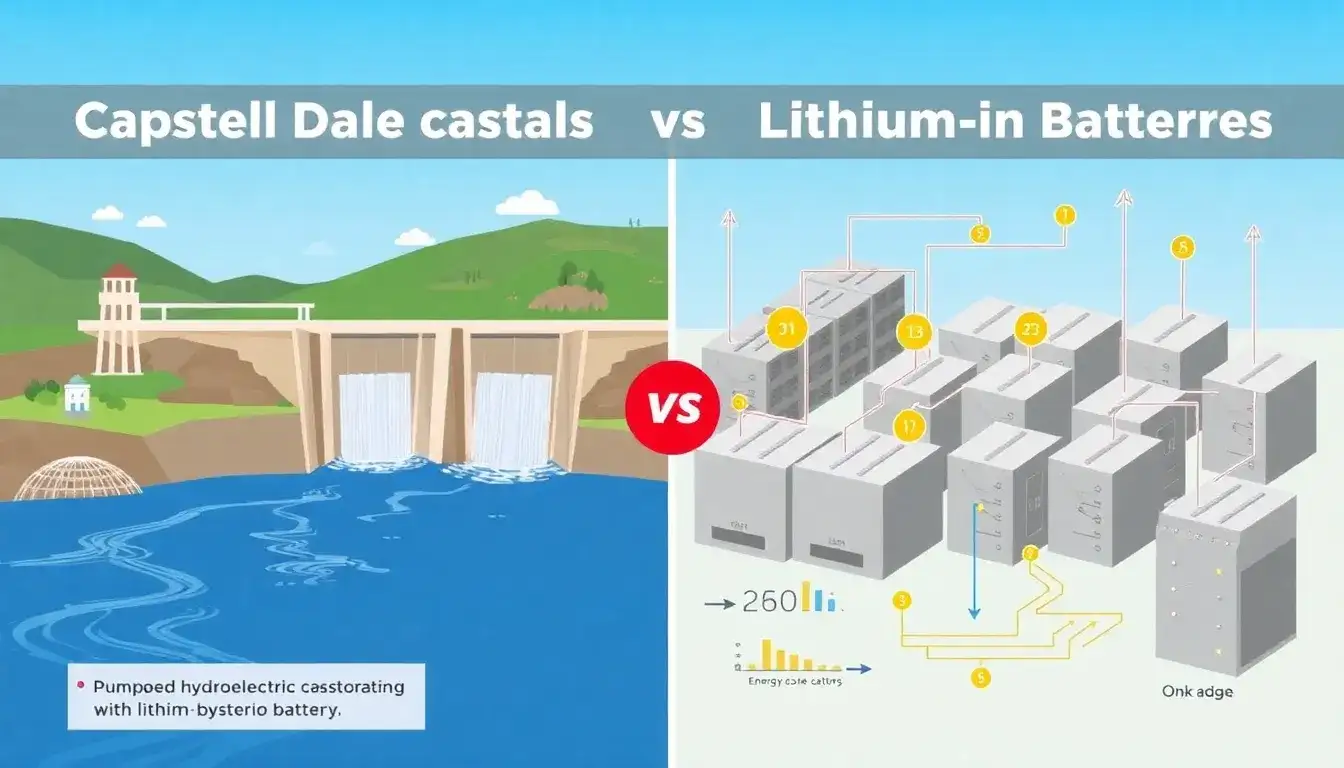
The capital costs of pumped hydroelectric storage (PHS) and lithium-ion batteries differ significantly, primarily due to scale, technology, and use case characteristics.
Pumped Hydroelectric Storage (PHS) Capital Costs:
- According to multiple sources from the National Renewable Energy Laboratory (NREL) and other studies, the installed capital cost of pumped storage hydro projects is roughly around $2,650 to $3,070 per kilowatt (kW) capacity in 2020 USD (or about $1,800/kW for smaller commercial and industrial scale projects, depending on specific site characteristics).
- When converted to energy capacity (considering typical durations like 10 hours), the cost can be in the range of approximately $104/kWh to $165/kWh.
- These costs include reservoir construction, tunnels, powerhouse excavation, equipment, balance of plant, and project management fees.
- PHS capital cost models include project contingency adjustments, often around 33%, to align with industry standards.
Lithium-ion Batteries Capital Costs:
- While the search results do not give direct capital cost figures for lithium-ion batteries, industry data outside these results typically show lithium-ion battery energy storage systems (BESS) capital costs are generally lower on a $/kW basis but higher on a $/kWh basis for long duration. Recent estimates (circa 2023) suggest lithium-ion battery capital costs range roughly between $300 to $500 per kWh of energy capacity, with power capacity costs around $400 to $600/kW depending on scale and application, but this varies.
- Lithium-ion batteries have advantages in modularity, fast response, and ease of installation but are typically more expensive than PHS for long-duration, multi-hour storage.
Comparison Summary:
| Feature | Pumped Hydroelectric Storage | Lithium-ion Batteries |
|---|---|---|
| Capital cost per kW | ~$1,800 to $3,070 per kW (installed) | ~$400 to $600 per kW |
| Capital cost per kWh | ~$104 to $165 per kWh (for ~10-hour duration) | ~$300 to $500+ per kWh (varies) |
| Typical duration | Long duration (~10 hours and more) | Short to medium duration (1–4 hours typical) |
| Scale and longevity | Very large scale, 40–60+ years lifespan | Smaller scale, 10–15 years typical lifespan |
| Site dependency | Requires suitable geography and large reservoirs | Modular and deployable anywhere |
In essence, pumped hydro is generally more capital-intensive upfront in terms of total project size but offers a lower cost per energy stored for long durations, making it cost-effective for bulk energy storage. Lithium-ion batteries have lower power capacity capital costs but higher energy capacity costs for longer storage durations, making them more suited to shorter duration and distributed energy storage applications.
Thus, for large-scale, long-duration energy storage, pumped hydro tends to have a cheaper capital cost per kWh despite the high initial capital cost per kW, whereas lithium-ion batteries are more capital-intensive per kWh for long durations but better for flexibility and shorter duration needs.
Original article by NenPower, If reposted, please credit the source: https://nenpower.com/blog/how-do-the-capital-costs-of-pumped-hydroelectric-storage-and-lithium-ion-batteries-compare/

