

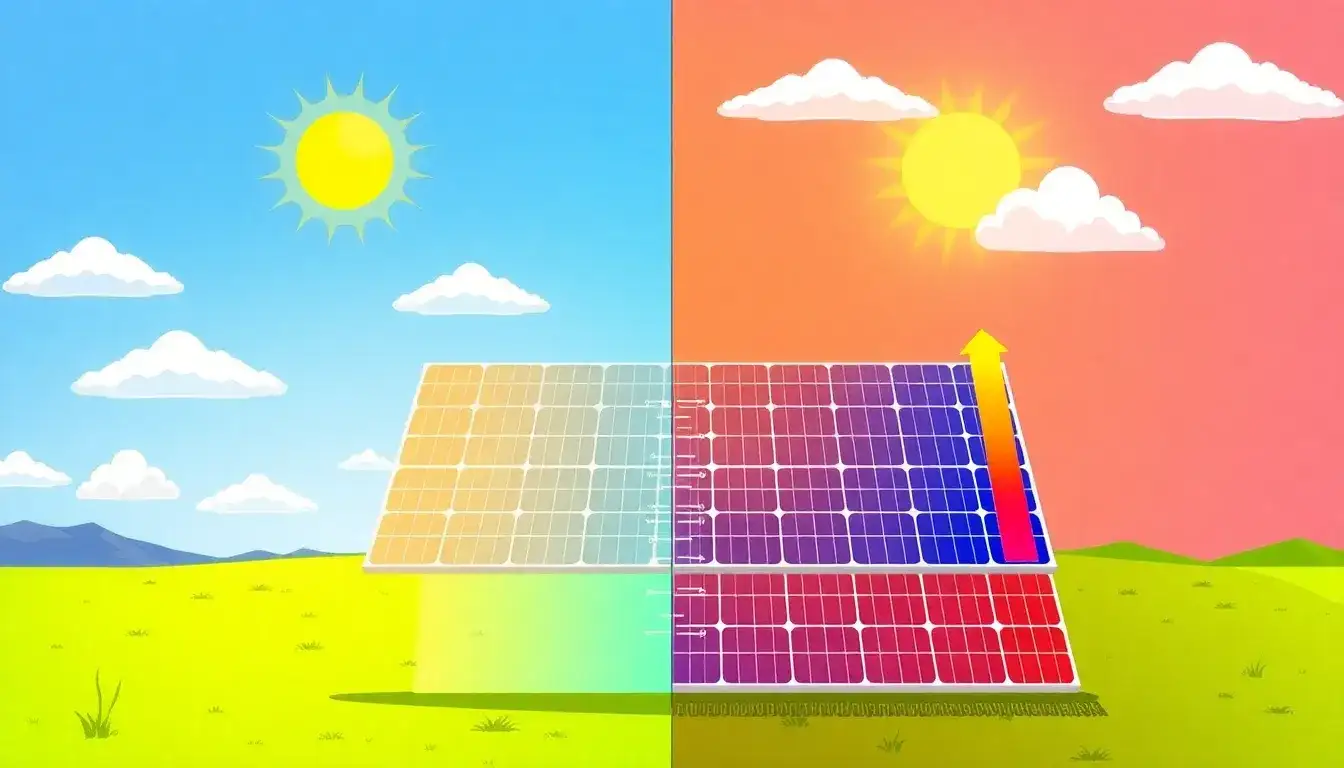
Temperature coefficients have a direct and measurable impact on solar panel efficiency by quantifying how much a solar panel’s power output decreases as its temperature rises above the standard testing condition of 25°C (77°F). This coefficient is typically expressed as a percentage loss in efficiency per degree Celsius increase in temperature.
Effect of Temperature Coefficient on Solar Panel Efficiency
- The temperature coefficient indicates the rate at which a solar panel’s power output declines for every 1°C rise above 25°C. For example, a temperature coefficient of -0.38% per °C means the panel loses 0.38% of its power output for each degree above 25°C.
- Since solar panels often operate at temperatures higher than ambient air temperature due to direct sunlight (sometimes reaching 60°C or more), this can result in a noticeable efficiency reduction. On a hot summer day, panels might lose 10-15% of their rated power output compared to their efficiency at 25°C.
- Conversely, solar panels perform better in cooler conditions, so for every degree below 25°C, efficiency increases by the coefficient percentage. For instance, solar panels may produce 5-7% more power at 0°C than at 25°C.
- The negative value of the temperature coefficient reflects that efficiency decreases as temperature rises — this is mostly due to physical effects in the solar cells: a decrease in open-circuit voltage, slight increase in current, increased recombination of charge carriers, and increased internal resistance.
Typical Values and Variations
- Most crystalline silicon solar panels have temperature coefficients ranging from about -0.3% to -0.5% per °C. Premium panels, such as SunPower or Maxeon, have slightly better coefficients around -0.29% to -0.38% per °C.
- Thin-film solar panels generally have lower temperature coefficients (closer to -0.2% per °C), meaning they lose less efficiency with heat compared to crystalline silicon panels.
Practical Implications
- For an example panel with a -0.38% per °C coefficient, if the panel surface reaches 35°C (10°C above standard test conditions), efficiency drops by roughly 3.8%.
- Even though higher temperatures reduce efficiency, solar panels still generate significant power on hot days due to higher sunlight intensity and longer daylight hours, but the relative efficiency loss should be factored into energy yield estimates.
- Factors influencing the actual panel temperature, and thus the efficiency loss, include installation type (angled vs. flat mounting), geographic location, roofing material, and shading.
- Roofing materials that reflect heat well (like metal roofs) can help keep panels cooler and minimize efficiency losses.
Summary Table of Temperature Coefficient Effects
| Aspect | Explanation |
|---|---|
| Temperature coefficient value | Typically -0.3% to -0.5% per °C for silicon panels; ~-0.2% for thin-film |
| Efficiency impact | Efficiency decreases by coefficient % per °C above 25°C; increases by same % per °C below 25°C |
| Physical cause | Decreased voltage, increased recombination, increased resistance at higher temp |
| Practical effect | 10-15% power loss on very hot days; small gains in cold weather |
| Mitigation | Use panels with better coefficients, optimize installation for ventilation, reflective roofing |
In conclusion, the temperature coefficient is a key factor in understanding and predicting solar panel performance in varying thermal conditions. It explains why solar panels perform best in cooler weather despite sunlight intensity and why high temperatures can reduce their efficiency even on sunny days.
Original article by NenPower, If reposted, please credit the source: https://nenpower.com/blog/how-do-temperature-coefficients-affect-solar-panel-efficiency/

