

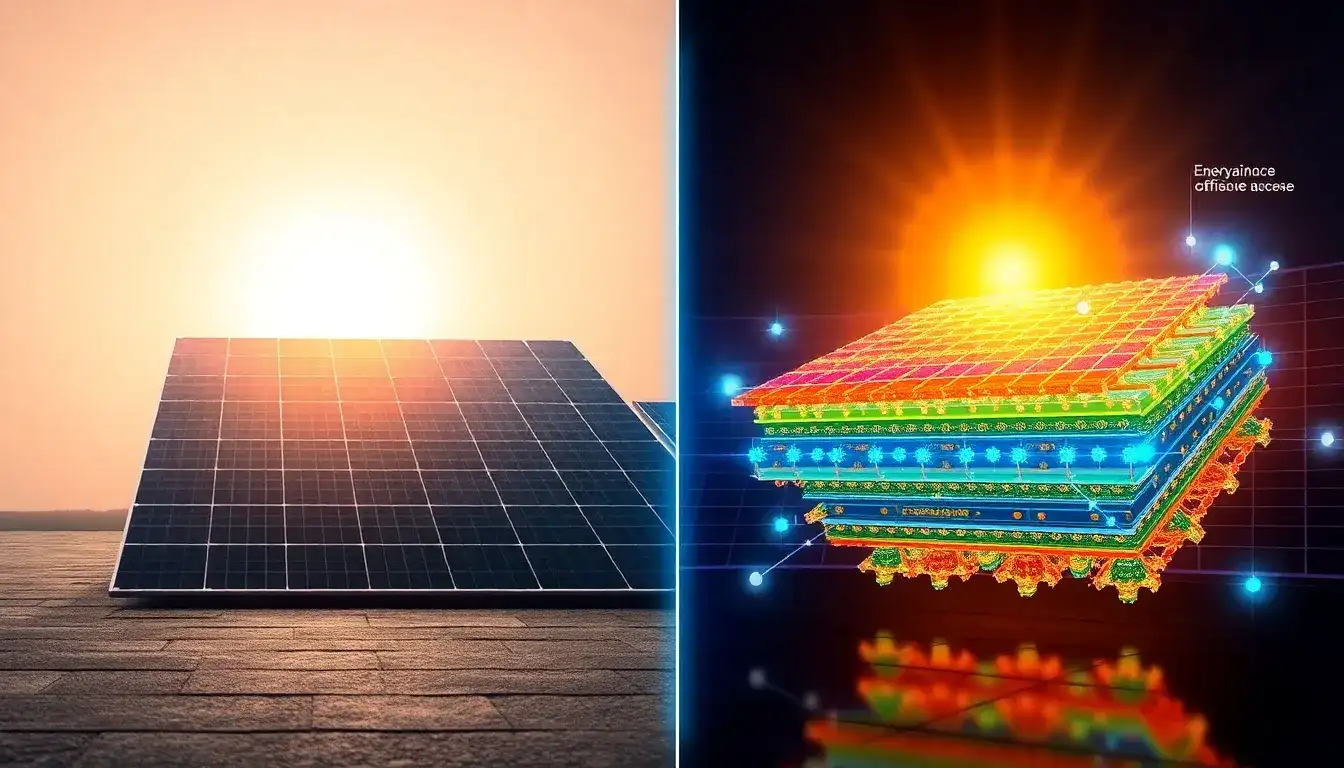
Efficiency and Lifespan Comparison: Perovskite-Silicon Tandem Cells vs. Traditional Silicon-Based Panels
Efficiency
- Perovskite-Silicon Tandem Cells: These cells have achieved remarkable efficiency records, with a recent high of 34.6% by Longi in June 2024 and another notable achievement of 28.6% by Qcells in December 2024. This is significantly higher than traditional silicon-based panels, which typically reach efficiencies up to 23-25% under optimal conditions.
- Traditional Silicon-Based Panels: While highly reliable and widely used, traditional silicon panels have lower efficiency compared to perovskite-silicon tandem cells. Their efficiency is typically capped at around 23-25% due to the Shockley-Queisser limit, although some high-efficiency modules can reach slightly higher figures.
Lifespan
- Perovskite-Silicon Tandem Cells: While perovskite materials are still developing in terms of stability, combining them with silicon significantly enhances their lifespan. Perovskite-silicon tandem cells are expected to perform well over a longer period, although exact lifespan data is still evolving. A conservative estimate assumes a lifespan of at least 15 years for perovskite-based tandem devices.
- Traditional Silicon-Based Panels: These panels have a well-documented lifespan of approximately 30 years or more, making them very reliable for long-term energy production. The durability and consistency of silicon panels are key factors in their widespread adoption.
Conclusion
Perovskite-silicon tandem cells offer higher efficiency than traditional silicon panels but still face challenges related to long-term stability. However, they represent a promising direction for improving solar technology by combining the efficiency advantages of perovskites with the durability of silicon.
Original article by NenPower, If reposted, please credit the source: https://nenpower.com/blog/how-do-tandem-cells-combining-perovskite-and-silicon-compare-to-traditional-silicon-based-panels-in-terms-of-efficiency-and-lifespan/

