

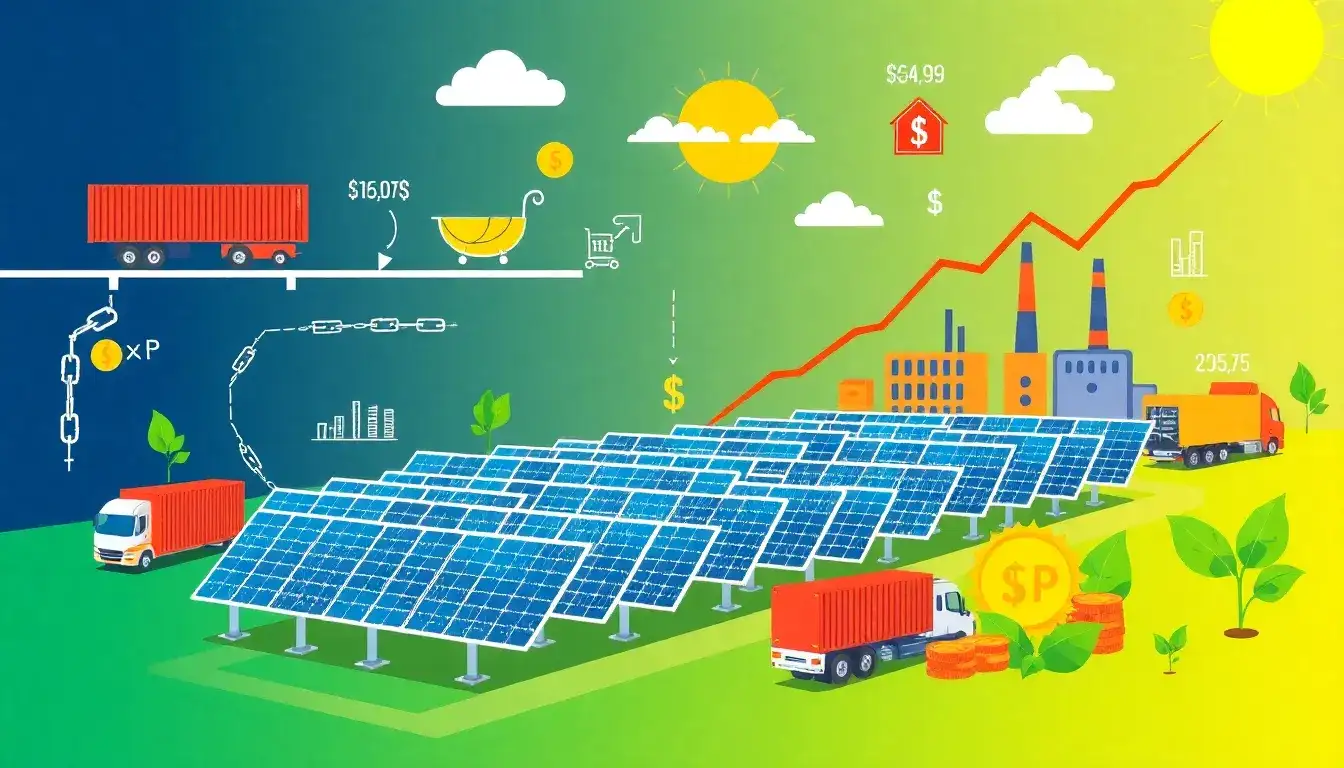
Supply chain issues significantly impact the overall cost of solar projects through several interrelated factors:
1. Increased Manufacturing Costs
- The solar supply chain is heavily concentrated in China, which controls most of the polysilicon production—a critical raw material for solar panels. This concentration creates a bottleneck and makes global solar panel manufacturing dependent on one region.
- China’s production relies heavily on fossil fuels, raising the cost to offset environmental impacts, and this dependency increases the cost base for manufacturing solar cells and modules.
- Electricity costs represent a large portion of production expenses (over 40% for polysilicon and nearly 20% for wafers and ingots). China has relatively low electricity prices, making manufacturing worldwide outside China more expensive, particularly in the U.S. and Europe where energy costs are higher.
2. Trade Restrictions and Tariffs
- Trade policies, including import taxes and tariffs (such as those imposed by the U.S. on solar cells and modules), add to the price by increasing the cost of imported solar materials and panels.
- The increase in antidumping, countervailing, and import duties on solar materials has risen sharply since 2011, now affecting 15% of global solar demand outside China, which raises costs and slows deployment.
- Tariffs aimed at protecting domestic manufacturers can paradoxically raise prices if domestic manufacturing cannot scale efficiently or compete on price with imports, causing supply bottlenecks and delays.
3. Supply Chain Bottlenecks and Delays
- Geopolitical tensions, natural disasters, and labor shortages disrupt the global supply chain. These disruptions delay deliveries and increase logistics costs, which are passed on to solar projects.
- Since China dominates global solar panel shipping, any disruption in shipping increases costs internationally.
- Delays from supply chain bottlenecks have recently contributed to about a 20% increase in solar panel prices worldwide, directly elevating project costs.
4. Limited Domestic Manufacturing and Higher Costs
- Countries like the U.S. have rapidly expanded solar manufacturing capacity, but still face shortages in critical segments like silicon ingots, wafers, and crystalline cells. This forces reliance on imports, which are subject to tariffs and shipping costs.
- Domestic production costs tend to be higher due to factors such as labor shortages, high interest rates, and more expensive energy, making domestic manufacturing less competitive without subsidies or incentives.
Summary Table of Supply Chain Impacts on Solar Project Costs
| Supply Chain Issue | Impact on Solar Project Costs |
|---|---|
| Concentration in China | Limited diversification raises risk and cost due to dependence on one region |
| High electricity and labor costs | Raises production costs outside low-cost regions |
| Tariffs and import taxes | Adds to cost of imported materials and panels, may slow manufacturing growth |
| Supply chain disruptions | Causes delays and higher logistics expenses |
| Limited domestic manufacturing | Higher costs and potential bottlenecks prevent scaling up affordable solar supply |
Conclusion
Supply chain issues increase the overall cost of solar projects by elevating material and manufacturing expenses, adding tariffs, causing delays, and limiting the availability of competitively priced domestic solar components. These challenges raise project costs and can slow the pace of solar deployment unless addressed through diversified production, supportive policies, and efforts to make manufacturing cleaner and more resilient.
Original article by NenPower, If reposted, please credit the source: https://nenpower.com/blog/how-do-supply-chain-issues-impact-the-overall-cost-of-solar-projects/

