

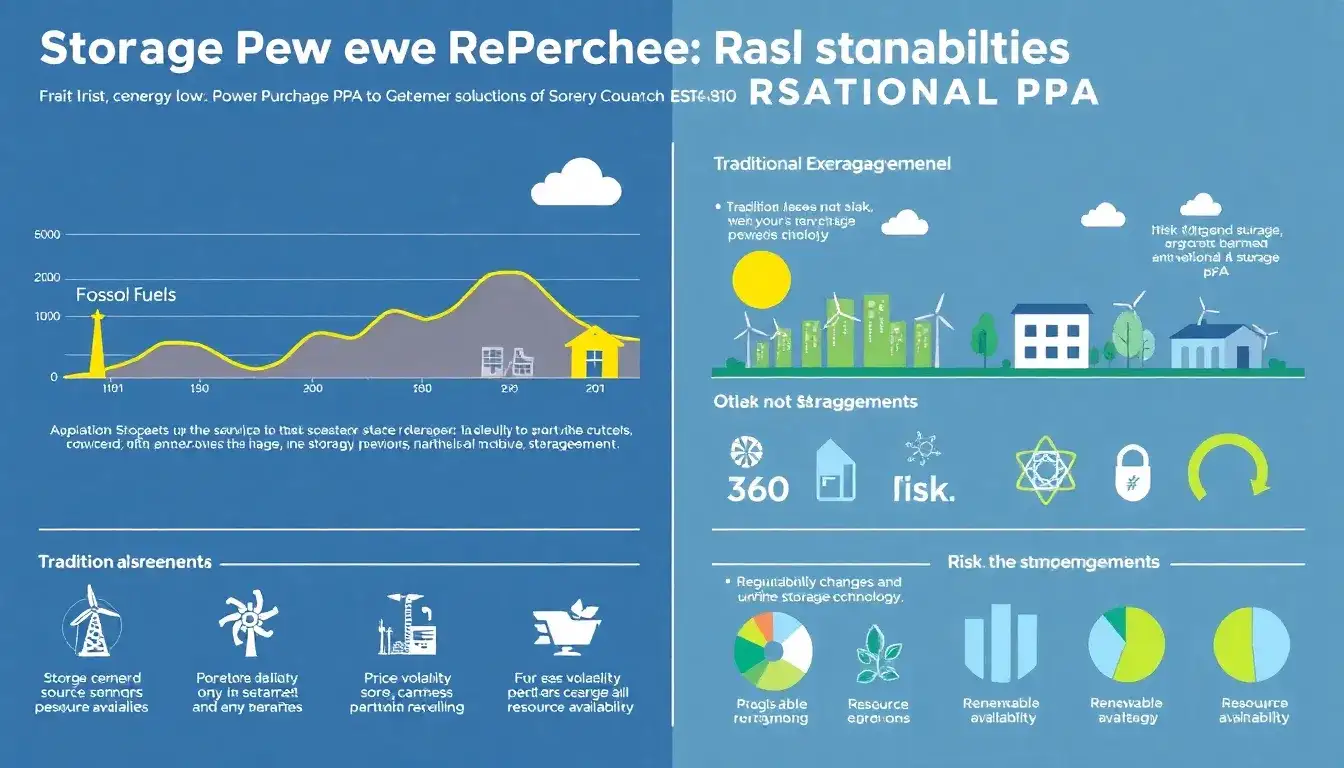
Storage PPAs and Traditional PPAs
Storage PPAs and traditional PPAs differ in their approach to risk management, primarily due to the nature of the services they provide and the technologies involved.
Traditional PPAs
Traditional PPAs focus on electricity generation from sources like solar or wind. They typically involve a straightforward sale of electricity at a set price, often with fixed terms to mitigate price volatility in the energy market. However, they do not include the storage component, which means they lack the flexibility to manage peak demand or stabilize grid frequency.
Risk Management in Traditional PPAs:
- Price Risk: Mitigated by fixed pricing terms.
- Volume Risk: Ensured through guaranteed offtake agreements.
- Counterparty Risk: Managed through credit checks and financial guarantees.
- Operational Risk: Generally handled by the generator, but not inclusive of storage services.
Storage PPAs
Storage PPAs, on the other hand, involve contracts for energy storage services, which can include energy arbitrage, peak shaving, frequency regulation, and backup power. These agreements offer more complex risk management strategies by providing a buffer against energy price volatility and grid stability issues.
Risk Management in Storage PPAs:
- Price Risk: Managed through predictable pricing for storage services, helping offtakers budget more effectively.
- Volume Risk: Addressed by ensuring consistent energy supply during periods of high demand or low generation.
- Operational Risk: Includes considerations for the degradation of storage technologies and their maintenance over time.
- Counterparty Risk: Similar to traditional PPAs, but can be influenced by complex technological aspects of storage systems.
- Market and Regulatory Risks: Storage PPAs often involve multiple revenue streams and are impacted by regulatory changes that affect their economic viability.
Comparison Summary
| Aspect | Traditional PPAs | Storage PPAs |
|---|---|---|
| Services | Focus on electricity generation | Focus on storage services like arbitrage, peak shaving, etc. |
| Price Risk | Fixed pricing to mitigate market volatility | Predictable pricing for storage services |
| Operational Complexity | Limited to generation operations | Includes maintenance and degradation considerations of storage systems |
| Flexibility | Less flexible in managing peak demand or frequency | Offers flexibility in managing peak demand and grid stability through various services |
| Regulatory Risks | Less affected by storage-specific regulations | More exposed to changes in storage and ancillary service regulations |
In summary, while traditional PPAs manage risks related to electricity generation, storage PPAs offer additional risk management strategies through their flexibility and ability to stabilize the grid, but they also introduce complexities related to technology and regulation.
Original article by NenPower, If reposted, please credit the source: https://nenpower.com/blog/how-do-storage-ppas-compare-to-traditional-ppas-in-terms-of-risk-management/

