

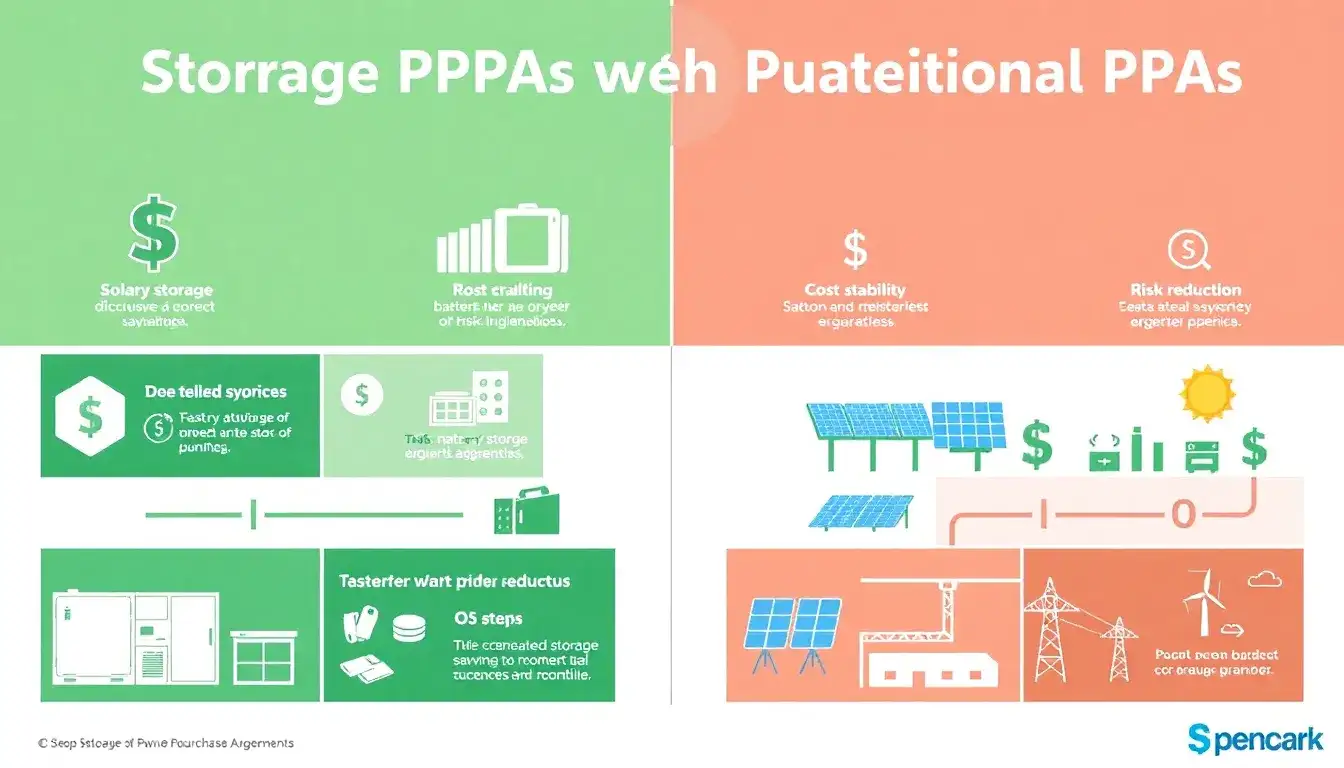
Comparison of Financial Benefits: Storage PPAs vs. Traditional PPAs
Traditional PPAs
Traditional PPAs, particularly those involving renewable energy like wind and solar, offer significant financial benefits to both energy suppliers and buyers. Here are some key advantages:
- Price Stability and Predictable Costs: Traditional PPAs provide long-term price stability by locking in fixed energy rates for the contract term, typically between 10 to 25 years. This predictability helps buyers manage energy costs effectively and supports investment in renewable energy infrastructure by providing a steady income stream to suppliers.
- Cost Efficiency: Renewable energy projects under traditional PPAs often have lower operating costs compared to conventional power plants, resulting in reduced energy bills for buyers over time.
- Risk Mitigation: By fixing energy prices for a long period, traditional PPAs shield buyers from market fluctuations and inflation risks, ensuring long-term cost savings.
- Capital Expenditure Avoidance: These agreements typically fall under operational expenditure, allowing buyers to avoid large upfront investments in energy infrastructure.
Storage PPAs
Storage PPAs, on the other hand, focus on energy storage services and offer unique financial benefits:
- Diversified Services: Storage PPAs provide services such as energy arbitrage, peak shaving, frequency regulation, and backup power. These services can reduce energy costs and enhance grid stability.
- Cost Savings and Risk Management: By offering fixed or predictable pricing for storage services, storage PPAs can help offtakers manage energy price volatility and avoid demand charges. They also facilitate capital expenditure avoidance since offtakers do not need to purchase and maintain storage systems themselves.
- Operational Flexibility: Storage PPAs enable offtakers to optimize their energy usage, providing flexibility in managing peak demand periods and ensuring a stable electricity supply.
Comparison
| Financial Benefits | Traditional PPAs | Storage PPAs |
|---|---|---|
| Price Stability | Offers fixed energy rates for long-term contracts. | Provides predictable pricing for storage services. |
| Cost Efficiency | Lower operating costs from renewable energy sources. | Reduces energy costs through energy arbitrage and peak shaving. |
| Risk Mitigation | Protects against market price fluctuations and inflation. | Manages energy price volatility through stable storage service pricing. |
| Capital Expenditure | Allows buyers to avoid upfront investments in energy infrastructure. | Enables offtakers to avoid capital expenditures on storage systems. |
| Diversified Services | Focuses on electricity purchase from renewable sources. | Offers multiple storage services like energy arbitrage and frequency regulation. |
In summary, while traditional PPAs provide long-term financial stability and cost predictability primarily through the purchase of generated electricity, storage PPAs offer flexibility in energy management and cost savings through specialized storage services. Both types of PPAs can help stabilize energy costs and mitigate risks but serve different aspects of energy management and financial planning.
Original article by NenPower, If reposted, please credit the source: https://nenpower.com/blog/how-do-storage-ppas-compare-to-traditional-ppas-in-terms-of-financial-benefits/

