

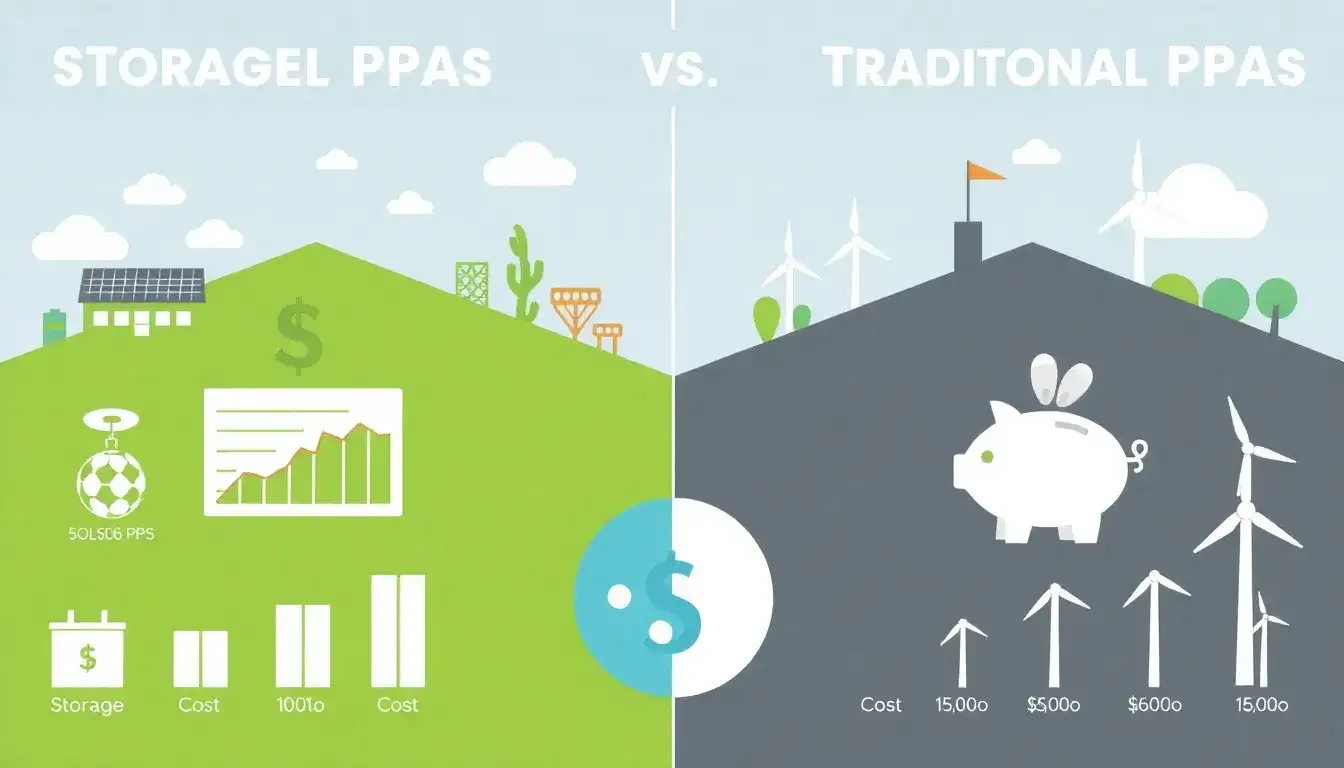
Storage PPAs (Power Purchase Agreements) and traditional PPAs both offer cost savings, but they differ in how these savings are achieved and the types of services provided:
Traditional PPAs
- Cost Savings: Traditional PPAs provide cost savings primarily through price stability and lower operating costs compared to traditional fossil-fuel-based power plants. They allow businesses to secure fixed energy rates over long-term contracts, typically 10 to 25 years, which helps manage and forecast energy costs effectively.
- Risk Mitigation: Traditional PPAs act as a hedge against market price fluctuations and inflation, reducing exposure to rising energy costs.
- Capital Expenditure Reduction: By entering into a PPA, companies can avoid large upfront investments in energy infrastructure, treating energy costs as operational expenditures instead of capital expenditures.
Storage PPAs
- Cost Savings: Storage PPAs offer cost savings through energy arbitrage, peak shaving, and backup power services. Energy arbitrage involves buying electricity when prices are low and selling it when they are high, while peak shaving reduces demand during peak periods to lower energy costs.
- Risk Management: Storage PPAs provide fixed or predictable pricing for storage services, helping offtakers manage energy price volatility and budget more effectively.
- Capital Expenditure Avoidance: Similar to traditional PPAs, storage PPAs allow offtakers to avoid significant capital expenditures for purchasing and maintaining storage systems.
- Additional Benefits: Storage PPAs contribute to grid stability and can mitigate negative price effects by storing excess energy from renewable sources, making renewable energy more reliable and consistent.
Comparative Analysis
| Aspect | Traditional PPAs | Storage PPAs |
|---|---|---|
| Primary Cost Savings Mechanism | Fixed energy rates and lower operating costs | Energy arbitrage, peak shaving, and price stabilization |
| Risk Management | Hedge against market fluctuations and inflation | Manage energy price volatility through fixed pricing for storage services |
| Capital Expenditure | Avoid large upfront costs by treating energy as OpEx | Avoid significant capital expenditures for storage systems |
| Additional Benefits | Sustainability and reputation enhancement | Grid stability and optimized renewable energy usage |
In summary, while both types of PPAs offer cost savings, traditional PPAs focus on securing stable long-term energy prices, whereas storage PPAs focus on leveraging storage services to optimize energy usage and manage price volatility.
Original article by NenPower, If reposted, please credit the source: https://nenpower.com/blog/how-do-storage-ppas-compare-to-traditional-ppas-in-terms-of-cost-savings/

