

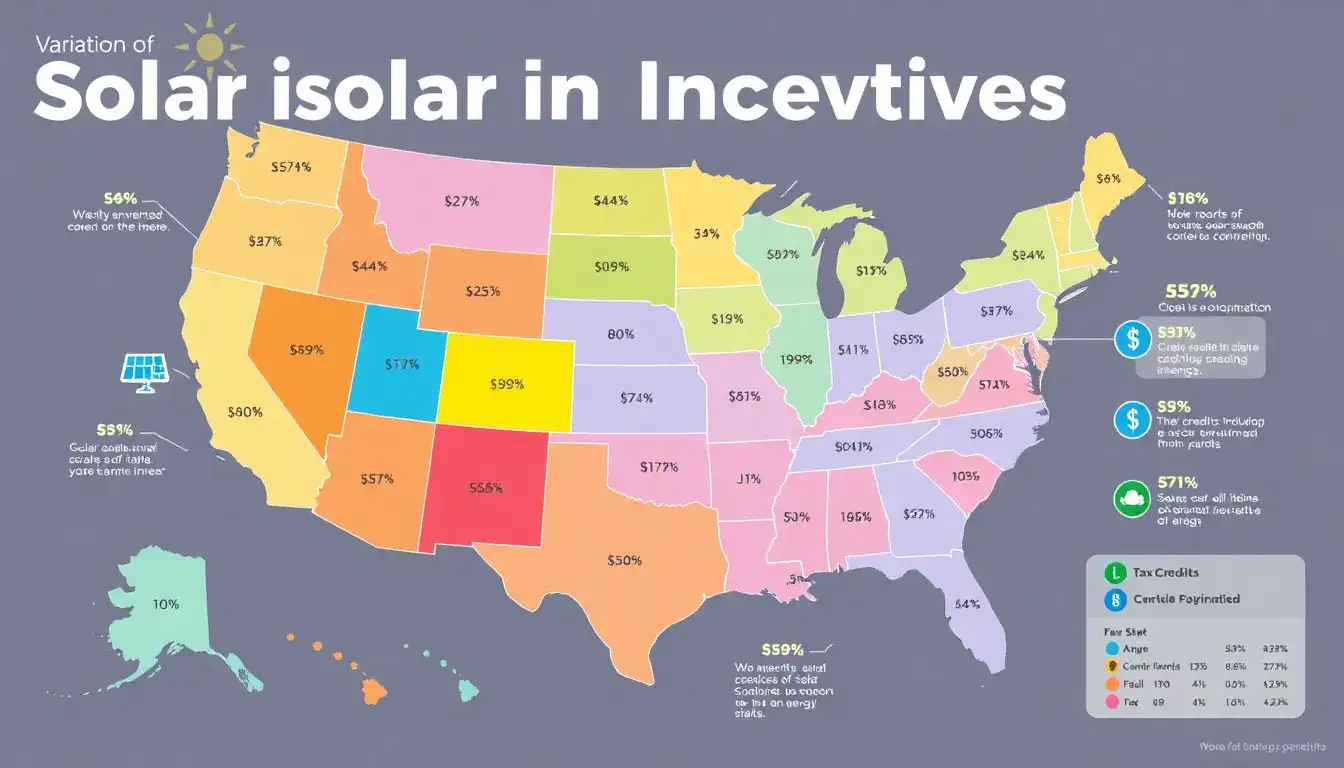
State-specific solar incentives vary significantly across different U.S. regions, shaped by local policies, utility companies, and state government priorities. These incentives take diverse forms, including tax credits, rebates, loans, net metering policies, and solar renewable energy credits (SRECs), with distinct availability and value depending on the state.
Types of Common Solar Incentives
- Federal Investment Tax Credit (ITC): Available nationwide, currently at 30% through 2032, gradually decreasing after 2032 unless renewed by Congress.
- State Tax Credits: Some states offer additional tax credits that reduce state income tax obligations by a percentage of solar installation costs.
- Rebates: Lump-sum payments or per-watt incentives provided after system installation, usually by utilities or state programs.
- Sales and Property Tax Exemptions: Many states exempt solar equipment from sales tax and exclude added home value from property tax assessments.
- Net Metering: Credits for excess solar energy sent back to the grid, sometimes at retail electricity rates.
- Solar Renewable Energy Certificates (SRECs): Tradable credits earned per kWh of solar electricity generated, monetized in states with Renewable Portfolio Standards.
- Low-Interest Loans: Financing programs with below-market interest rates to encourage solar adoption.
Regional Variations
Northeast (e.g., New York, Massachusetts, New Jersey)
- New York offers a state tax credit of 25% (up to $5,000), direct cash incentives of $0.40-$0.70 per watt under the NY-Sun program, a 15-year property tax exemption, and zero-interest financing options.
- New Jersey’s updated SREC Successor Program guarantees payments for solar production, offers higher incentives for moderate-income households, and includes battery storage bonuses and property tax exemptions.
- Massachusetts and neighboring states feature a mix of rebates, property tax exemptions, and aggressive net metering policies, positioning them among the top states for solar incentives.
West Coast (California, Oregon, Washington)
- California’s NEM 3.0 program revamps net metering with peak period export credits, enhanced battery storage incentives, smart home integration bonuses, and local utility rebates. Despite reduced rebate amounts compared to the past, strategic installation can maximize savings.
- Oregon provides robust statewide rebates: up to $5,000 for solar panels and $2,500 for solar battery storage, full exemption from sales tax (as the state lacks sales tax), and property tax exemptions. Its net metering credits are at full retail rate for most utilities.
- Washington waives sales tax on photovoltaic equipment and installation labor, has a renewable energy system incentive paying per kWh generated, and maintains net metering with variability depending on the utility provider.
Midwest (Illinois)
- Illinois offers a unique Adjustable Block Program, providing Renewable Energy Credits (RECs) tradeable on energy marketplaces, which can significantly offset costs over 15 years.
- The state also features net metering at retail rates, solar property tax exemptions, and programs like Illinois Solar for All for low-income homeowners.
Mountain States (Colorado)
- Colorado provides a 100% sales and property tax exemption on solar and battery equipment.
- The state offers a Residential Energy Upgrade (RENU) low-cost loan and regional rebates such as Energy Smart Colorado, which reimburses 25% of project costs up to $2,500.
Southeast (South Carolina)
- South Carolina offers competitive solar incentives but specifics vary by utility and locality; however, it ranks within the top nine states for solar incentives with notable rebates and tax exemptions.
Summary Table of Selected States with Key Incentives
| State | Key Incentives | Notes |
|---|---|---|
| New York | 25% state tax credit (up to $5,000), $0.40-$0.70/W cash incentives, 15-year property tax exemption | Can reduce cost by up to 60% combining incentives |
| New Jersey | SREC payments, higher incentives for moderate-income, battery storage incentives, property tax exemption | One of the fastest payback periods due to SRECs |
| California | NEM 3.0 with peak export credits, enhanced battery incentives, local rebates | Focus on smart home integration and battery storage |
| Oregon | Up to $5,000 rebate for panels, $2,500 for batteries, no sales tax, property tax exemption, net metering at full retail rate | Strong state rebates combined with federal ITC |
| Washington | Sales tax exemption, renewable energy system incentives (feed-in tariffs), net metering varies | Incentive program currently waitlisted but promising |
| Illinois | Adjustable Block Program with RECs, net metering at retail rate, property tax exemption | Effective REC market creates steady income stream for solar owners |
| Colorado | 100% sales and property tax exemption, low-cost loans, regional rebates | Supports solar and battery systems integration |
Conclusion
State-specific solar incentives vary widely by region, reflecting local energy policies, utility rules, and market conditions. States in the Northeast and West Coast currently provide some of the most generous combinations of rebates, tax credits, and net metering benefits. Midwestern and Mountain states often leverage unique REC markets and tax exemptions to promote solar adoption. When combined with the stable federal ITC, these incentives can greatly reduce the upfront and long-term costs of solar installations, though the most advantageous programs depend heavily on the state and local utility.
Original article by NenPower, If reposted, please credit the source: https://nenpower.com/blog/how-do-state-specific-solar-incentives-vary-across-different-regions/

