

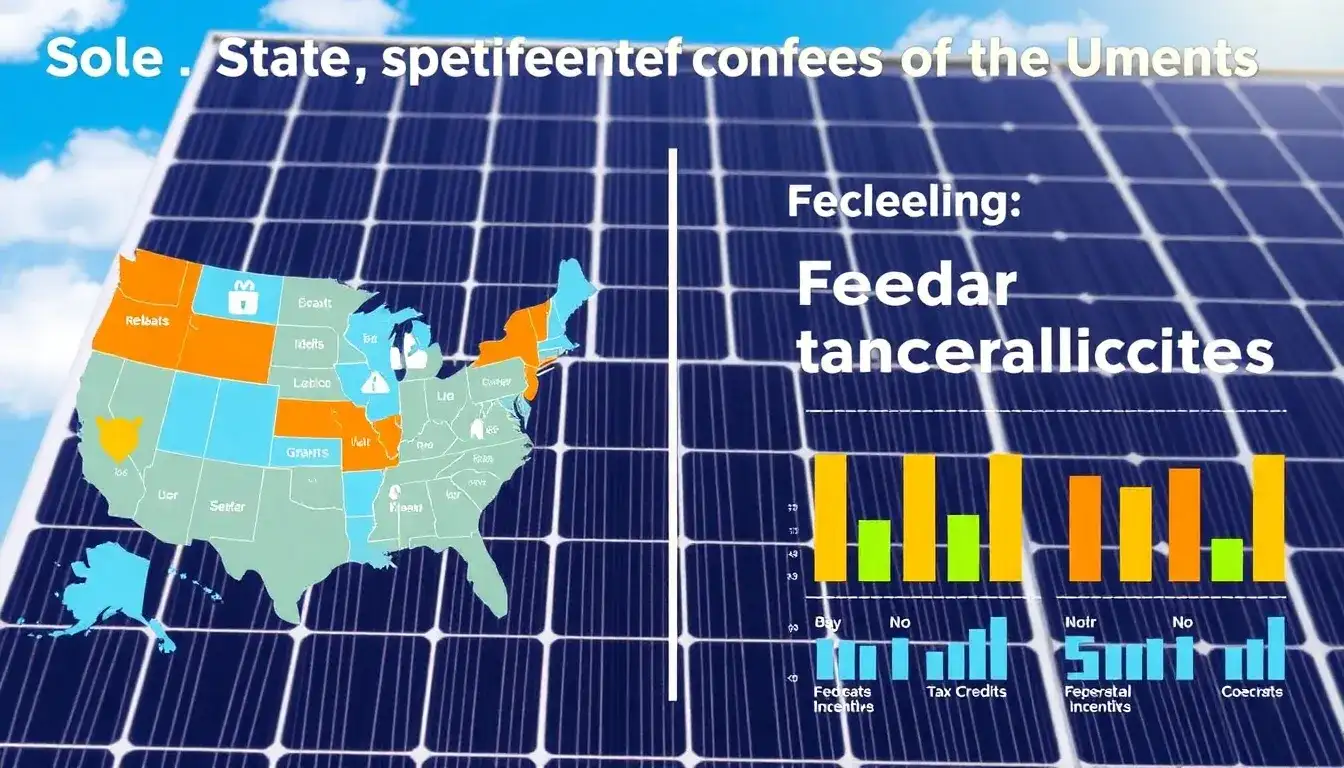
Federal Tax Credits
- The main federal tax incentive is the Federal Solar Investment Tax Credit (ITC), offering a 30% credit on the cost of a solar panel system. This credit directly reduces the federal income tax owed by the system owner and is available nationwide. For example, in Florida, this credit reduces the cost of a 5 kW system from about $10,566 to $7,396 after the 30% credit.
- The federal credit applies to the system’s purchase price and is claimed when filing federal taxes.
- It is a fixed percentage credit currently set at 30% until at least the end of 2032 under the Inflation Reduction Act.
State-Specific Incentives
- State incentives vary widely depending on the state, municipality, or utility provider. These can include rebates, sales tax exemptions, property tax exemptions, low-cost financing, and direct grants.
- Unlike the federal ITC, many state incentives provide upfront rebates or reduce the costs through exemptions rather than a tax credit applied later.
- Examples of state incentives include:
- Sales Tax Exemption: Some states, like Colorado, exempt solar equipment purchases from state sales tax, reducing the initial purchase price.
- Property Tax Exemption: Certain states exempt the added home value from solar installations from property tax assessments.
- Rebates and Loans: Some states or local programs offer direct rebates worth a percentage of the project cost (e.g., 25% rebate up to a set amount) or low-cost financing for solar installations.
- Programs for Underserved Populations: Some incentives focus on making solar accessible to low-income households or community installations.
- State incentives often complement federal tax credits, further decreasing the net cost of solar investments on top of the federal credit.
Summary Comparison
| Feature | Federal Tax Credit (ITC) | State-Specific Incentives |
|---|---|---|
| Coverage | Nationwide | Varies by state, city, or utility |
| Type of Incentive | Tax credit (percentage of system cost) | Rebates, tax exemptions, loans, grants |
| Timing of Benefit | Claimed when filing federal taxes | Often immediate cost reductions or financing |
| Value | 30% credit until at least 2032 | Varies widely, can be percentage or fixed amount |
| Purpose | Encourage renewable energy broadly | Target local adoption, support specific groups |
In essence, federal tax credits provide a broad, standardized financial benefit via tax reduction, whereas state-specific incentives provide diverse, localized financial support mechanisms that can include up-front cost savings, tax exemptions, and specialized programs tailored to local priorities and populations.
Original article by NenPower, If reposted, please credit the source: https://nenpower.com/blog/how-do-state-specific-incentives-differ-from-federal-tax-credits-for-solar-energy/

