

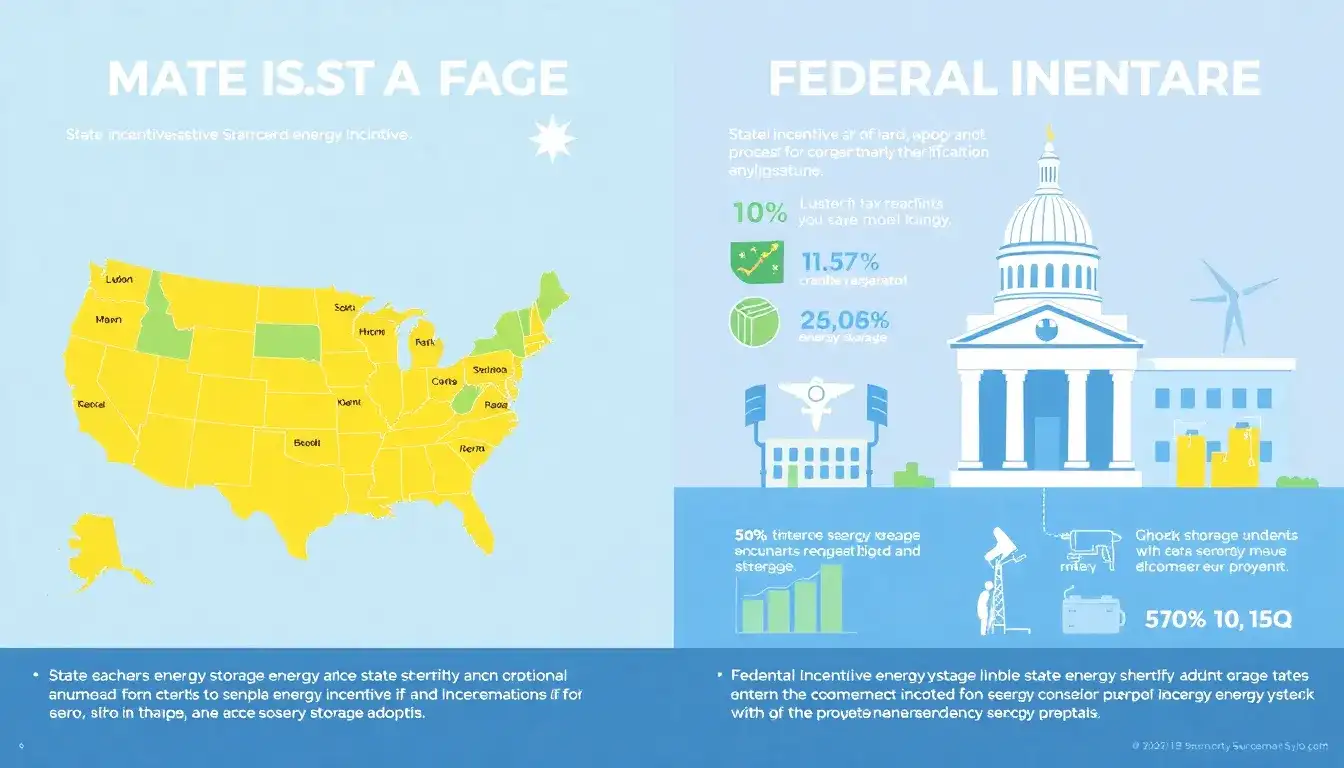
State-specific incentives for energy storage vary widely in structure and rates compared to federal incentives, with notable differences in design and target outcomes:
Federal Incentives
- Investment Tax Credit (ITC):
Offers a 30% tax credit (as of 2025) for energy storage systems paired with solar.
Structure: Universal, one-time tax reduction based on installation cost.
Scope: Nationwide, no performance requirements or income qualifications.
State Incentives
Program Types
- Upfront rebates:
Connecticut’s Energy Storage Solutions provides $250–$450/kWh upfront for residential systems, with 2x multipliers for low-income households. - Performance-based payments:
Massachusetts’ ConnectedSolutions pays $350–$1,000+ per kW/year for discharging during peak demand. - Hybrid models:
California’s SGIP combines rebates ($/kW installed) with equity adjustments for high-fire-risk and low-income areas.
Key Comparisons
| Aspect | Federal ITC | State Programs (e.g., CT, MA, CA) |
|---|---|---|
| Incentive Rate | 30% of system cost | $350–$1,333.33/kWh (mean: $805/kWh) |
| Structure | Tax credit | Rebates, performance payments, or hybrids |
| Targets | Broad adoption | Grid reliability, equity, fire resilience |
| Equity Focus | None | Priority incentives for low-income |
Complementary Roles
- Federal incentives drive baseline affordability for all adopters.
- State programs address local grid needs (e.g., Massachusetts’ Clean Peak Standard for peak shaving) and equity gaps (e.g., Connecticut’s 2x low-income multiplier).
- Combined Impact: Pairing federal tax credits with state rebates can reduce payback periods by 40–60% compared to standalone incentives.
While the ITC provides foundational support, state programs enable tailored solutions but face challenges like complex eligibility rules and variable uptake depending on utility partnerships.
Original article by NenPower, If reposted, please credit the source: https://nenpower.com/blog/how-do-state-specific-incentives-compare-to-federal-incentives-for-energy-storage-2/

