

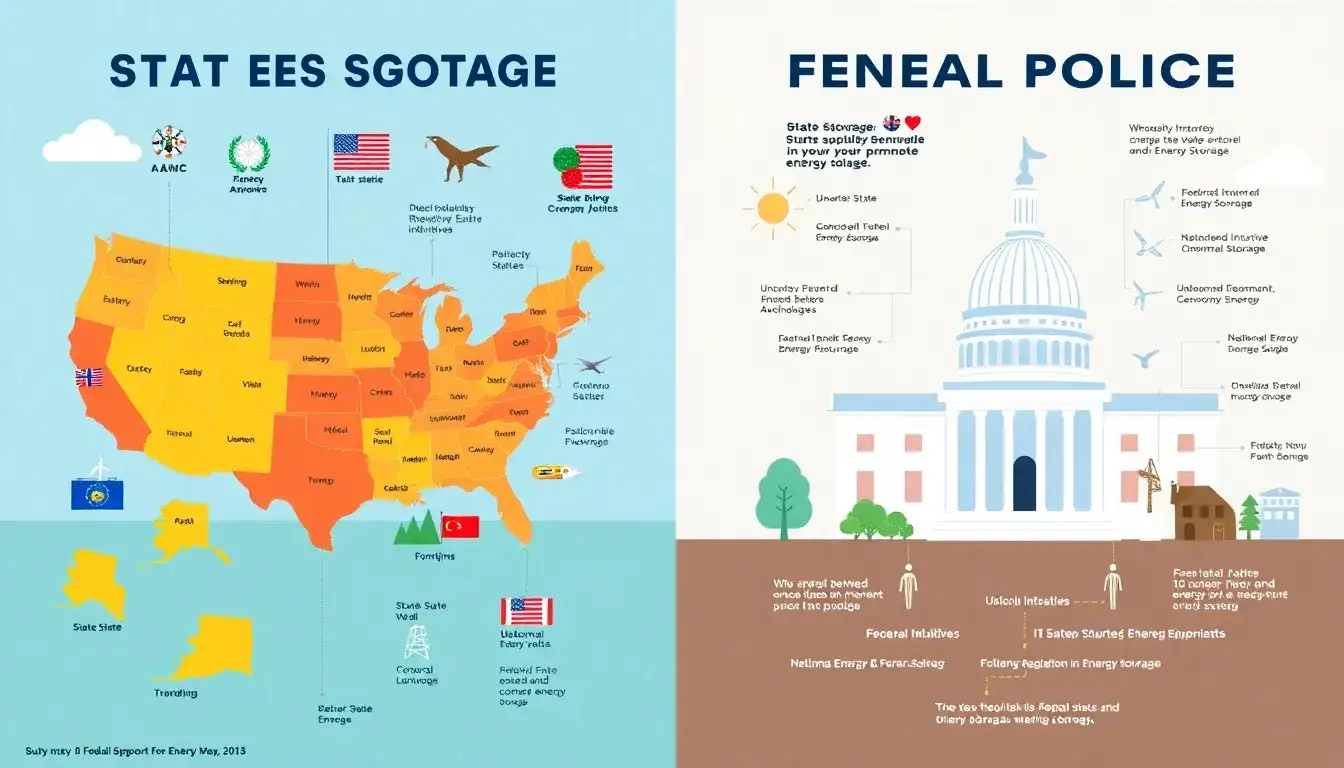
State-level and federal energy storage policies in the US differ significantly in scope, focus, and implementation:
Policy Scope and Targets
State-level policies often include specific procurement targets (e.g., California’s 1,825 MW by 2020, New York’s 6,000 MW by 2030) and technology-specific incentives for behind-the-meter (BTM) storage. Approximately 17 states have adopted policies falling into categories like:
- Procurement mandates (12 states including CA, NY, and NJ)
- Financial incentives (e.g., rebates, tax credits)
- Regulatory adaption (streamlining interconnection rules)
- Demonstration programs and consumer protections.
Federal policies focus on research funding (e.g., DOE grants), tax credits (e.g., ITC for solar+storage under 26 USC §48), and cross-state infrastructure planning, but lack binding procurement targets or state-specific regulatory frameworks.
Regulatory Authority
States retain primary jurisdiction over grid operations and utility regulations, enabling tailored policies like:
- Time-varying rates to incentivize storage use (e.g., CA’s SGIP program)
- Storage-friendly interconnection standards (adopted in HI, MA, and NY).
Federal policies often address interstate transmission and market participation rules (e.g., FERC Order 841, which requires wholesale markets to compensate storage for multiple services).
Incentive Structures
State incentives emphasize locally relevant outcomes:
- California prioritizes BTM storage to mitigate wildfire-related outages.
- Hawaii and New York use storage to integrate renewables and reduce curtailment.
Federal incentives are technology-agnostic, such as the Investment Tax Credit (ITC), which applies uniformly across states without mandating specific use cases.
Policy Flexibility
State policies can rapidly adapt to local needs (e.g., Nevada accelerated its 2030 storage target after early success), while federal policies face longer legislative timelines but provide market-wide consistency (e.g., ITC extension under the Inflation Reduction Act).
Key distinction: States act as laboratories for storage policy innovation, while federal policies create foundational incentives and market structures that enable nationwide scaling.
Original article by NenPower, If reposted, please credit the source: https://nenpower.com/blog/how-do-state-level-policies-differ-from-federal-policies-in-supporting-energy-storage/

