

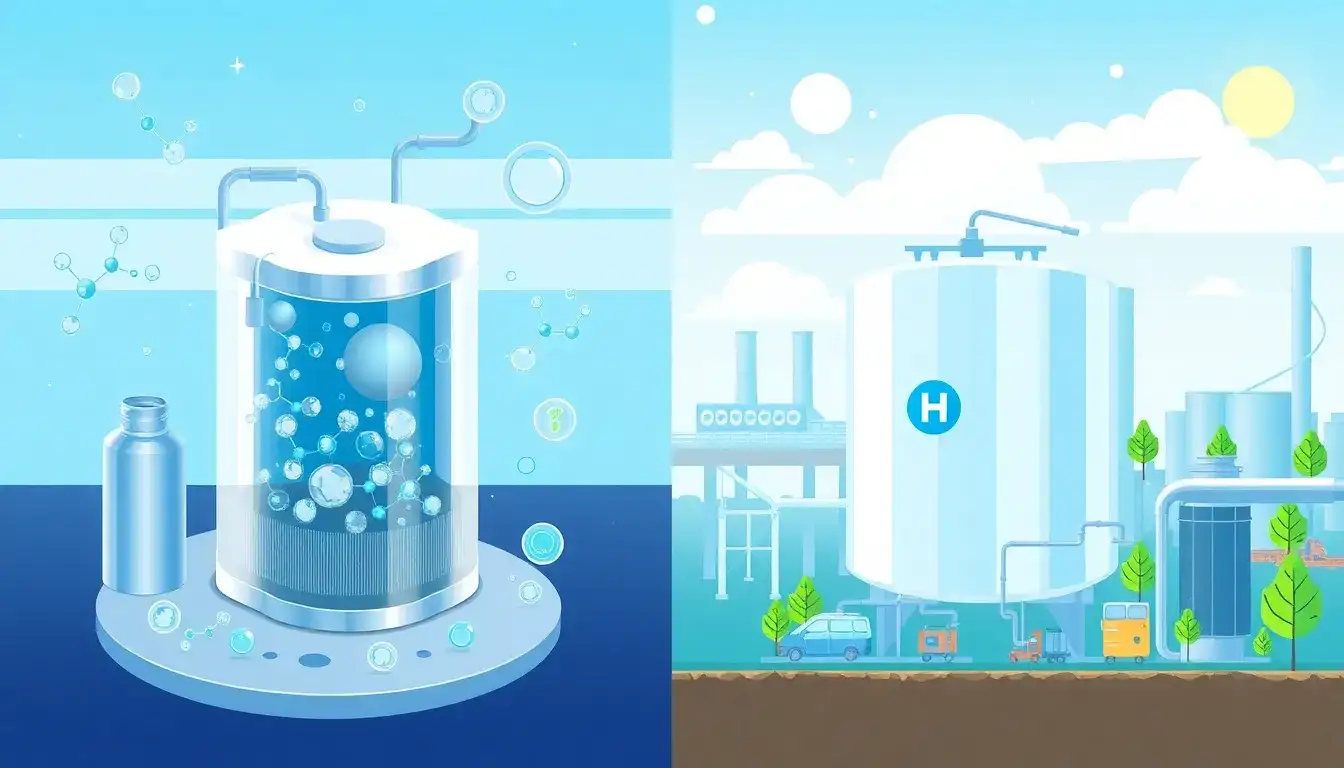
Solid-state hydrogen storage differs significantly from traditional hydrogen storage methods such as compressed gaseous hydrogen and liquid hydrogen storage. Here’s a detailed comparison:
Storage Form and Technology
- Solid-State Storage: Hydrogen is stored by being absorbed or chemically bound within a solid carrier material, typically metal hydrides. These materials capture hydrogen in a compact and stable form without the need for high pressure or very low temperatures.
- Traditional Storage: Hydrogen is stored either as a compressed gas, often at pressures around 700-900 bar, or as a cryogenic liquid at extremely low temperatures (around -253°C) to maintain hydrogen in liquid form.
Storage Density
- Solid-State Storage: Can achieve high volumetric hydrogen densities theoretically comparable to or exceeding gaseous storage, with values such as H2/m³ possible depending on the material used. Metal hydrides provide a dense packing of hydrogen atoms within the solid phase.
- Traditional Storage: Liquid hydrogen has a density of approximately 71 kg H2/m³, while compressed hydrogen at 900 bar has about 40 kg H2/m³. Solid-state solutions offer competitive densities without the extreme conditions needed for liquefaction.
Safety and Stability
- Solid-State Storage: Offers enhanced safety due to ambient temperature and pressure storage conditions with minimal risk of hydrogen boil-off or leaks. The hydrogen is chemically bonded and stable within the solid, reducing hazards associated with high-pressure gas or cryogenic liquid handling.
- Traditional Storage: Compressed gas storage entails risks due to high pressures, including tank rupture or leaks, while liquid hydrogen storage faces boil-off losses and requires insulated cryogenic tanks, complicating safety and logistics.
Longevity and Cycle Life
- Solid-State Storage: Metal hydride-based systems are extremely cycle-proof and can maintain functional lifetimes of 25 years or more, with the ability to use full storage capacity without degradation over many charge-discharge cycles.
- Traditional Storage: Compressed and liquid storage systems are subject to wear and potential degradation of tanks and insulation but generally have a shorter lifespan and can lose efficiency over time due to hydrogen losses.
Infrastructure and Implementation
- Solid-State Storage: Allows storage at ambient conditions, simplifying infrastructure needs. This technology is well-suited for small to mid-volume use cases with straightforward scalability and can integrate into existing transport and energy infrastructure more easily, potentially reducing capital investment barriers.
- Traditional Storage: Requires specialized high-pressure compressors, robust pressure vessels, or cryogenic equipment, leading to higher upfront infrastructure investment and operational complexity.
Environmental Impact
- Solid-State Storage: Considered environmentally friendly as it reduces the need for energy-intensive compression or liquefaction processes and minimizes hydrogen losses during storage and transport.
- Traditional Storage: Compression and liquefaction are energy-intensive processes that contribute to overall system emissions and operational costs.
Emerging Developments
New research projects and demonstrations, such as those by SoCalGas, GKN Hydrogen, and the National Renewable Energy Laboratory, are validating solid-state hydrogen storage’s performance and integration with renewable energy systems, highlighting its potential role in advancing clean energy and net-zero goals.
Summary Table
| Aspect | Solid-State Hydrogen Storage | Traditional Storage (Compressed/Liquid) |
|---|---|---|
| Storage Form | Hydrogen bound in metal hydrides (solid) | Gaseous (high pressure) or liquid (cryogenic) |
| Storage Density | Comparable or higher, e.g., H2/m³ values | Liquid: ~71 kg/m³, Gas (900 bar): ~40 kg/m³ |
| Operating Conditions | Ambient temperature and pressure | High pressure (up to 900 bar) or very low temperature (cryogenic) |
| Safety | Lower risk of leaks/boil-off, stable storage | High pressure risks, boil-off losses with liquid |
| Lifetime and Durability | >25 years, highly cycle-stable | Limited by tank integrity, boil-off losses |
| Infrastructure Complexity | Lower, easier integration, less capital needed | Higher, requires compressors, insulation, heavy tanks |
| Environmental Impact | Energy efficient, environmentally friendly | Energy-intensive compression/liquefaction |
In conclusion, solid-state hydrogen storage offers a safer, potentially more compact, and environmentally friendly alternative to traditional gaseous and liquid hydrogen storage methods, particularly advantageous for mid-volume applications and renewable energy integration. However, it is still emerging and likely to coexist with traditional methods depending on the specific use case, volume, and transport distance.
Original article by NenPower, If reposted, please credit the source: https://nenpower.com/blog/how-do-solid-state-hydrogen-storage-solutions-compare-to-traditional-methods/

