

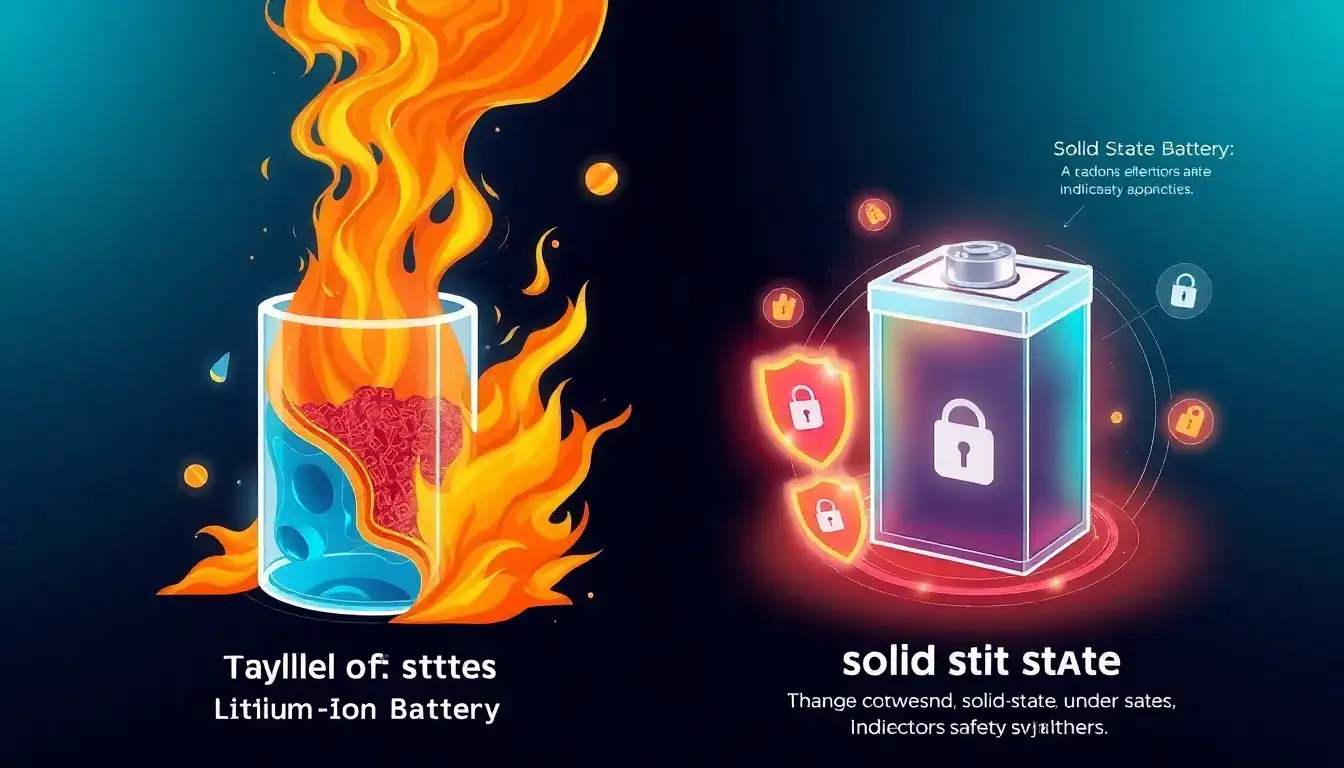
Solid-state batteries enhance safety through multiple fundamental improvements over traditional lithium-ion batteries:
Elimination of flammable components
Solid-state batteries replace liquid electrolytes (flammable and prone to leakage) with non-flammable solid electrolytes, drastically reducing fire risks. This prevents thermal runaway—a chain reaction causing overheating and fires in traditional batteries—by stabilizing ion flow and minimizing heat generation.
Thermal and mechanical resilience
Solid electrolytes exhibit higher thermal stability (resisting decomposition under heat) and superior mechanical integrity, reducing puncture risks and structural damage. Unlike liquid-based cells, they maintain stability across extreme temperatures, lowering failure rates in harsh environments.
Dendrite suppression
Advanced designs (e.g., Harvard’s lithium-metal anode) mitigate dendrite formation—spiky lithium growths causing short circuits—through multi-layer electrolytes that block penetration. This addresses a critical failure mode in lithium-ion batteries.
Reduced toxic hazards
Solid-state systems avoid toxic fumes or gases during failure, enhancing safety for users and the environment. Combined with advanced battery management systems, they enable real-time monitoring to preempt faults.
Key safety comparison
| Feature | Solid-State Batteries | Traditional Batteries |
|---|---|---|
| Electrolyte | Non-flammable solid | Flammable liquid |
| Thermal Runaway | Rare due to stable electrolyte | Common risk |
| Dendrite Resistance | Engineered barriers suppress growth | Prone to dendrites |
| Failure Emissions | Minimal/no toxic fumes | Toxic gases possible |
Original article by NenPower, If reposted, please credit the source: https://nenpower.com/blog/how-do-solid-state-batteries-improve-safety-compared-to-traditional-batteries/

