

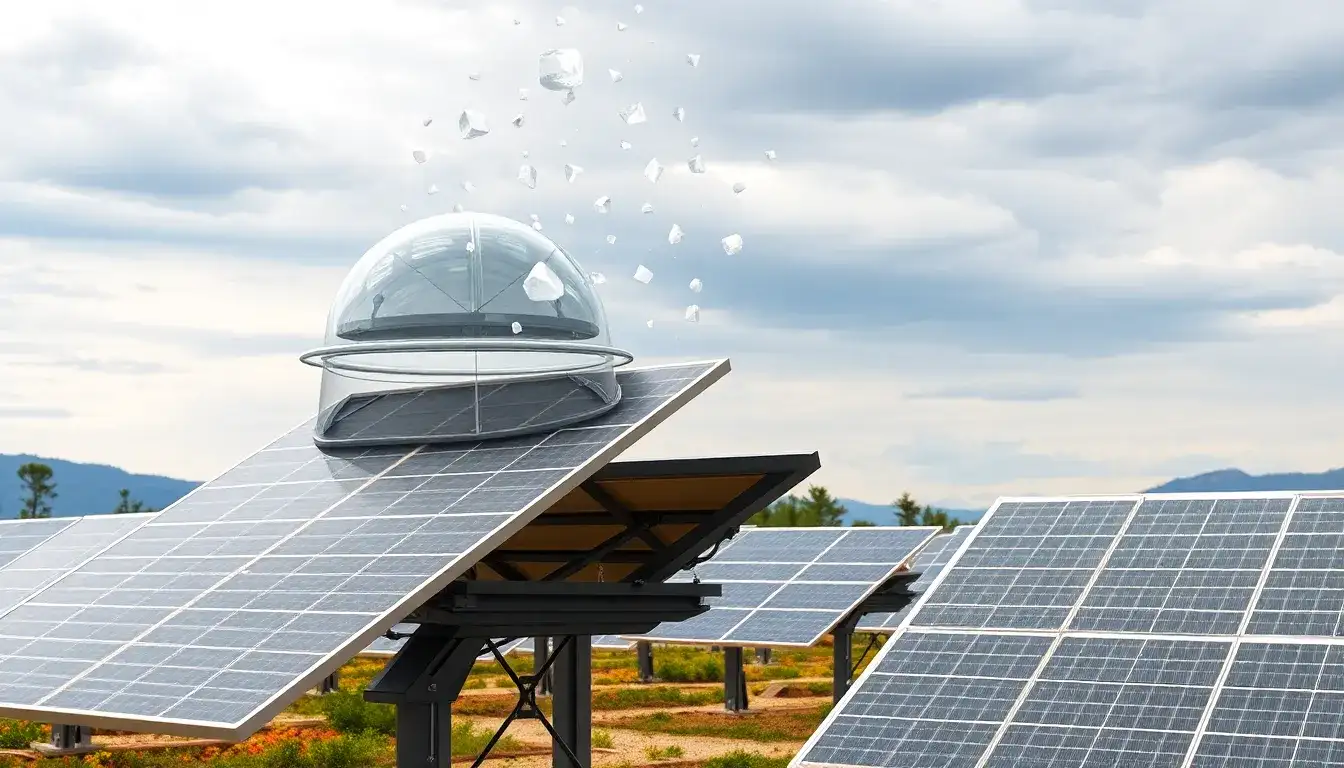
Solar trackers prevent damage from hail primarily by repositioning solar panels into a protective “hail stow” position designed to minimize the impact force and exposure of the panels to falling hailstones.
How Solar Trackers Protect Against Hail
- Tilting to Maximum Tilt Angle
Trackers rotate the photovoltaic (PV) modules to their maximum tilt angle, typically between 50° and 75°, which reduces the direct kinetic energy of falling hail. This steep angle causes hailstones to glance off rather than strike directly, significantly lowering damage potential by minimizing direct impact force. - Orienting Panels Relative to Hail and Wind Direction
Advanced hail protection algorithms position panels so their surface is as perpendicular as possible to the hail’s trajectory, or sometimes the back of the module is exposed to hail rather than the front to further reduce damage. For example, Soltec’s hail stow position sets the tracker tilt around 55° (optionally 60°), matching the common hailstone trajectory angles of 25-50 mm hailstones, thereby minimizing exposed surface and impact frequency. - Quick System Response
Rapid activation is critical since hailstorms evolve quickly. Some systems, like Soltec’s, feature fast motors (e.g., 20°/minute rotation) enabling timely positioning in the hail defense stance to reduce exposure and impacts. - Balancing Wind and Hail Risks
Because hail often occurs with wind, solar trackers must balance protecting panels from hail with avoiding structural damage from wind. For instance, stowing fully into the wind can increase hail damage risk, while stowing away from the wind reduces hail damage but requires structural capability to withstand increased wind load. High-quality trackers are designed to endure full-site wind speeds at maximum tilt angles, allowing safe stowing positions that mitigate both wind and hail damage risks simultaneously. - Partial Stowing and Smart Algorithms
Some systems can selectively stow only rows directly threatened by hailstorms, maintaining energy production in unaffected rows. They use weather sensors and advanced control algorithms to predict hail events and respond appropriately.
Summary Table of Hail Protection Measures
| Protection Strategy | Effectiveness/Benefit |
|---|---|
| Maximum tilt angle (50°-75°) | Reduces direct impact force by inducing glancing blows. |
| Aligning panel perpendicular/opposite hail direction | Minimizes exposed surface area and hail impact frequency. |
| Rapid rotation (e.g., 20°/min) | Enables timely positioning before/during hailstorm. |
| Robust structural design for wind + hail | Allows safe stowing away from wind, reducing hail damage risk. |
| Partial row stowing and advanced sensors | Limits downtime and protects vulnerable modules efficiently. |
In conclusion, solar trackers mitigate hail damage by smartly repositioning the panels to a steep tilt and an orientation that reduces hail impact, rapidly activating protective positions based on real-time weather data, and using sturdy designs to handle combined wind and hail forces. This approach minimizes panel breakage and microcracks, extending system durability even in hail-prone areas.
Original article by NenPower, If reposted, please credit the source: https://nenpower.com/blog/how-do-solar-trackers-prevent-damage-from-hail/

