

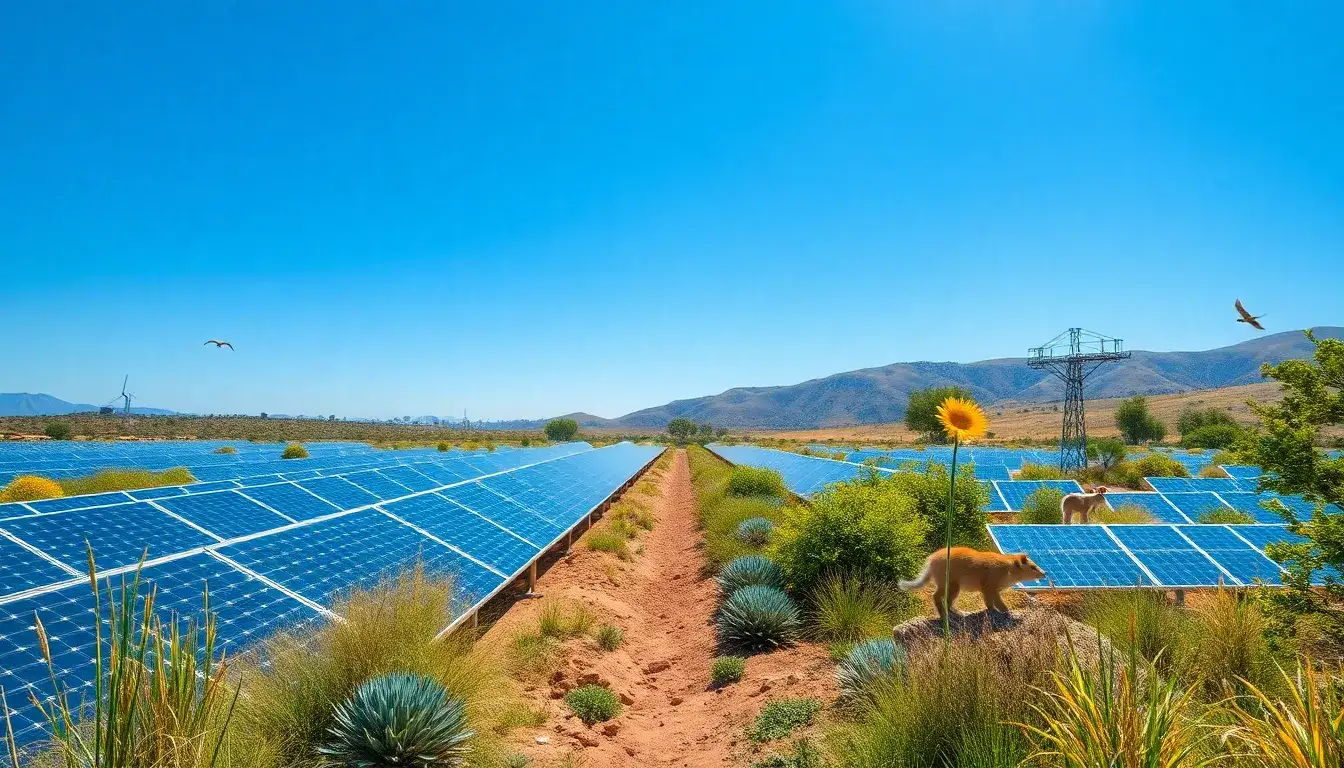
Solar farms can contribute to carbon sequestration in several ways:
1. Regenerative Energy and Agrivoltaics
Solar farms can be integrated with regenerative agriculture, a practice known as agrivoltaics, to enhance soil carbon sequestration. This approach co-locates solar energy generation with regenerative land management, improving the natural ability of vegetation and soils to capture and store atmospheric carbon. By restoring native grassland vegetation under solar panels, research suggests a potential 65% increase in carbon storage compared to conventional turf grass management.
2. Diverse Plant Species and Grazing Practices
Encouraging a diverse range of plant species, especially native wildflowers, can enhance carbon storage in soils. Low-to-moderate grazing intensity, such as rotational grazing, allows pastures to recover, promoting plant diversity and boosting the soil’s carbon capture capacity. This approach supports biodiversity while enhancing soil health and carbon sequestration.
3. Soil Health Management
Solar farms can be managed to improve soil health by adopting practices that promote carbon storage. This includes minimizing soil disturbance, maintaining soil cover, and integrating organic amendments, which help increase soil organic matter and carbon sequestration potential.
4. Carbon Offset from Emissions Reduction
Although solar farms themselves do not directly sequester carbon from the atmosphere, they significantly reduce CO2 emissions by displacing fossil fuel-based energy sources. An acre of solar panels can save approximately 175 to 198 metric tons of CO2 annually by replacing natural gas, vastly exceeding the carbon sequestration potential of forests.
Overall, solar farms contribute to carbon sequestration indirectly through emissions reduction and directly through regenerative practices that enhance soil health and ecosystem services.
Original article by NenPower, If reposted, please credit the source: https://nenpower.com/blog/how-do-solar-farms-contribute-to-carbon-sequestration/

