

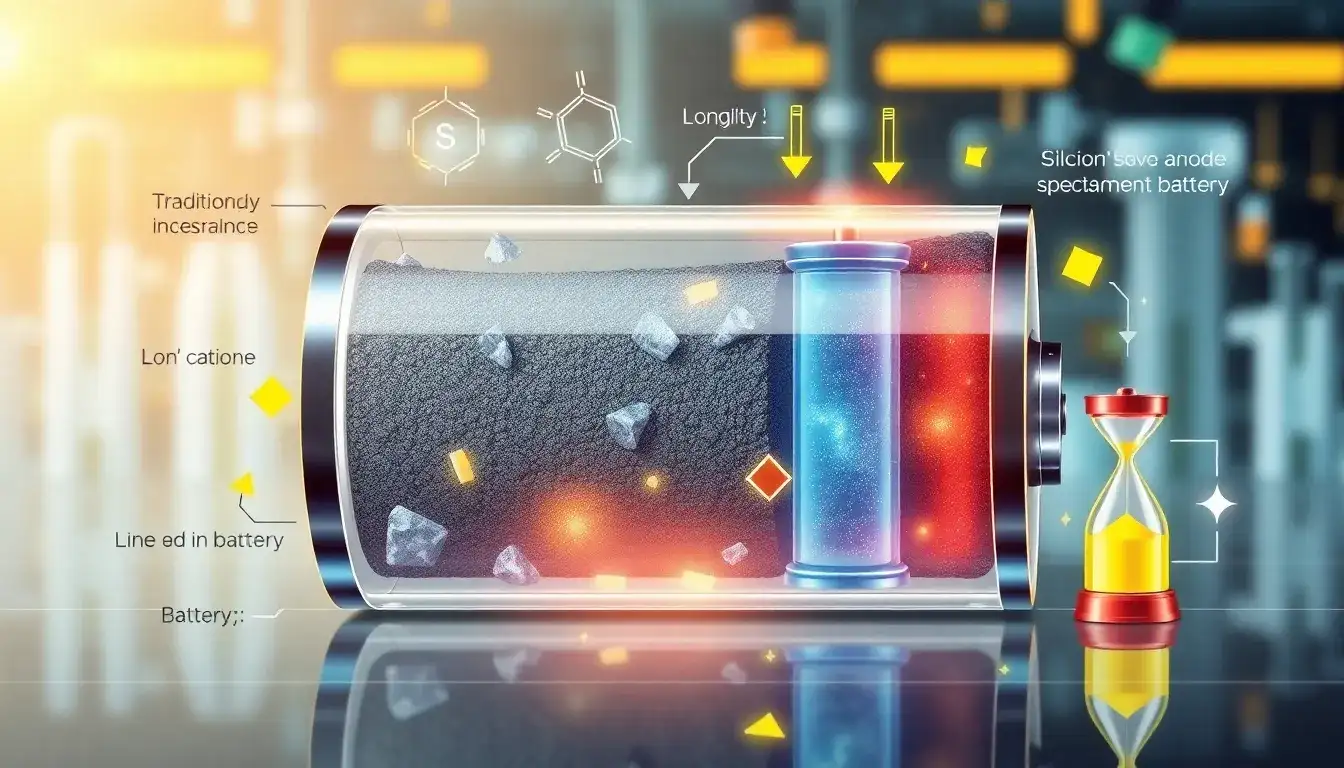
Silicon-based anodes significantly influence lithium-ion battery lifespan, presenting both advantages and challenges that current research aims to address:
Capacity and Energy Density Benefits
Silicon offers 10× higher theoretical capacity than graphite (3,600 mAh/g vs. 360 mAh/g) and improves gravimetric/volumetric energy density, supporting longer-range EVs and compact electronics. However, this high capacity introduces critical trade-offs.
Cycle Life Challenges
- Volume expansion: Silicon anodes expand by ~300% during lithiation, causing mechanical stress that cracks the anode and destabilizes the solid electrolyte interphase (SEI).
- Capacity decay: Unmodified silicon anodes exhibit rapid degradation, retaining only 26% capacity by 600 cycles under standard testing.
- Electrolyte consumption: Repeated SEI repair during cycling depletes lithium inventory and electrolyte, lowering Coulombic efficiency.
Calendar Aging Effects
Silicon’s reactivity accelerates parasitic side reactions during storage:
- Gas formation and electrolyte decomposition occur even at 30–47.5°C storage temperatures.
- Interface instability: Unlike graphite, silicon lacks a self-stabilizing SEI, leading to continuous lithium loss and impedance growth.
Mitigation Strategies
- Electrolyte engineering: Localized high-concentration electrolytes (LHCEs) improve CE stability during cycling.
- Consortium efforts: NREL’s Silicon Consortium Project is developing accelerated aging protocols and interface-stabilizing additives to extend calendar life.
- Anode architecture: Nanostructured silicon (e.g., porous frameworks) and composite designs (with graphite/carbon) reduce mechanical stress.
While silicon anodes enhance energy density, their lifespan currently lags behind graphite. Advances in electrolyte chemistry, binder engineering, and anode structuring are critical to realizing their full potential.
Original article by NenPower, If reposted, please credit the source: https://nenpower.com/blog/how-do-silicon-based-anodes-impact-the-overall-lifespan-of-lithium-ion-batteries/

