

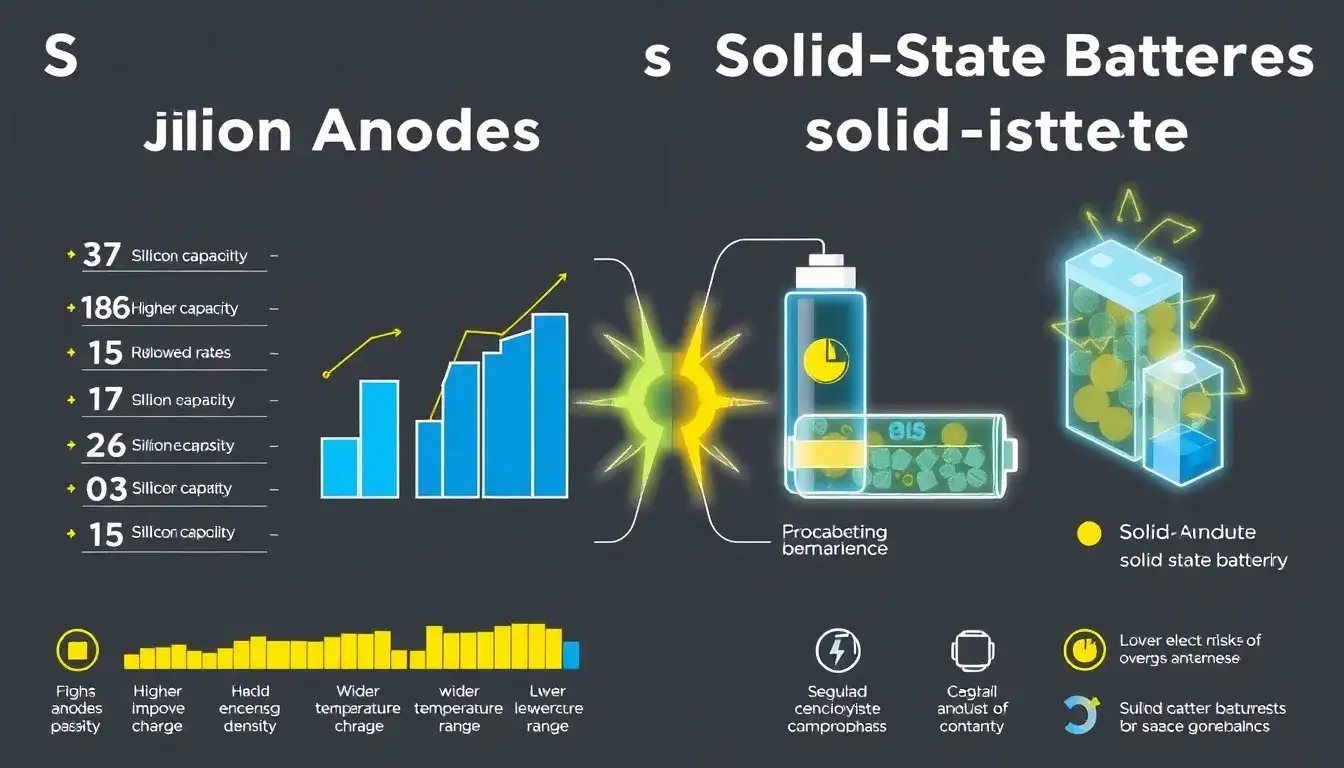
Silicon anodes and solid-state batteries represent different approaches to improving lithium-ion battery performance, with distinct advantages and challenges:
Energy Density and Capacity
- Silicon anodes offer high theoretical capacity (up to 3600 mAh/g, ~10x graphite), enabling higher energy density (up to 500 Wh/kg in commercial cells). This translates to longer runtime for devices and extended driving ranges for EVs.
- Solid-state batteries typically focus on safety and stability, but advanced designs (e.g., lithium-metal anodes) can potentially surpass silicon in energy density (theoretically >500 Wh/kg). However, commercial solid-state batteries today often prioritize safety over maximum energy density.
Cycle Life and Stability
- Silicon struggles with volume expansion (up to 300% during charging), causing mechanical degradation and reduced cycle life. Solutions like silicon nanowires (Amprius’ SiCore) mitigate this through nanostructured designs.
- Solid-state batteries eliminate liquid electrolytes, reducing flammability and improving thermal stability. Their cycle life depends on the anode material (e.g., graphite vs. lithium-metal), but solid electrolytes can suppress dendrite growth, enhancing longevity for lithium-metal anodes.
Power and Charge Rates
- Silicon anodes achieve high power density (up to 10C discharge rates), making them suitable for high-performance EVs and aviation.
- Solid-state batteries often face lower ionic conductivity in solid electrolytes, limiting fast-charge capabilities. However, recent advances in sulfide/oxide-based electrolytes are addressing this bottleneck.
Manufacturing and Cost
- Silicon integration requires advanced engineering (e.g., coatings, composites) to manage expansion, increasing production complexity.
- Solid-state batteries face material compatibility issues (e.g., electrolyte-electrode interfaces) and rely on expensive materials (e.g., LLZO electrolytes), keeping costs high.
Key Applications
- Silicon anodes: High-energy EVs (e.g., longer-range models), consumer electronics, and aviation/drone batteries.
- Solid-state batteries: Safety-critical applications (medical devices, aerospace) and next-gen EVs prioritizing non-flammability.
| Feature | Silicon Anodes | Solid-State Batteries |
|---|---|---|
| Energy Density | Up to 500 Wh/kg (current commercial) | 400-500+ Wh/kg (theoretical) |
| Cycle Life | ~500-1000 cycles (depending on design) | ~1000+ cycles (varies by chemistry) |
| Safety | Moderate (liquid electrolyte remains) | High (non-flammable electrolyte) |
| Maturity | Commercial (e.g., Amprius, Tesla) | Limited commercialization |
| Cost | Moderate (scaling challenges) | High (material/process costs) |
In summary, silicon anodes excel in energy density and power, while solid-state batteries prioritize safety and stability, with both technologies advancing toward commercial viability in complementary applications.
Original article by NenPower, If reposted, please credit the source: https://nenpower.com/blog/how-do-silicon-anodes-compare-to-solid-state-batteries-in-terms-of-performance/

