

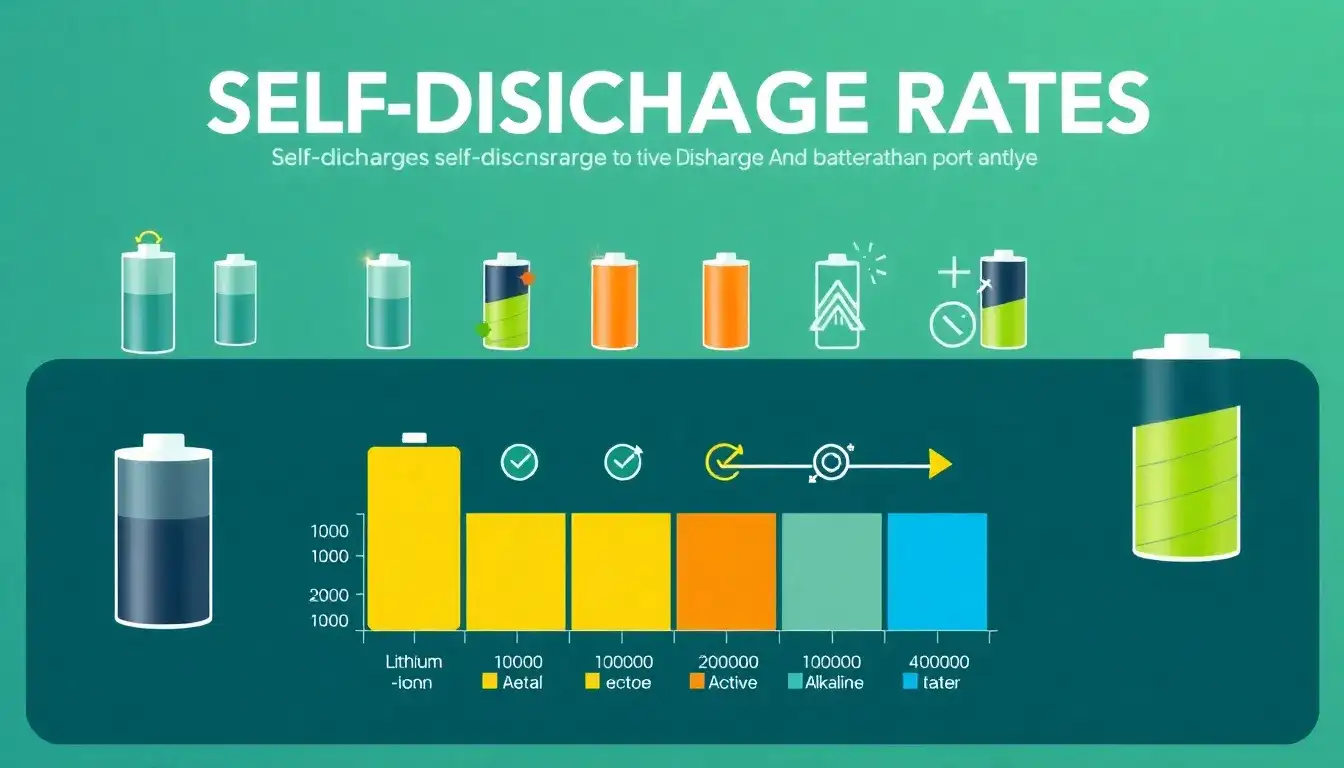
Self-discharge rates in batteries vary significantly among different types, influenced by factors such as internal chemistry, ambient temperature, state of charge, and construction. Here’s a comparison of typical self-discharge rates for various battery types:
Typical Self-Discharge Rates by Battery Type
| Battery Type | Rechargeable? | Typical Self-Discharge Rate |
|---|---|---|
| Lithium-Polymer | Yes | ~5% per month |
| Lithium-Ion (Li-ion) | Yes | 2-3% per month; up to 5% initially |
| Low Self-Discharge NiMH | Yes | As low as 0.25% per month |
| Lead-Acid | Yes | 4–6% per month |
| Nickel-Cadmium | Yes | 15–20% per month |
| Alkaline | No | 2–3% per year (5-10 years shelf life) |
| Zinc-Carbon | No | 2–3 years shelf life |
| Lithium-Metal | No | 10% in 5 years (long shelf life) |
| Thionyl Chloride (LiSOCl2) | No | <1% per year (up to 40-year shelf life) |
Factors Affecting Self-Discharge
- Temperature: Higher temperatures significantly increase self-discharge rates.
- Chemistry: Different battery chemistries have inherently different self-discharge rates due to their internal reactions.
- State of Charge: Batteries stored at higher states of charge tend to have higher self-discharge rates.
- Use of Passivation Layers: Some batteries like LiSOCl2 have passivation layers that reduce self-discharge.
Implications of Self-Discharge
Self-discharge affects the shelf life and usability of batteries, making some types more suitable for applications where long storage times are expected, while others may require frequent recharging or monitoring.
Original article by NenPower, If reposted, please credit the source: https://nenpower.com/blog/how-do-self-discharge-rates-vary-among-different-battery-types/

