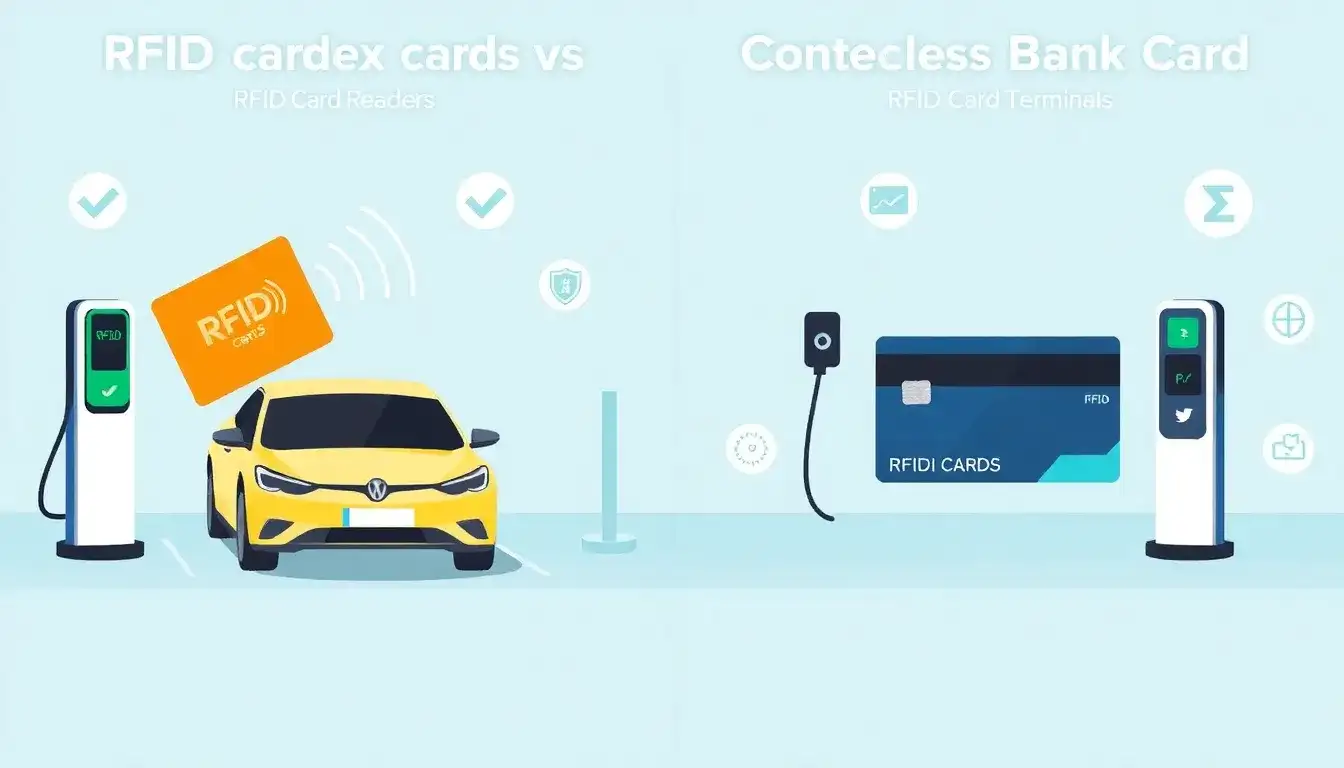
Comparing RFID cards to contactless bank cards for EV charging involves several key aspects, including convenience, reliability, and network compatibility.
Comparison Overview
| Feature | RFID Cards | Contactless Bank Cards |
|---|---|---|
| Technology | Uses Radio-Frequency Identification (RFID) | Uses Near Field Communication (NFC) |
| Payment Process | Tap to start and stop charging; linked to a specific charging account | Tap to make payment; linked to bank account |
| Reliability | Highly reliable; less prone to technical failures | Can experience app or network issues |
| Convenience | No need for mobile signal; quick payment confirmation | Requires a mobile signal; may need app or app issues can occur |
| Network Compatibility | Often allows broader network access across charging stations with multi-network cards | Limited to stations that support contactless payments |
| Billing | Centralized billing for business fleets; detailed usage reports | Standard bank billing; less control over fleet management |
Detailed Comparison
Convenience and Reliability
- RFID Cards: These cards are reliable and don’t require a mobile signal, making them useful in areas with poor connectivity. They offer quick payment confirmation and are less prone to technical issues compared to mobile apps or bank cards.
- Contactless Bank Cards: While they are convenient for everyday transactions, they require a stable NFC connection. In environments with poor connectivity, contactless bank cards may struggle to function smoothly.
Payment Process and Network Compatibility
- RFID Cards: They simplify the payment process by linking directly to a charging account, allowing for seamless access across multiple charging networks, especially with multi-network cards.
- Contactless Bank Cards: These cards require support from each charging station, which can be limited. They also involve standard bank billing processes, which may not be ideal for managing fleet usage.
Billing and Fleet Management
- RFID Cards: These cards are particularly advantageous for business fleet managers as they provide centralized billing and detailed usage reports, making it easier to manage multiple vehicles.
- Contactless Bank Cards: While convenient for personal use, they do not offer the detailed reporting or centralized billing that fleets require.
Future Developments and Trends
Both RFID and contactless technologies are evolving, with RFID offering a more streamlined experience for EV charging due to its reliability and broader network access. However, contactless payments are becoming more prevalent as the charging infrastructure expands.
In conclusion, RFID cards offer advantages in reliability, network compatibility, and fleet management, while contactless bank cards provide convenience for personal use but might lack the specialized features and broad network access of RFID cards.
Original article by NenPower, If reposted, please credit the source: https://nenpower.com/blog/how-do-rfid-cards-compare-to-contactless-bank-cards-for-ev-charging/