

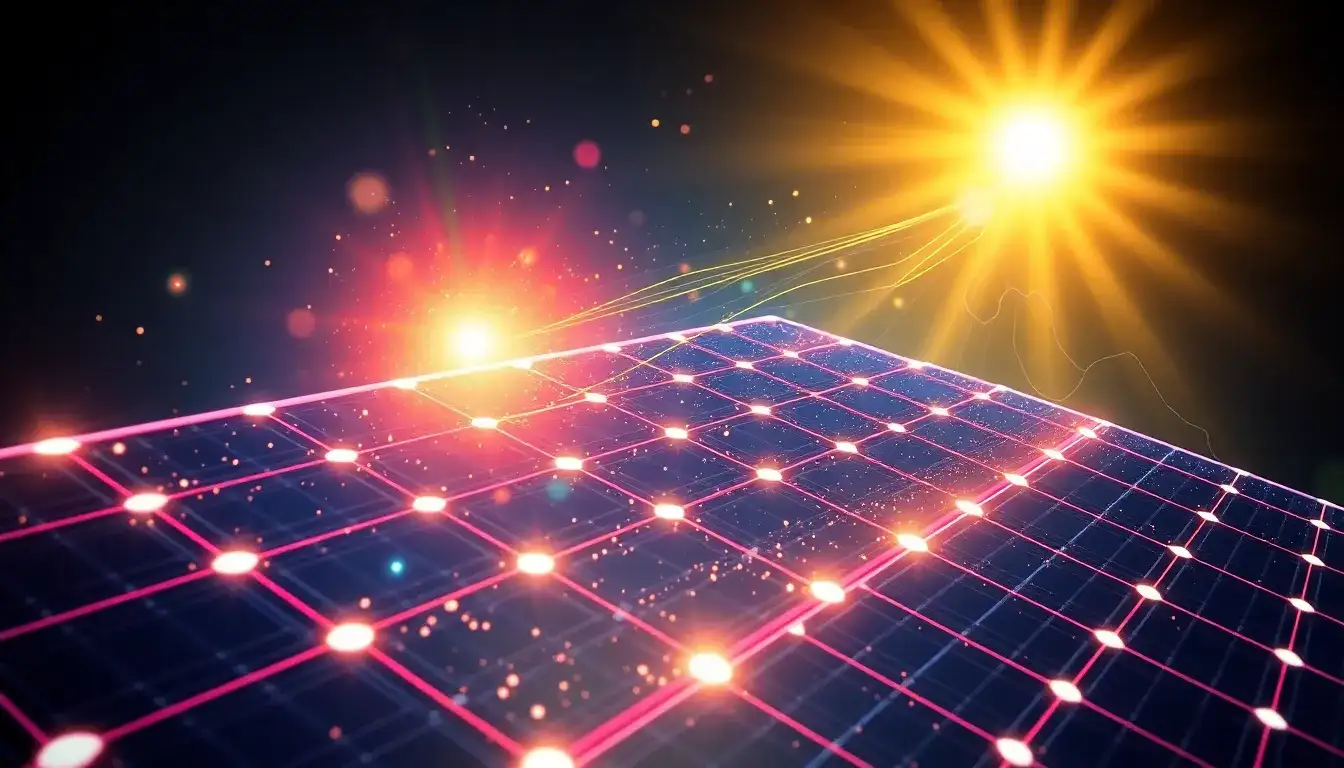
Quantum dots enhance solar cell efficiency through several unique quantum-mechanical properties and design features that traditional bulk semiconductor materials cannot provide:
Key Mechanisms by Which Quantum Dots Enhance Efficiency
1. Tunable Bandgap and Broad Spectrum Absorption
Quantum dots are nanoscale semiconductor crystals whose bandgap can be finely tuned by changing their size. Smaller dots absorb higher-energy (shorter wavelength) photons, while larger dots absorb lower-energy photons. This size-dependent tunability enables quantum dot solar cells (QDSCs) to absorb a broader range of the solar spectrum compared to traditional solar cells made from bulk materials with fixed bandgaps.
2. Intermediate Band Formation and Sub-Bandgap Photon Absorption
Quantum dots introduce an intermediate energy band between the valence and conduction bands. This intermediate band allows two-step photon absorption processes, enabling the capture of sub-bandgap photons that conventional cells miss, effectively broadening light absorption and enhancing current generation.
3. Multiple Exciton Generation (MEG)
A crucial advantage of quantum dots is their ability to generate more than one exciton (electron-hole pair) per high-energy photon absorbed, a phenomenon called multiple exciton generation. Traditional solar cells typically create only one exciton per photon. MEG can thus significantly boost the number of charge carriers generated from the same amount of absorbed light, increasing current and efficiency beyond conventional limits.
4. Higher Photovoltages via Hot Carrier Utilization
Quantum dot solar cells can utilize photogenerated hot carriers (electrons and holes with excess energy) before they thermalize (lose energy to heat), which allows for higher photovoltages and improved power conversion efficiency. This effect contributes to pushing theoretical efficiency limits up to about 66%, nearly doubling that of traditional single-junction cells.
5. Flexible and Low-Cost Fabrication
Quantum dots can be synthesized via solution processes and deposited on various substrates, allowing low-cost, scalable manufacturing and flexible device integration. This contrasts with expensive epitaxial growth methods and rigid silicon wafers, making quantum dot solar cells promising for diverse applications.
Recent Advances and Performance
- Quantum dot solar cells have reached certified efficiencies of over 18.1% recently, a record approaching commercial silicon cells, achieved by optimizing quantum dot composition (e.g., organic perovskite dots), improving dot packing density, and enhancing stability.
- Stability improvements have allowed these cells to maintain performance under prolonged illumination and elevated temperatures, overcoming earlier concerns about degradation.
Summary Table
| Feature | Quantum Dot Solar Cells | Traditional Solar Cells |
|---|---|---|
| Bandgap | Tunable by dot size (2–10 nm) | Fixed by bulk material |
| Light Absorption | Broad spectrum, including sub-bandgap photons | Limited to fixed bandgap range |
| Exciton Generation | Multiple excitons per photon (MEG effect) | One exciton per photon |
| Theoretical Efficiency Limit | Up to ~66% | ~31% (Shockley-Queisser limit) |
| Fabrication | Low-cost, solution-processable | Typically high-cost, rigid wafer-based |
| Stability | Improving, still under research | Established, highly stable |
In essence, quantum dots enhance solar cell efficiency by enabling broader light absorption, generating multiple charge carriers per photon, and harnessing hot carriers to surpass conventional efficiency limits. Ongoing advances in materials, surface passivation, and device architecture continue to close the gap with commercial silicon technology, positioning quantum dot solar cells as a transformative breakthrough for future solar energy harvesting.
Original article by NenPower, If reposted, please credit the source: https://nenpower.com/blog/how-do-quantum-dots-enhance-the-efficiency-of-solar-cells/

